

Vendor Whisperer – Your Guide to Effective Vendor Management
Why Effective Vendor Management Is Critical for Modern Businesses
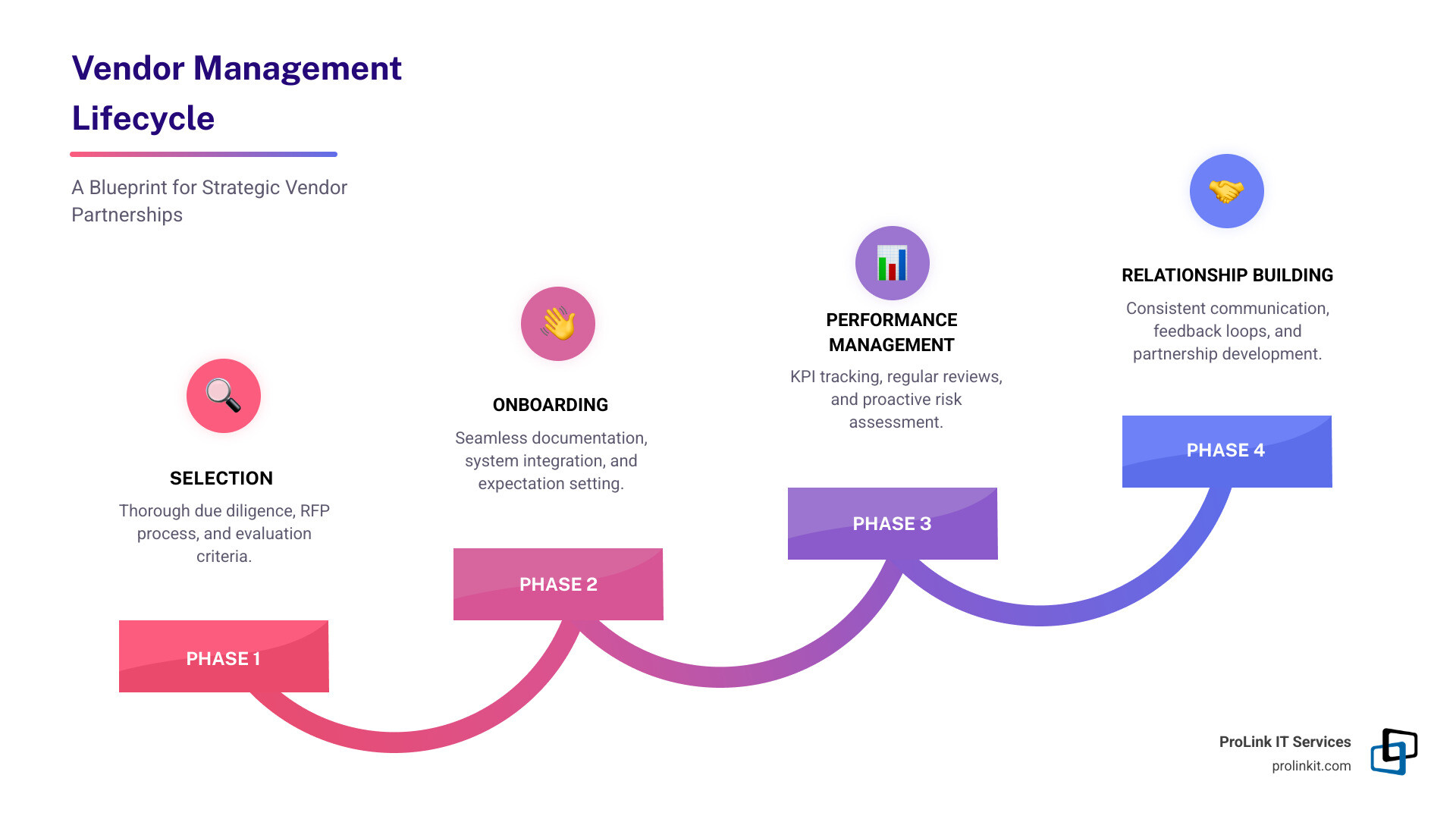
Knowing how to manage vendors effectively is essential for any business that relies on third-party providers. Here’s a quick overview of the key steps:
- Select carefully – Evaluate expertise, stability, and cultural fit.
- Set clear expectations – Define scope, timelines, and performance metrics.
- Communicate regularly – Schedule check-ins and maintain open dialogue.
- Monitor performance – Track KPIs and conduct regular reviews.
- Build partnerships – Focus on long-term relationships, not just transactions.
- Manage risk – Assess compliance, security, and operational risks.
- Optimize costs – Analyze spend and renegotiate when needed.
The stakes are high. Research shows that 84% of businesses have experienced operational disruption due to third-party incidents, while 66% faced adverse financial impact. However, effective vendor management delivers significant value, with organizations often achieving 10-20% reductions in procurement costs.
Modern businesses rely heavily on external partners for everything from cloud services to IT support. Consequently, vendor relationships have evolved from simple transactions to strategic partnerships. Companies that master vendor management gain competitive advantages through better service, reduced costs, and stronger operational resilience.
This is about building relationships that drive mutual success, managing complex risks, and creating systems that scale with your business. As Mitch Johnson, CEO of ProLink IT Services, my 20+ years in technology have shown that companies with disciplined vendor management processes consistently outperform those that treat vendors as afterthoughts.
How to manage vendors vocab to learn:
The Foundation: Strategy, Selection, and Onboarding
Effective how to manage vendors starts with a solid foundation. Before building successful partnerships, you need the right strategy, selection process, and onboarding plan in place.

Your vendor management policy is your guide for every vendor decision. It defines your approach to partnerships, sets standards, and ensures consistency across departments. Without it, teams create their own rules, leading to conflicting contracts and missed opportunities.
The numbers show why this matters. With 52% of executives outsourcing business functions and 76% outsourcing IT vendor functions, strategic sourcing is no longer optional. In the IT world, where systems handle sensitive data, every vendor relationship has ripple effects. This is Why Businesses Are Turning to Outsourced IT Support in 2025—they need partners who understand these interconnections.
Selecting the Right Vendor Partners
Choosing a vendor is like choosing a business partner who will have access to your systems, data, and reputation. Getting it wrong can cause long-term problems.
Smart selection starts with clear requirements. Define the problem you’re solving, the technical specs that matter, and the outcomes that define success. Involve all stakeholders to prevent future headaches.
The Request for Proposal (RFP) process standardizes responses, allowing you to compare vendors’ capabilities fairly.
Due diligence is where you verify a vendor’s background, check references, and confirm financial stability. For IT services, scrutinize their security and data privacy protocols. A low price can hide costs like security vulnerabilities or downtime.
Cultural fit is crucial. A vendor’s communication style and values should align with your team’s to ensure a smooth relationship. Look for partners who share your commitment to quality.
The evaluation process should balance expertise, financial stability, cultural alignment, and cost. The cheapest option can become the most expensive if it leads to problems and delays. For more on this, see our guide on How to Hire an IT Consultancy Company: A Complete Guide.
The Essential Vendor Onboarding Process
Onboarding transforms a signed contract into a working relationship. A smooth process is critical for success.
First, handle the documentation. Gather contracts, tax forms, and insurance certificates to prevent payment delays and compliance issues.
System integration is key for IT vendors. Grant them secure, but not unlimited, access to your systems. Define data access and establish monitoring protocols to maintain security.
Set clear expectations to prevent most relationship problems. Discuss communication preferences, escalation procedures, and success metrics. Involve the vendor in setting realistic deadlines.
Establish a communication rhythm early. Decide who talks to whom, how often, and through what channels (e.g., weekly check-ins, emergency contacts).
Provide training and orientation so vendors can understand your internal processes and security protocols. This investment pays off in faster results and fewer mistakes.
Onboarding isn’t just about getting vendors up to speed; it’s about starting a partnership where both sides understand expectations and are set up for success.
The Blueprint for How to Manage Vendors: Contracts, Communication, and Collaboration
Once vendors are selected and onboarded, the work of building the relationship begins. This means moving beyond transactions to cultivate partnerships based on trust and shared goals.

A healthy vendor relationship is a two-way street requiring consistent effort and open dialogue. With roughly 40% of customer-vendor relationships spanning over 3 years, nurturing these connections is vital. As The Balance notes, treating vendors as partners is a best practice for mutual benefit. Long-term partnerships save time and money, reduce vetting processes, and foster a deeper understanding of your needs, leading to more innovative solutions.
Establishing Clear Contracts and Expectations
The contract is the backbone of the vendor relationship, detailing the shared understanding to ensure accountability. A well-crafted contract protects both parties and provides a clear framework for collaboration.
Key elements to define in your contracts include:
- Scope of Work (SOW): Clearly outlines the specific services, technical requirements, and deliverables.
- Service-Level Agreements (SLAs): Defines performance metrics the vendor must meet, such as response times and uptime guarantees.
- Timelines and Milestones: Ensures both parties are on track and can monitor progress effectively.
- Payment Terms: Covers rates, billing frequency, and payment methods. Paying on time is crucial.
- Termination Clauses: Includes clear conditions under which either party can end the contract.
- Contingency Plans: Outlines procedures for handling unexpected issues or disputes.
- Scalability and Flexibility: Allows for scaling services up or down as business needs change.
Putting these expectations in writing creates a transparent, legally binding agreement that serves as a reference point throughout the relationship.
Fostering Strong Relationships Through Consistent Communication
Even the best contract needs consistent, open communication to succeed. Poor communication is a leading cause of relationship failure, so we prioritize it to ensure everyone stays informed and can solve problems collaboratively.
Our best practices for communication include:
- Regular Check-ins: Establish a schedule for updates, such as weekly calls or quarterly reviews, to discuss challenges and plan ahead.
- Two-Way Feedback: Ask vendors for their feedback on the relationship. This encourages mutual growth.
- Transparency: Be open about your goals, expectations, and any changes in priorities or budgets.
- Proactive Updates: Inform vendors immediately of any changes on your end, and expect the same from them.
- Collaborative Problem-Solving: When issues arise, approach them as a team and brainstorm solutions together.
- The Human Touch: Remembering that vendors are people builds goodwill. A small personal gesture can make a big difference.
By investing in these practices, you can transform transactional dealings into collaborative partnerships that deliver superior results.
Optimization: Performance, Risk, and Cost Management
Once vendor relationships are running, how to manage vendors effectively means actively monitoring performance, managing risks, and optimizing costs. This ongoing oversight is crucial for getting the best results.

The stakes are high. A Gartner survey found that 84% of organizations experienced operational disruption from third-party incidents, and 60% were concerned about regulatory scrutiny. However, companies that master vendor optimization reduce costs, improve service quality, and build resilience.
How to Manage Vendors by Measuring Performance and Mitigating Risk
To effectively manage vendors, you need clear ways to track performance and spot potential problems.
Key Performance Indicators (KPIs) are your compass. Tailor them to each vendor, focusing on categories like quality (defect rates, accuracy), delivery performance (on-time percentages), and cost management (budget adherence). For IT vendors, track uptime, support response times, and project completion rates. Some metrics you may want to consider tracking can help build your framework.
Vendor scorecards turn these metrics into actionable insights. Share them quarterly with vendors to celebrate successes and identify areas for improvement.
Risk management is critical. Zycus identifies several key risk categories:
- Financial risk: Assess a vendor’s financial stability to avoid service disruption if they go out of business.
- Operational risk: Examine their ability to deliver consistently, including business continuity plans.
- Compliance risk: Ensure vendors meet the same regulatory standards you do (e.g., GDPR, HIPAA).
- Data security risk: This is critical for IT vendors who access sensitive information.
Address these risks through regular audits, continuous monitoring, and contingency planning. For essential vendors, always have backup options identified.
Effectively Managing Vendor Spend and Optimizing Costs
Smart cost management is about maximizing value, not just finding the lowest price. Sometimes paying more upfront saves you money in the long run.
Spend analysis provides visibility into where your money is going and helps identify optimization opportunities like service consolidation.
Renegotiation is a standard business practice. Deloitte’s 2025 Global Chief Procurement Officer (CPO) survey found that 41% of CPOs actively renegotiate with vendors. Approach these conversations as opportunities to strengthen partnerships, perhaps offering longer commitments for better rates.
Evaluate the value versus price equation. A vendor charging more might deliver better results, making them the smarter choice. Consider reliability, innovation, and the total cost of ownership.
Streamlined invoice management and timely payments improve cash flow and demonstrate your commitment to the partnership. A “No PO, No Pay” policy can reduce administrative burdens.
Finally, incentivize exceptional service by building rewards for outstanding performance into your contracts. This encourages vendors to strive for excellence.
Streamlining Your Process with Vendor Management Technology
Trying to manage vendors with spreadsheets and email is inefficient and prone to error. Modern technology can transform vendor management from a chaotic task into a smooth, strategic operation.

Vendor Management Systems (VMS) are game-changers. These platforms act as a central hub for all vendor-related information and activities, helping you make better decisions and build stronger partnerships through automation and centralized data.
A VMS streamlines the entire vendor lifecycle. It can store detailed vendor profiles, simplify the RFP process, and manage contracts by tracking key dates like renewals and expirations. Instead of manually tracking performance, reporting dashboards provide real-time insights into KPIs and vendor scorecards. Advanced systems can even flag potential risks before they become major problems.
Collaboration tools within these systems foster transparent communication through shared workspaces and messaging features, keeping everyone on the same page.
At ProLink IT Services, we’ve seen how integrated systems transform operations. Our Managed Network Services bring this same level of efficiency and oversight to your IT infrastructure, creating the well-managed environment where vendor relationships thrive.
The bottom line is that effective vendor management today means embracing technology. It doesn’t replace the human touch; it frees up your time to focus on building the strategic partnerships that drive real business value.
Frequently Asked Questions about Vendor Management
After helping hundreds of businesses, I’ve noticed the same questions about how to manage vendors come up repeatedly. Here is a quick reference for the most common challenges.
What are the first steps in setting up a vendor management process?
Starting a vendor management process from scratch is manageable if you follow these steps:
- Clarify your goals. What do you want to achieve? Cost savings? Reduced downtime? Write them down to guide your decisions.
- Assess your current situation. Understand how you currently manage vendors to see what needs to change.
- Create a vendor management policy. Start with the basics: how you’ll select vendors, what contracts should include, and who is responsible for what. Get input from key departments like finance, legal, and IT.
- Categorize your vendors. Group them into strategic (mission-critical), important (significant impact), and tactical (low risk). This helps you focus your energy where it matters most.
- Define success. Establish clear, measurable metrics for your most important vendors, such as response times or uptime percentages.
Start with your most critical vendors and expand the process as you gain confidence.
How do you handle an underperforming vendor?
Addressing performance issues quickly can prevent major business disruptions.
- Document everything. Keep detailed, objective records of performance issues, including dates, specific problems, and the impact on your operations.
- Have a direct conversation. Schedule a meeting to discuss the issues. Reference your original agreement and performance expectations.
- Listen to their side. There may be legitimate reasons for the issues. Understanding the root cause helps find a solution.
- Create an improvement plan together. Set specific, measurable goals with realistic deadlines. Ensure both sides agree on how to measure progress.
- Monitor progress closely. Increase check-ins and provide regular feedback. Acknowledge improvements.
- Know when to walk away. If performance doesn’t improve, review your contract’s termination clauses and have backup options ready.
What’s the difference between a vendor and a partner?
This distinction is at the heart of effective vendor management.
A vendor relationship is transactional. They provide a product or service, you pay, and the interaction is largely complete. The focus is on price and basic requirements.
A partner relationship is collaborative. Partners understand your business goals and actively contribute to your success. They bring ideas, help solve problems, and invest in a long-term relationship. For example, an IT partner doesn’t just fix problems; they proactively suggest solutions to prevent future issues and help you plan for growth.
The partnership approach requires mutual investment. You share more about your business, and they invest time in understanding your needs. At ProLink IT Services, we’ve built our business on this partnership model. As a veteran-owned team, we bring discipline and integrity to every relationship, believing that when both sides are invested, everyone wins.
Choose which relationships deserve this level of investment. Your strategic vendors are worth developing into true partnerships, while tactical vendors can remain transactional.
Conclusion: Build Strategic Partnerships for Long-Term Success
Mastering how to manage vendors has evolved from a procurement task into a strategic business capability. We’ve covered the entire journey: from selection and onboarding to performance monitoring, risk management, and cost optimization.
Businesses that treat vendor management as a strategic discipline consistently outperform those that don’t. By building solid foundations, fostering genuine relationships through communication, and using data to optimize performance, you build a significant competitive advantage.
Partnership is the key. The most successful vendor relationships are not transactional; they are built on mutual respect, shared goals, and honest communication. When both sides are invested in each other’s success, the results are better service, innovative solutions, and greater resilience.
At ProLink IT Services, this partnership philosophy is central to how we operate. As a veteran-owned business, we bring the discipline and integrity from our military service to every client relationship. We understand how critical your partners are because we strive to be that kind of indispensable partner for our clients.
Your IT infrastructure is too important to leave to chance. The vendors you choose and how you manage them can make or break your efficiency, security, and ability to scale. By viewing your vendors as extensions of your team, you build a foundation for long-term success.
Ready to transform your IT vendor relationships from expenses into strategic assets? We can help you steer these complexities and build partnerships that drive real results. Get expert help with your IT vendor management through our Managed IT Services.