

The Ultimate Guide to Evaluating Risk (Without the Panic Attacks)
Why Every Business Owner Needs to Master Risk Evaluation
How to evaluate risk is one of the most critical skills any business owner can develop. Yet many leaders find themselves frozen in analysis paralysis or, worse, making reactive decisions after problems have already hit their bottom line.
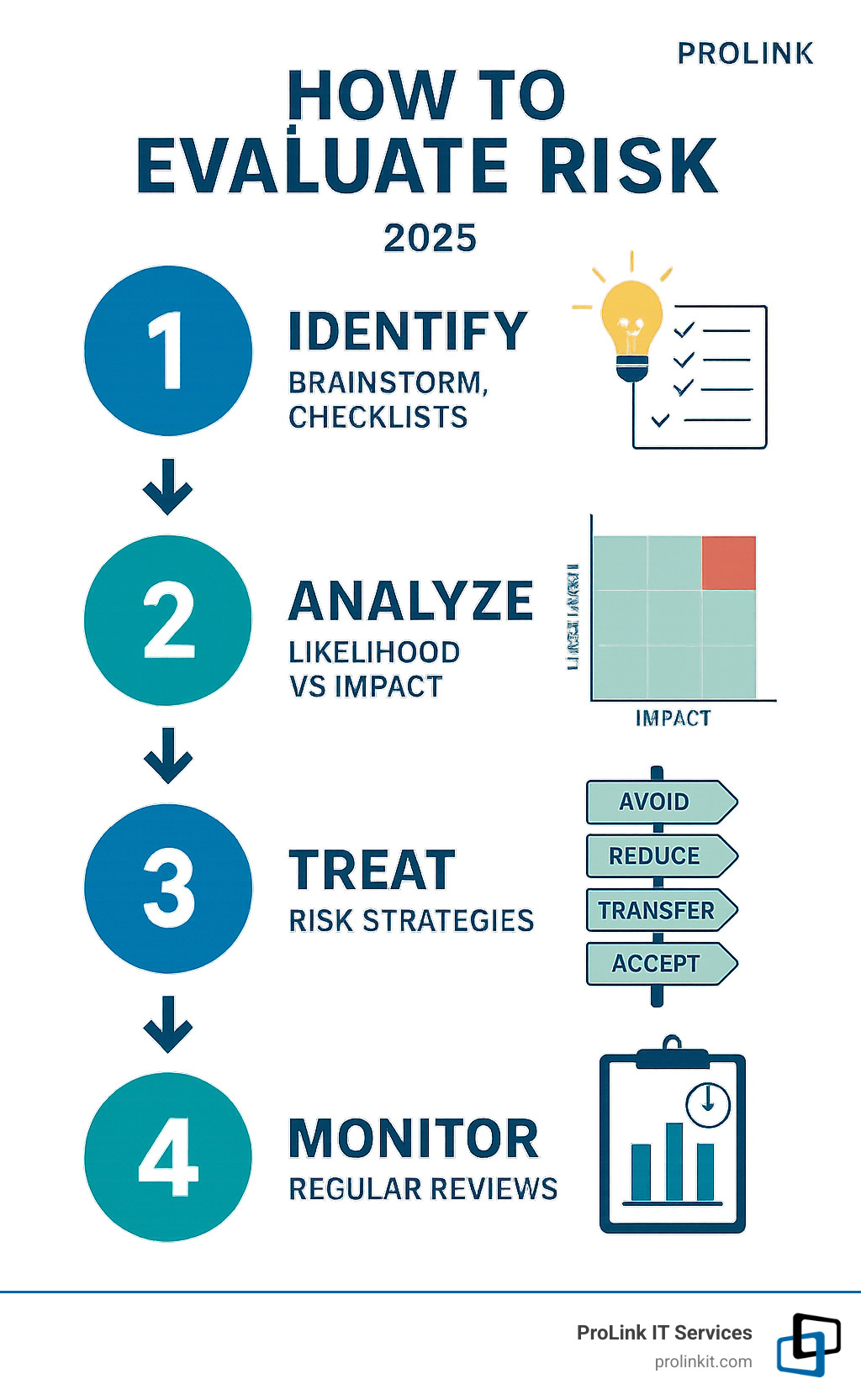
Quick Answer: How to Evaluate Risk in 4 Steps
- Identify – List potential threats to your business objectives
- Analyze – Rate likelihood (1-5) and impact (1-5) for each risk
- Treat – Choose to avoid, reduce, transfer, or accept each risk
- Monitor – Review and update your assessment regularly (quarterly minimum)
Risk evaluation isn’t about creating “huge amounts of paperwork” or drowning in complexity. It’s about understanding how your business might be harmed and taking reasonable steps to protect what you’ve built.
The research shows that 99% of organizations use simple qualitative methods to get started. You don’t need a PhD in statistics – just a systematic approach to asking the right questions: What could go wrong? How likely is it? How bad would it be?
When done right, risk evaluation becomes your early warning system. It helps you spot problems before they become crises, allocate resources where they matter most, and sleep better knowing you’ve got your bases covered.
As Mitch Johnson, founder of ProLink IT Services with over 20 years of technology experience, I’ve helped countless business owners learn how to evaluate risk in their IT infrastructure and operations. My approach focuses on practical, no-nonsense methods that protect your business without overwhelming your team.
How to evaluate risk word guide:
Step 1: Uncovering Potential Pitfalls (Risk Identification)
Before managing risks, you must find them. Risk identification is the crucial first step of asking, “What could possibly go wrong?” It’s about finding anything that could prevent you from reaching your business goals.
Start by asking key questions:
- What’s the worst that could happen?
- How might we stumble or fail?
- What absolutely must go right for us to succeed?
- Where are we most vulnerable to problems?
- Which assets are absolutely vital to protect?
- How could someone disrupt our daily operations?
- And what legal headaches might be waiting for us?
These questions help scan for risks everywhere. Effective methods include brainstorming with key people from all levels, as they have unique insights. Also, analyze past incidents and close calls—history is a great teacher. Using tools like checklists and a SWOT analysis (Strengths, Weaknesses, Opportunities, Threats) helps uncover hidden risks.
It’s not just about looking at routine operations; we also peek at non-routine activities like special projects or maintenance. We even consider bigger external factors like shifts in the economy, new regulations, or global events. A thorough approach is key. For an even deeper dive into this initial phase, check out this helpful guide: A guide to identifying, assessing, and managing risk.
Who is Responsible for Identifying Risks?
While a risk management team may lead, identifying risks is everyone’s job. Managers are vital, as they decide the level of risk their teams take on, whether it’s financial, operational, or compliance-related.
At ProLink IT Services, we empower all our business units to be the “first line of defense.” We foster a culture where every team member is responsible for spotting and reporting potential risks in their area, both at the departmental level and the activity (or process) level. For instance, the finance department might identify cash-handling risks, while IT flags software vulnerabilities. Our veteran-owned roots instill the discipline and integrity to make risk identification a continuous, collaborative effort, not a one-time audit.
Common Risk Categories to Consider
To make identification manageable, we group risks into common categories to ensure we’re looking at the full spectrum of potential threats:
- Strategic Risk: Threats to your long-term plans, like market shifts, new competitors, or changing customer demands.
- Operational Risk: Day-to-day risks from processes, systems, or people, including internal failures, human error, or supply chain disruptions.
- Financial Risk: Anything harming your company’s financial health, such as cash flow problems, credit risks, market volatility, or fraud.
- Compliance Risk: The risk of breaking laws, regulations, or internal company policies.
- Reputational Risk: Anything that could damage your brand’s public image, often stemming from other risk categories.
- External Risk: Broader risks outside your direct control, like economic downturns, political events, or natural disasters.
By neatly categorizing risks, we can ensure we’re taking a holistic approach to finding them.
Spotting Modern Threats: IT and Cybersecurity Risks
IT and cybersecurity risks are constantly evolving. The rise of new technologies like AI creates new cyber threats that can affect any business. For us at ProLink IT Services, these are daily realities we help our clients steer.
Modern businesses face a constant barrage of digital threats, including:
- Cybersecurity Threats: Malicious attacks like ransomware, phishing scams, and malware designed to disrupt operations, steal data, or extort money.
- Data Breaches: Unauthorized access to or leakage of sensitive information, leading to fines, reputational damage, and loss of customer trust. You can learn more about The 4 Types of Data Breaches You Need to Know.
- System Failures: Critical IT systems malfunctioning or stopping, which can halt business operations and cause significant financial loss.
- Cloud Security Risks: Vulnerabilities related to data storage and applications in the cloud, including misconfigurations, unauthorized access, and data loss.
- Network Vulnerabilities: Weaknesses in your network infrastructure that attackers can exploit. For comprehensive protection, consider 24/7 Protection: How Network Security Services Keep Your Data Safe.
These technology-specific risks are incredibly important and require a proactive strategy to both identify and reduce their impact.
Step 2: A Step-by-Step Guide on How to Evaluate Risk
After identifying risks, you must evaluate them to understand their significance and prioritize your efforts. This step focuses on two key dimensions: likelihood (how probable is it?) and impact (how bad would it be?).
Beyond just likelihood and impact, we also consider:
- Vulnerability: How prepared are we to withstand or recover from the risk?
- Speed of Onset: How fast could the risk arise, and how quickly would we need to respond?
Assessing these factors helps determine which risks demand immediate attention. This process defines your “risk appetite”—the level of risk you’re willing to assume to achieve your objectives. It’s about finding the right balance to pursue goals effectively without being overly cautious or reckless. For a practical look at this process, check out Risk assessment in practice.
The Go-To Method: Qualitative Risk Analysis
Qualitative risk analysis is the most accessible method for learning how to evaluate risk. It’s quick, easy, and doesn’t require complex calculations, which is why 99 percent of organizations use it for initial assessments.
This scenario-based method uses descriptive terms (e.g., High, Medium, Low) to rank risks by likelihood and impact. Its main purpose is to quickly identify which risks need more detailed analysis and immediate action. While subjective, its speed and simplicity make it an excellent starting point for any organization to understand its risk landscape without getting bogged down in data.
How to Evaluate Risk with a Risk Matrix
A risk assessment matrix is a visual tool that helps prioritize risks based on their likelihood and impact. It’s a simple grid where one axis represents likelihood and the other represents potential impact.

Here’s how we typically define our scales:
Likelihood Scale (Probability of Occurrence):
- Highly Likely: 91%+ chance of occurring.
- Likely: 61-90% chance.
- Possible: 41-60% chance.
- Unlikely: 11-40% chance.
- Highly Unlikely: <10% chance.
Impact Scale (Severity of Consequence):
- Catastrophic: Major financial loss ($1M+), operational shutdown, severe reputational damage.
- High: Significant financial loss ($100K+), major operational disruption.
- Moderate: Minor financial loss ($1K-$10K), temporary disruption.
- Low: Negligible financial loss (<$1K), minor inconvenience.
- Insignificant: No noticeable impact.
To get a “risk score,” we multiply the likelihood rating by the impact rating (e.g., Likely (4) x High (4) = 16). We then use color-coding (green, yellow, red) to visually represent the severity, making it easy to identify which risks require immediate attention. This matrix allows us to quickly prioritize high-likelihood, high-impact risks. For more detailed definitions of risk occurrence levels, you can refer to resources like http2.mitre.org/work/sepo/toolkits/risk/StandardProcess/definitions/occurence.html.
For the Numbers-Driven: Quantitative Risk Analysis
While qualitative analysis provides a quick overview, quantitative risk analysis offers more precision for high-priority risks. It assigns objective numerical values, enabling detailed financial projections and cost-benefit analyses.
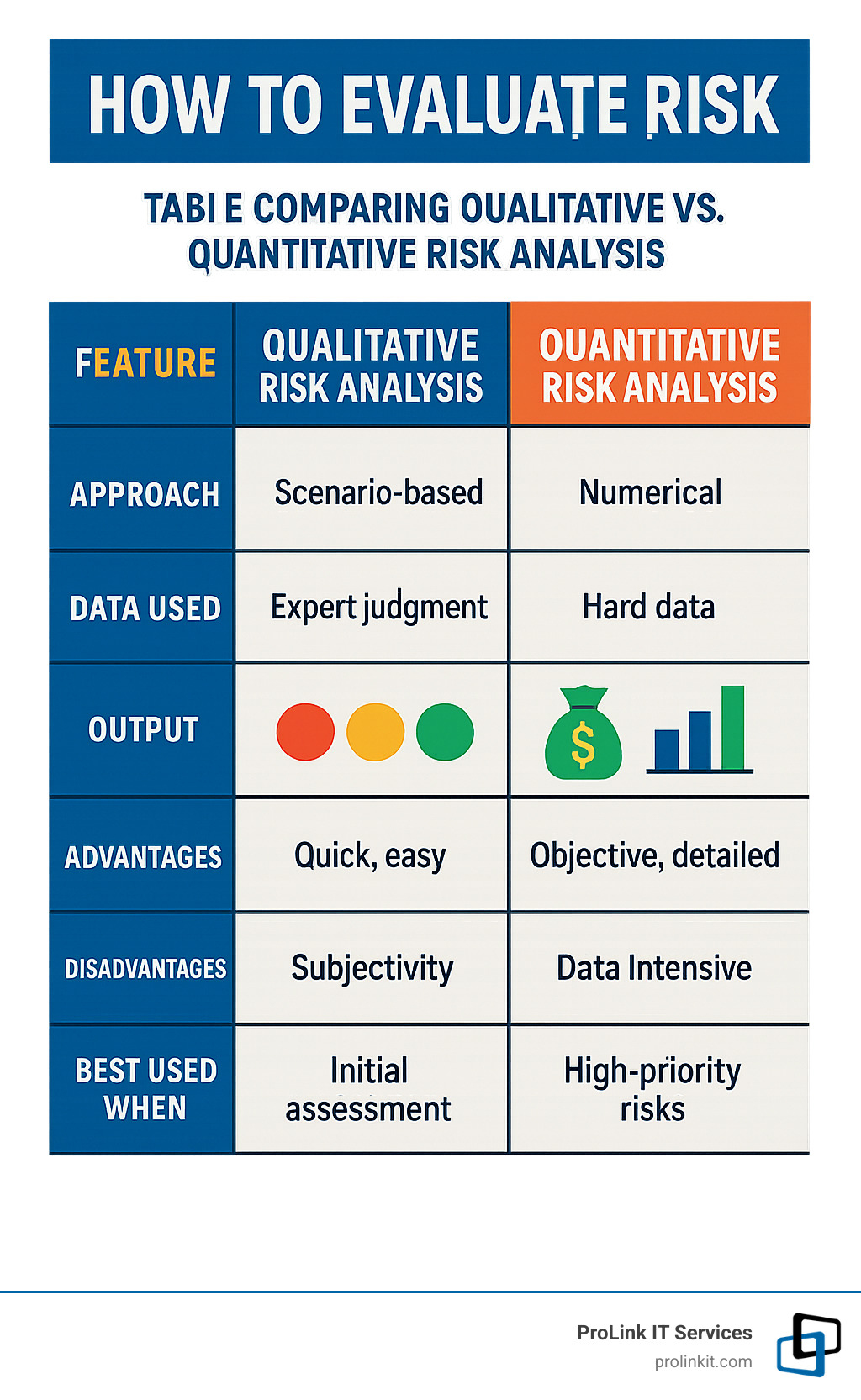
Qualitative vs. Quantitative Risk Analysis
| Feature | Qualitative Risk Analysis | Quantitative Risk Analysis |
|---|---|---|
| Approach | Scenario-based, subjective, descriptive terms | Numerical, objective, statistical models |
| Data Used | Expert judgment, brainstorming, historical data (non-numerical) | Hard data, algorithms, actuarial data, financial figures |
| Output | High/Medium/Low ratings, color-coded matrices | Monetary values, probabilities, cost-benefit analyses |
| Advantages | Quick, easy to implement, good for initial screening | Objective, detailed justification, supports budget planning |
| Disadvantages | Subjectivity, potential for bias, less precise | Data intensive, complex, can be costly and time-consuming |
| Best Used When | Initial assessment, small projects, limited data | High-priority risks, large projects, financial justification |
In quantitative risk analysis, we aim to put a dollar figure on potential losses using metrics like the Annual Loss Expectancy (ALE). This helps justify investments in security controls.
The formula for ALE is:
ALE = Single Loss Expectancy (SLE) x Annual Rate of Occurrence (ARO)
- Single Loss Expectancy (SLE): The cost of a single occurrence of a risk event (e.g., $10,000 for a server failure).
- Annual Rate of Occurrence (ARO): How many times the event is expected to occur in a year (e.g., 0.2 for once every five years).
For our server example: ALE = $10,000 x 0.2 = $2,000. This is the expected annual financial impact.
The biggest challenge with quantitative assessment is often a lack of sufficient data. However, for critical issues or large projects, the investment is worthwhile. It provides a clear, objective business case for risk management. For more in-depth information, explore resources like More on quantitative risk analysis.
Step 3: Taking Control (Risk Treatment and Monitoring)
Identifying and analyzing risks is only half the battle; the real power comes from taking action. The process of how to evaluate risk culminates in deciding what to do about each threat. This step is about proactive control—making smart choices to manage risks and then monitoring them to stay ahead of problems.
Choosing Your Strategy: The Four T’s of Risk Treatment
Once you understand a risk’s likelihood and impact, you choose a response strategy, often called the “Four T’s”:
-
Treat (or Mitigate): This is the most common approach. It means actively working to reduce the likelihood or impact of a risk. For example, to counter data breach risks, you would invest in robust cybersecurity, train your team on phishing, and tighten data access. This is where ProLink IT Services shines, helping clients build defenses with our Cyber Security and Network Management services.
-
Tolerate (or Accept): This means you’ve acknowledged the risk but have decided the cost of mitigation outweighs the potential impact. The risk is deemed manageable within your business goals. You accept it, monitor it, but don’t invest heavily in eliminating it.
-
Transfer (or Share): This involves shifting some of the risk to a third party. The most common example is buying insurance, like cyber insurance, to cover financial losses from a data breach. You can also outsource high-risk activities to specialists.
-
Terminate (or Avoid): If a risk is too great or costly to mitigate, you might choose to stop the activity causing it. For instance, if a software application is a constant security risk, you might replace it with a safer alternative.
The key is to choose the strategy that best balances cost and protection for your business. When an attack does happen, a swift response is critical. Learn more about 6 Steps to Regain Control During a Cyberattack. Proactive defense is always best: Don’t Wait Until After an Attack to Protect Yourself.
Staying Vigilant: Ongoing Monitoring and Review
Risk management is not a one-time task. The threat landscape is constantly changing, so ongoing monitoring and review are vital to keep your business protected.

We strongly recommend reviewing your risk assessments at least quarterly, with an annual review as the bare minimum. You should also update your assessments whenever significant changes occur, such as:
- New equipment, materials, or work processes are introduced.
- There are significant changes in staff or organizational structure.
- An accident or a “near-miss” occurs.
- External factors (like new regulations or market shifts) change your risk exposure.
This continuous vigilance helps you track patterns, spot warning signs, and ensure your mitigation strategies remain effective. Regularly fine-tuning your approach to how to evaluate risk prevents surprises and keeps your business resilient. A solid business continuity plan is a key outcome, and you can read about its benefits here: 3 Bonus Benefits of a Disaster Recovery Plan.
Frequently Asked Questions about Risk Evaluation
Here are answers to common questions business owners have when learning how to evaluate risk.
What’s the difference between risk assessment and risk evaluation?
These terms are often used interchangeably, but they have distinct meanings:
- Risk Assessment: This is the overall process, covering identification, analysis, and evaluation of risks.
- Risk Analysis: This is the step where you investigate each risk’s characteristics, such as its likelihood and potential impact.
- Risk Evaluation: This is the judgment step. After analysis, you compare risks against your tolerance levels to determine their significance and prioritize them for action.
In short, risk assessment is the entire journey, while risk analysis and evaluation are key steps within it.
How do you calculate a risk rating?
The math here is refreshingly simple. We calculate a risk rating by multiplying the likelihood score by the impact score. Both are typically rated on a scale of 1 to 5, so the formula looks like this:
Risk Rating = Likelihood × Impact
For example, if you rate a server failure’s likelihood as 3 (“Possible”) and its impact as 4 (“High”), your risk rating would be 3 × 4 = 12.
Once you have that numerical score, you can sort risks into categories:
- Low risk (scores 1-5) might just need periodic monitoring.
- Medium risk (scores 6-15) require planned mitigation strategies.
- High risk (scores 16-25) demand immediate attention and robust action plans.
This structured approach takes the guesswork out of prioritization, helping you see which problems deserve your resources first.
How often should a risk assessment be reviewed?
While an annual review is a common minimum, it’s not enough in today’s environment. We recommend reviewing your risk assessment quarterly at a minimum.
More importantly, you must update it immediately whenever a significant event occurs, such as:
- Introduction of new equipment, processes, or technology.
- Significant changes in staff or organizational structure.
- After an accident or a near-miss incident.
- In response to external changes like new regulations or market shifts.
A rhythm of quarterly reviews combined with event-driven updates ensures your risk management remains current and effective without creating unnecessary work.
Secure Your Success by Mastering Risk
So, we’ve walked through the journey of how to evaluate risk together. It might sound a bit daunting at first, but truly, it’s not about being scared of what might happen. Instead, it’s about giving you the power to understand, prepare for, and even turn challenges into opportunities.
Think of it as having a crystal ball for your business, allowing you to identify potential bumps in the road, analyze their size, decide how to treat them, and then diligently monitor everything to stay on track. This proactive approach is the secret sauce to not just surviving, but truly thriving in today’s world.
Here at ProLink IT Services, our veteran-owned foundation means we approach every challenge with discipline and integrity. We believe in being a true partner, working side-by-side with you. We apply the same meticulous, strategic thinking to managing your technology risks – from strengthening your cybersecurity defenses to ensuring your cloud systems are rock-solid and your network runs smoothly – as we did in our service to our country.
You don’t have to carry the burden of potential threats alone. By understanding your risks, you gain clarity and control. Let us help you build that secure, resilient future you envision for your business. We’re ready to stand with you.
Ready to strengthen your defenses? Reach out today! Strengthen your defenses with our Managed IT Services.