

Cloud-Based Managed Services That Won’t Rain on Your Parade
Why Cloud-Based Managed Services Are Worth Your Investment
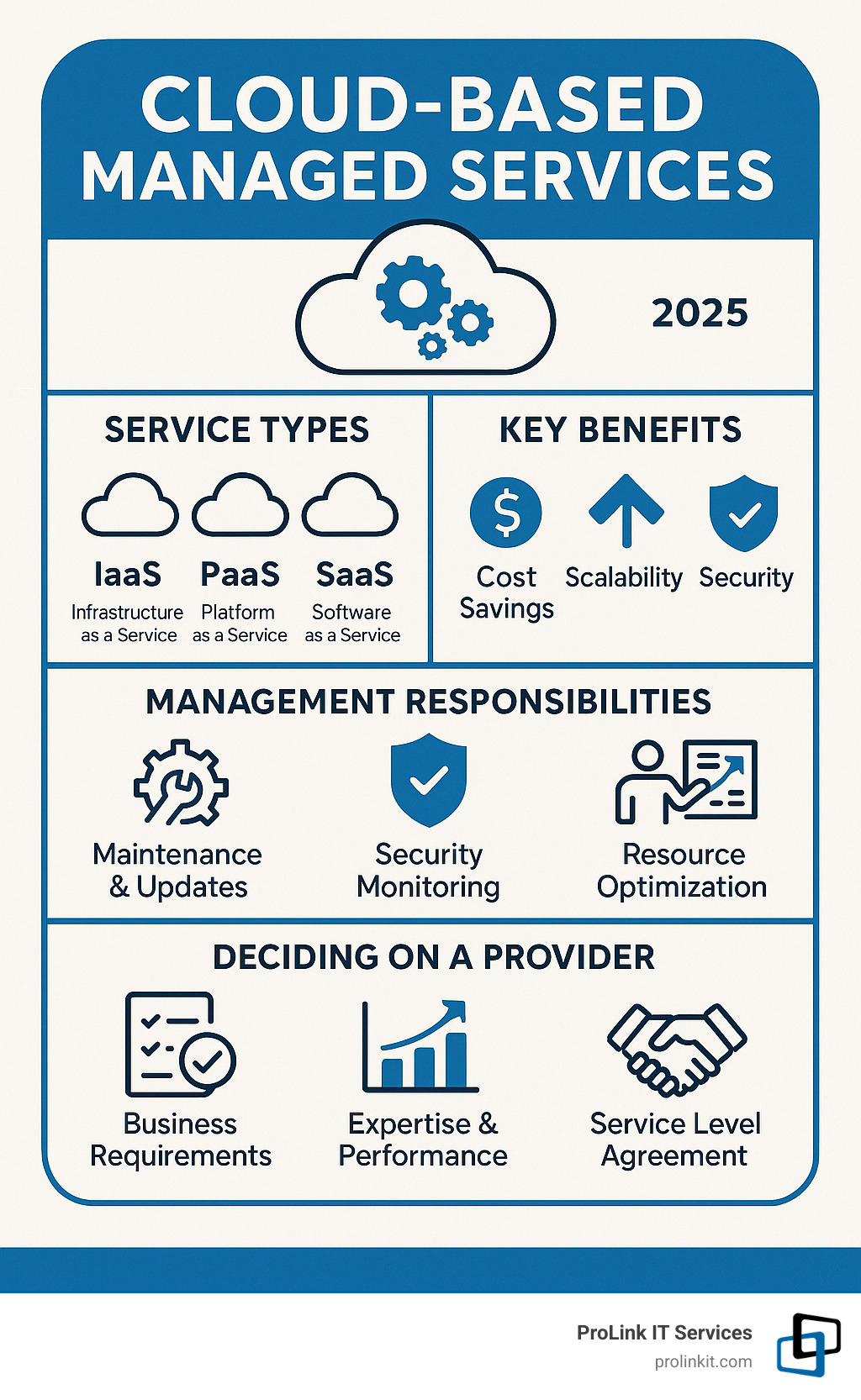
Cloud based managed services are applications, services, or ecosystems in the cloud that a third-party organization manages on your behalf. These services handle everything from deployment and maintenance to security monitoring and optimization – freeing your team to focus on what matters most: growing your business.
Quick Answer for Busy Decision-Makers:
- What they are: Third-party management of your cloud infrastructure, applications, and services
- Key benefits: 30% cost reduction, 24/7 monitoring, automatic updates, disaster recovery
- Service types: IaaS, PaaS, SaaS, plus specialized offerings like BMaaS and STaaS
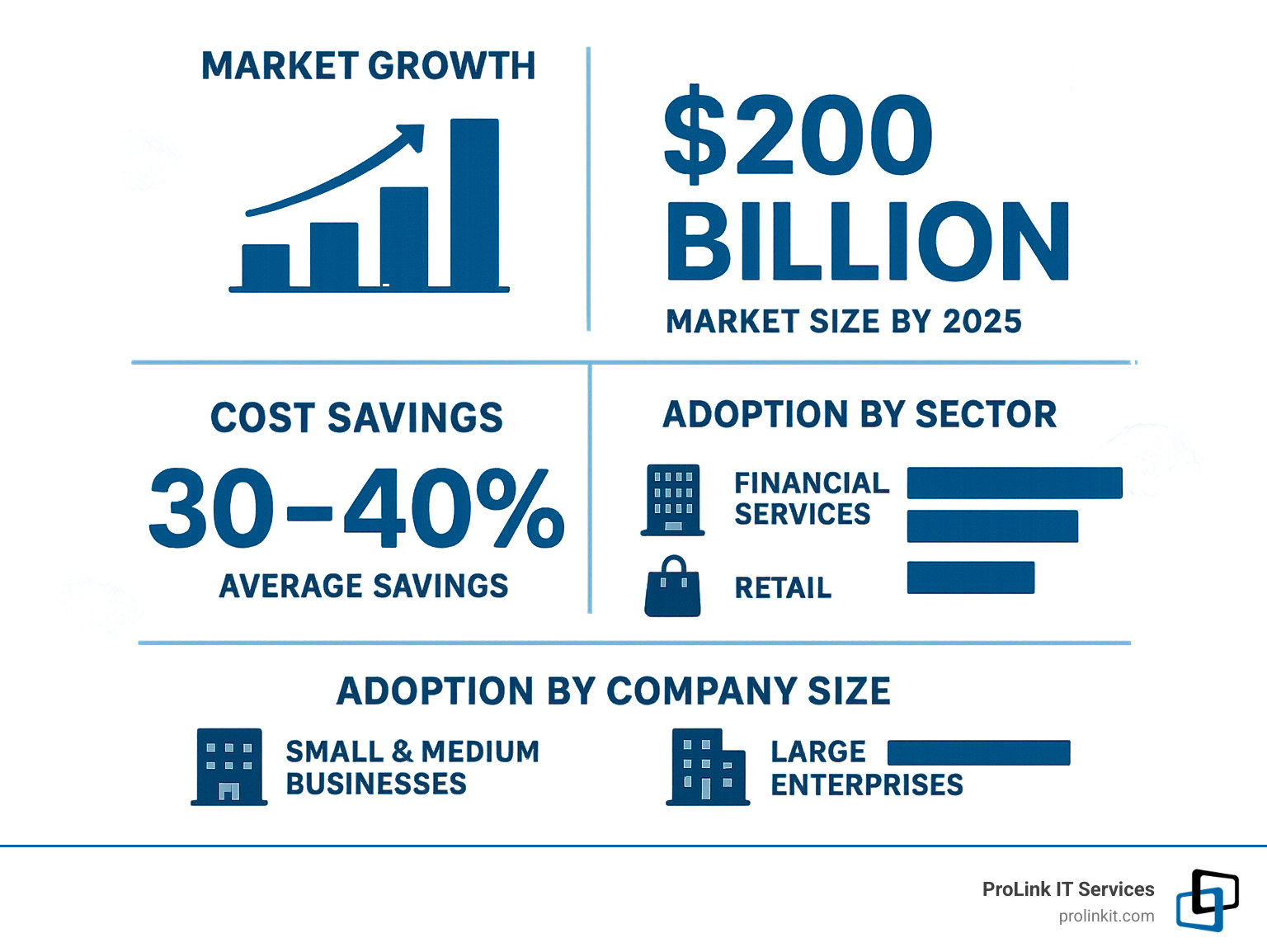
- Market size: Projected to reach $116.2 billion by 2025
- Best for: Businesses wanting cloud benefits without the management headaches
The numbers speak volumes. With 70% of organizations now using two or more cloud providers and 83% identifying application management as a significant challenge, managing cloud infrastructure isn’t getting easier.
The real question is whether you want to cook from scratch using cloud “ingredients” or get a ready-made meal delivered to your door. That’s essentially the difference between DIY cloud and managed services.
As someone who’s spent over 20 years helping businesses steer technology challenges, I’ve seen how cloud based managed services can transform operations. I’m Mitch Johnson, founder of ProLink IT Services, and I’ve guided countless organizations through successful cloud transitions that actually deliver on their promises.
What Are Cloud-Based Managed Services?
Cloud based managed services are exactly that partnership. Instead of you handling every aspect of your cloud infrastructure, a managed cloud service provider (MCSP) takes responsibility for running, monitoring, and optimizing your technology stack. Think of it as having a dedicated IT team that never sleeps, never takes vacation, and stays current on every security update and best practice.
There’s a big difference between a traditional cloud service provider (CSP) and a managed cloud service provider. CSPs give you the tools – raw computing power, storage, and networking capabilities. MCSPs take those tools and actually use them for you – they handle the configuration, monitoring, maintenance, and optimization.
A CSP is like a grocery store that sells you flour, cheese, and tomatoes. You get all the ingredients, but you still need to know how to make pizza. An MCSP is like your favorite pizza place – they handle everything from preparation to delivery, and you get exactly what you ordered, hot and ready.
Managed service providers provide 24/7 monitoring, automation that keeps your applications running smoothly, pay-as-you-go models that mean you only pay for what you use, and multi-tenant architecture that shares infrastructure costs while keeping your data completely separate and secure.
More info about cloud managed services
Cloud Based Managed Services vs. DIY Cloud
There’s a massive talent gap in cloud expertise right now. Finding qualified cloud engineers and architects has become incredibly difficult and expensive.
When you choose the DIY cloud route, you’re essentially saying “we’ll become cloud experts ourselves.” That means hiring specialists, setting up round-the-clock monitoring, staying current with security patches, and building disaster recovery plans that actually work.
The time-to-value difference is huge. DIY cloud implementations can take six months or more to get properly configured. Meanwhile, managed services can have you up and running in weeks with enterprise-grade governance and security practices built right in.
Cloud based managed services are like having a reliable relationship with a great pizza place. You get consistent quality, predictable timing, and professional results without needing to become a pizza expert. Your team can focus on running the business instead of managing infrastructure.
Fully vs. Partially Managed Models
Fully managed services handle absolutely everything. The provider takes complete responsibility for setup, configuration, monitoring, updates, security, and optimization. This works beautifully for standard applications or when you want to minimize your internal IT overhead.
Partially managed services split the responsibilities between you and the provider. This shared responsibility model gives you more customization options but requires more involvement from your team.
Service Level Agreements (SLAs) become crucial in defining these boundaries. A good SLA specifies uptime guarantees (typically 99.9% or higher), response times for different types of issues, performance benchmarks, and clear security responsibilities.
Customization levels vary significantly between models. Fully managed services often use standardized configurations that limit customization but ensure reliability and cost-effectiveness. Partially managed services offer more flexibility but require more technical involvement from your side.
Key Service Models & Emerging Flavors
The world of cloud based managed services has grown way beyond the basic “big three” models. Today’s managed services landscape includes everything from traditional infrastructure management to highly specialized solutions that target specific business challenges.
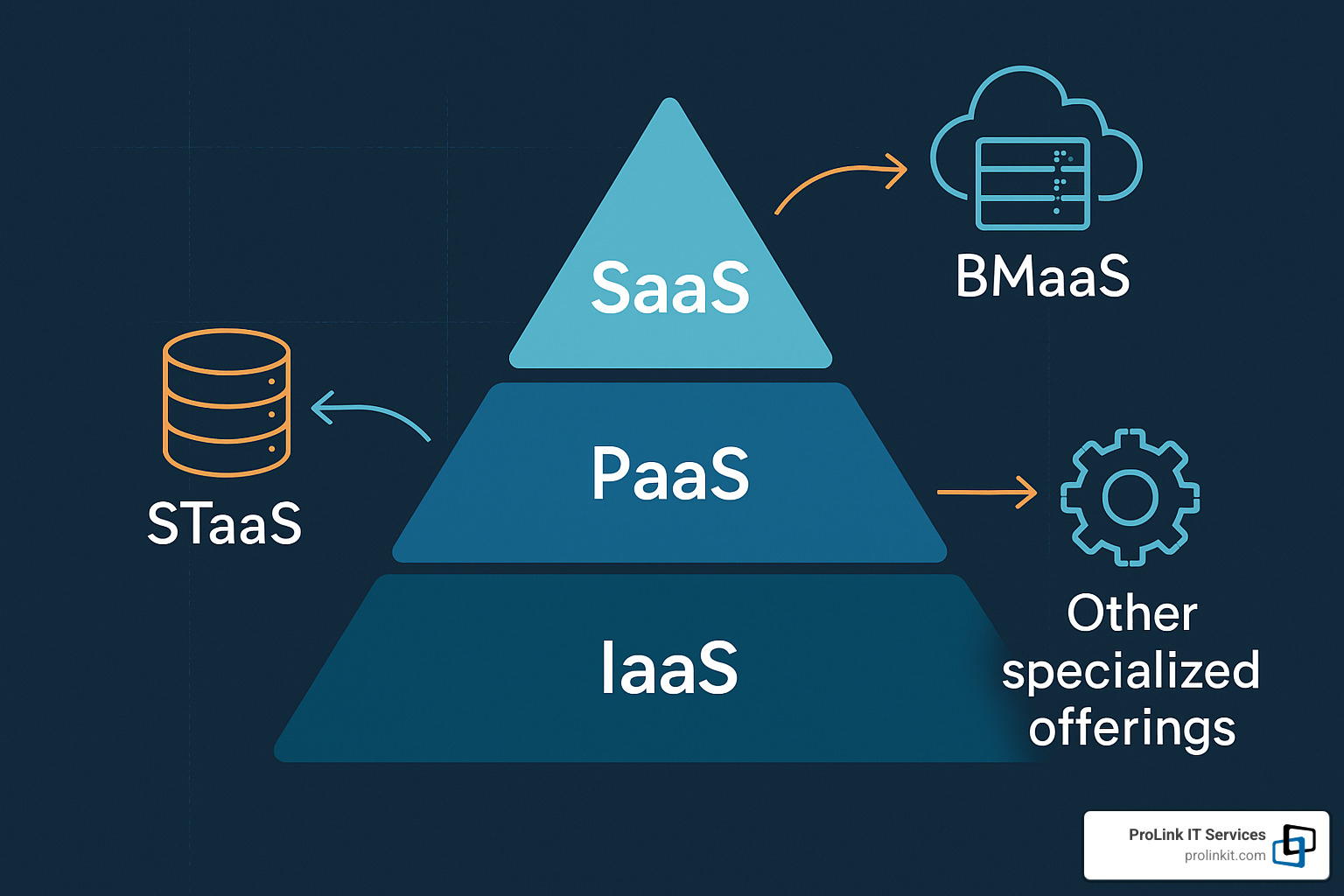
The traditional foundation includes Infrastructure-as-a-Service (IaaS) for managed servers and networking, Platform-as-a-Service (PaaS) for development environments, and Software-as-a-Service (SaaS) for complete applications.
Bare Metal-as-a-Service (BMaaS) gives you dedicated physical servers without the virtualization layer – perfect when you need raw performance. Storage-as-a-Service (STaaS) treats your data storage like a utility bill, scaling based on actual usage.
Container platforms have become game-changers for organizations embracing modern application development. Edge services bring computing power closer to where your customers actually are, crucial for real-time applications and fast content delivery.
Deep Dive: Infrastructure-as-a-Service (IaaS)
When we manage IaaS, we’re essentially becoming your virtual data center team. Compute management includes monitoring usage patterns and optimizing virtual machines to match real-world demand rather than worst-case scenarios.
Storage management goes beyond keeping data safe – we design backup strategies that actually work, optimize performance for different workloads, and implement intelligent cost controls that move rarely-used data to cheaper storage tiers automatically.
Networking management creates secure connections between all components, including load balancing, security configurations, and VPN setups for remote work.
The real magic happens with autoscaling – automatically adding and removing resources based on actual demand. Many clients see 30% cost reductions just from intelligent resource management.
Deep Dive: Platform-as-a-Service (PaaS)
PaaS managed services eliminate the headaches that keep development teams from building great applications. DevOps pipeline management creates smooth paths from development to production with automated testing and consistent deployment processes.
Database management covers everything from setup to ongoing optimization, including performance tuning, backups, and security configurations. Serverless computing represents the ultimate in managed platforms – your code runs when needed, scales automatically, and costs nothing when idle.
Deep Dive: Specialized “-as-a-Service” Offerings
Backup and disaster recovery services provide complete recovery procedures with geographically distributed backups and guaranteed recovery times. Regular disaster recovery testing ensures everything works when you need it most.
Security operations services provide 24/7 monitoring and incident response from security specialists, including vulnerability assessments and compliance reporting.
AI and machine learning platforms handle the complex infrastructure needed for data science projects, including massive datasets and computing power for model training.
Benefits & Watch-Outs of Cloud Based Managed Services
The Compelling Benefits:
Cost optimization often delivers the most immediate impact. Organizations typically see 30% or more reduction in cloud spend through right-sizing, automated scaling, and expert optimization.
Scalability and elasticity become automatic rather than manual processes. Instead of planning capacity months in advance, managed services scale resources based on real-time demand.
Disaster recovery transforms from a complex, expensive project into a standard service feature. Security posture typically improves significantly through enterprise-grade security monitoring and threat detection.
Business continuity benefits from 24/7 monitoring and support. Issues get detected and resolved before they impact users, often through automated self-healing systems.
Important Watch-Outs:
Vendor lock-in risk is real and should be planned for. Always understand the exit strategy and data portability options before committing.
Limited control can frustrate organizations used to having complete administrative access. Compliance concerns vary by industry and provider – you remain responsible for ensuring the service meets your specific regulatory requirements.
Cost unpredictability can occur if usage patterns change significantly or if you don’t monitor consumption carefully.
Scientific research on managed-cloud-cost-savings
How Automation and Platform Engineering Add Value
Modern managed services leverage automation to deliver capabilities that would be impossible to achieve manually.
Self-Healing Infrastructure automatically detects and resolves common issues – failed servers get replaced automatically, performance degradation triggers scaling actions, and security threats get isolated and remediated.
Infrastructure as Code (IaC) ensures consistency with all infrastructure defined in version-controlled code and changes deployed through automated pipelines.
CI/CD Pipeline Automation accelerates development with automated testing, staging deployments, and rollback procedures.
Observability Tools provide real-time monitoring, intelligent alerting, and predictive analytics for capacity planning.
Impact on Internal IT Teams
One of the most significant benefits is how cloud based managed services transform internal IT teams from firefighters into strategic partners.
Focus Shifts to Strategy – IT teams spend time on business-enabling projects rather than reactive problem-solving. Upskilling Opportunities emerge as teams learn modern cloud-native architectures and DevOps practices.
Resource Reallocation creates new possibilities where operations staff can focus on application optimization while development teams get more time for feature development.
Product Roundup & Comparison Guide
Shopping for cloud based managed services can feel overwhelming. After two decades in this business, I’ve learned that the best provider depends entirely on your specific needs, industry, and company culture.
Hyperscaler-bundled services come from major cloud providers. These offer comprehensive service portfolios with deep integration and global reach. The trade-off? Standardized solutions with limited customization options.
Vertical specialists focus on specific industries. They bring deep expertise in regulatory requirements and industry-specific tools that generic providers can’t match. Premium pricing is often justified through specialized knowledge.
Regional boutiques serve local markets with personal touch, offering local presence with relationship-focused approaches and rapid response times. They’re more willing to customize solutions but may lack scale for massive deployments.
Multi-cloud orchestrators manage services across different providers, offering vendor-neutral approaches that avoid lock-in while providing unified management. This flexibility comes with higher complexity and overhead.
| Provider Type | Best For | Key Strengths | Watch-Outs |
|---|---|---|---|
| Hyperscaler-Bundled | Large scale, standard workloads | Global reach, integration, automation | Limited customization, potential lock-in |
| Vertical Specialists | Regulated industries, specific needs | Deep expertise, compliance focus | Higher costs, limited scope |
| Regional Boutiques | Local presence, custom solutions | Personal service, flexibility | Limited scale, resource constraints |
| Multi-Cloud Orchestrators | Avoiding vendor lock-in | Flexibility, vendor neutrality | Complexity, higher overhead |
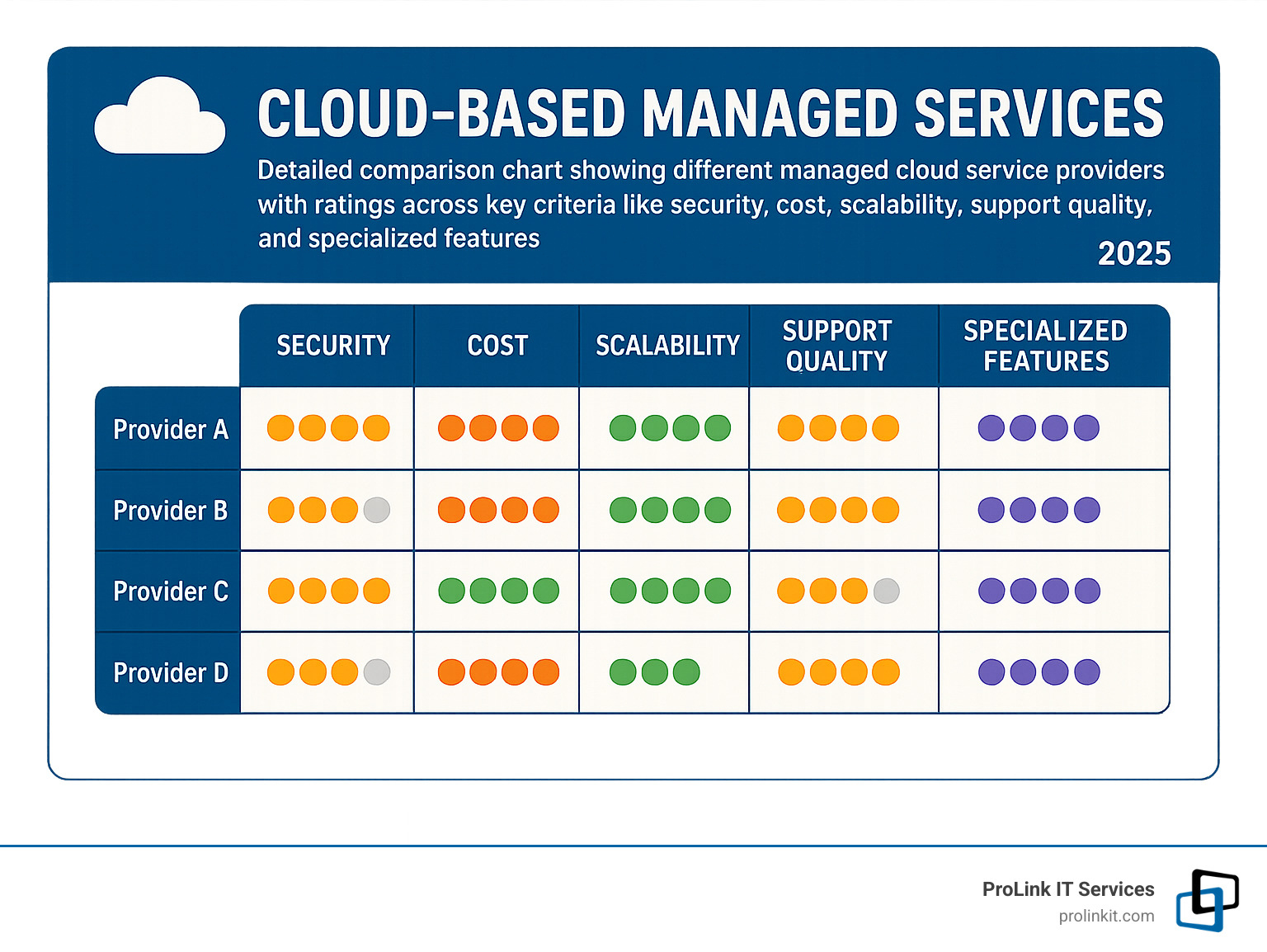
Evaluation Criteria for Cloud Based Managed Services
Security certifications should be your starting point. Look for SOC 2 Type II certification and industry-specific certifications like HIPAA, PCI DSS, or FedRAMP. Ask about third-party security audits and incident handling procedures.
Uptime guarantees sound impressive until you read the fine print. A 99.9% uptime SLA means about 8 hours of downtime per year. Look at their actual uptime statistics for the past year.
Scalability limits become critical as your business grows. Ask about maximum resource limits, automatic scaling policies, and capacity planning during growth spurts.
Cost models vary dramatically. Some use flat-rate pricing that’s predictable but potentially wasteful. Others use usage-based billing that scales with needs but can surprise you. Look for transparent pricing without hidden fees.
Support channels make the difference between minor hiccups and business disasters. 24/7 support should mean actual technical experts with clear response time commitments and escalation procedures.
Essential questions to ask every potential provider:
- What specific services are included in your base pricing?
- How do you handle security incidents and notification timelines?
- Can you share actual uptime statistics for the past 12 months?
- How do you manage capacity planning and scaling decisions?
- What’s your disaster recovery testing schedule?
- How do you handle compliance reporting and audit support?
- What’s your change management process for service upgrades?
- How do you measure and report service performance?
Shortlist Highlights & Use-Case Matches
E-commerce businesses need providers who understand traffic spikes. Look for automatic scaling capabilities, global content delivery networks, and specialized payment processing security.
Regulated industries require providers who speak your compliance language fluently. Deep regulatory expertise matters more than lowest price when audit season arrives.
Data-heavy organizations need high-performance computing capabilities, specialized analytics platforms, and cost optimization for variable compute needs.
Fast-growing startups need quick deployment capabilities, flexible pricing models, developer-friendly tools, and growth-oriented support that understands startup urgency.
The key is matching provider strengths with your specific challenges. Take time to understand how well their capabilities align with your actual business needs.
Frequently Asked Questions about Cloud-Based Managed Services
What is the difference between a CSP and an MCSP?
The distinction between Cloud Service Providers (CSPs) and Managed Cloud Service Providers (MCSPs) is fundamental to understanding your options.
CSPs provide access to cloud infrastructure and tools:
– Raw computing resources (servers, storage, networking)
– Platform services (databases, analytics, AI/ML tools)
– Software applications (email, collaboration, CRM)
– Self-service portals and APIs for management
– Pay-as-you-go pricing models
Think of CSPs as providing the ingredients and kitchen – you still need to know how to cook.
MCSPs add operational management and expertise:
– Configuration and optimization of cloud resources
– 24/7 monitoring and incident response
– Security management and compliance
– Backup and disaster recovery procedures
– Performance tuning and cost optimization
– Help desk support and user training
MCSPs are like having a professional chef who not only cooks but also plans meals, shops for ingredients, and cleans up afterward.
Many organizations use both – CSPs for the underlying infrastructure and MCSPs for management and operations. Some providers offer both services, while others specialize in one area.
How is billing typically handled?
Managed service billing models vary significantly and can dramatically impact your total cost of ownership. Understanding the options helps you choose the right model for your usage patterns.
Subscription-Based Models:
– Fixed monthly or annual fees
– Predictable costs for budgeting
– Often include specific resource allocations
– May have overage charges for excess usage
– Good for stable, predictable workloads
Pay-as-You-Go Models:
– Charges based on actual resource consumption
– More flexible for variable workloads
– Can include management fees as percentage of usage
– Requires careful monitoring to avoid surprises
– Ideal for seasonal or unpredictable usage
Hybrid Models:
– Base subscription plus usage-based components
– Minimum commitment with flexible scaling
– Often the most cost-effective for most organizations
– Balances predictability with flexibility
– Common in enterprise managed services
Credit-Based Systems:
– Purchase credits upfront for future consumption
– Useful for seasonal businesses (tax preparation, retail)
– Often provide volume discounts
– Credits may expire if not used
– Good for project-based work
Most managed service providers offer transparent billing with detailed usage reports, cost optimization recommendations, and spending alerts to help you manage costs effectively.
Can automation reduce security risks?
Automation in managed services can significantly improve security posture, but it’s not a silver bullet. Understanding how automation helps and where human oversight remains crucial is important for setting realistic expectations.
How Automation Improves Security:
Consistency and Standardization:
– Automated configurations eliminate human error
– Security policies applied uniformly across all systems
– Compliance requirements enforced automatically
– Configuration drift detected and corrected immediately
Rapid Response to Threats:
– Automated threat detection and initial response
– Immediate isolation of compromised systems
– Automated patching and vulnerability remediation
– Real-time security monitoring and alerting
Continuous Compliance:
– Automated compliance checking and reporting
– Policy violations detected and remediated automatically
– Audit trails maintained automatically
– Regular security assessments and updates
Where Human Oversight Remains Critical:
Complex Threat Analysis:
– Advanced persistent threats require human analysis
– False positive investigation and tuning
– Strategic security planning and risk assessment
– Incident response coordination and communication
Policy Development:
– Security policy creation and updates
– Risk assessment and mitigation strategies
– Compliance interpretation and implementation
– Business context and decision making
The most effective managed security services combine automated tools with human expertise, using automation to handle routine tasks while reserving human intelligence for complex analysis and strategic decisions.
Conclusion
Cloud based managed services offer the support you need to thrive in today’s fast-moving digital world. That projected $116.2 billion market growth by 2025 tells a story – businesses everywhere are finding that trying to manage complex cloud infrastructure internally just doesn’t make sense anymore.
The smartest organizations are realizing they can access enterprise-grade capabilities without the enterprise-level headaches. They’re partnering with managed service providers who specialize in this technology so they don’t have to.
At ProLink IT Services, we’ve built our entire approach around three core principles: discipline, integrity, and genuine partnership. As a veteran-owned business, we understand what it means when systems absolutely must work. We know the value of having partners you can count on when everything’s on the line.
We’ve walked alongside startups experiencing explosive growth and established enterprises navigating major digital changes. Time and again, we’ve watched cloud based managed services change IT from “that department that costs money” into “the team that drives our competitive advantage.”
The magic isn’t just in choosing any managed service provider. It’s about finding a partner who genuinely understands your business, shares your values, and has the battle-tested expertise to deliver on their promises every single time.
Moving to the cloud isn’t the end goal – it’s the beginning. The real prize is using the cloud’s power to drive actual business results. That takes more than technical know-how. It requires a partner who understands your business objectives and can align every technology decision with real business outcomes.
Your IT shouldn’t keep you up at night. It should be the foundation that lets you sleep soundly, knowing your systems are in expert hands while you focus on what you do best – growing your business.
Ready to find how cloud based managed services can transform your operations? We’re here to help you steer the options, sidestep the common pitfalls, and build a cloud strategy that delivers real, measurable value. Because at the end of the day, your success isn’t just our goal – it’s our mission.