

The Simplicity of Systems: Expert Opinions
Why Simple Systems Transform Business Operations
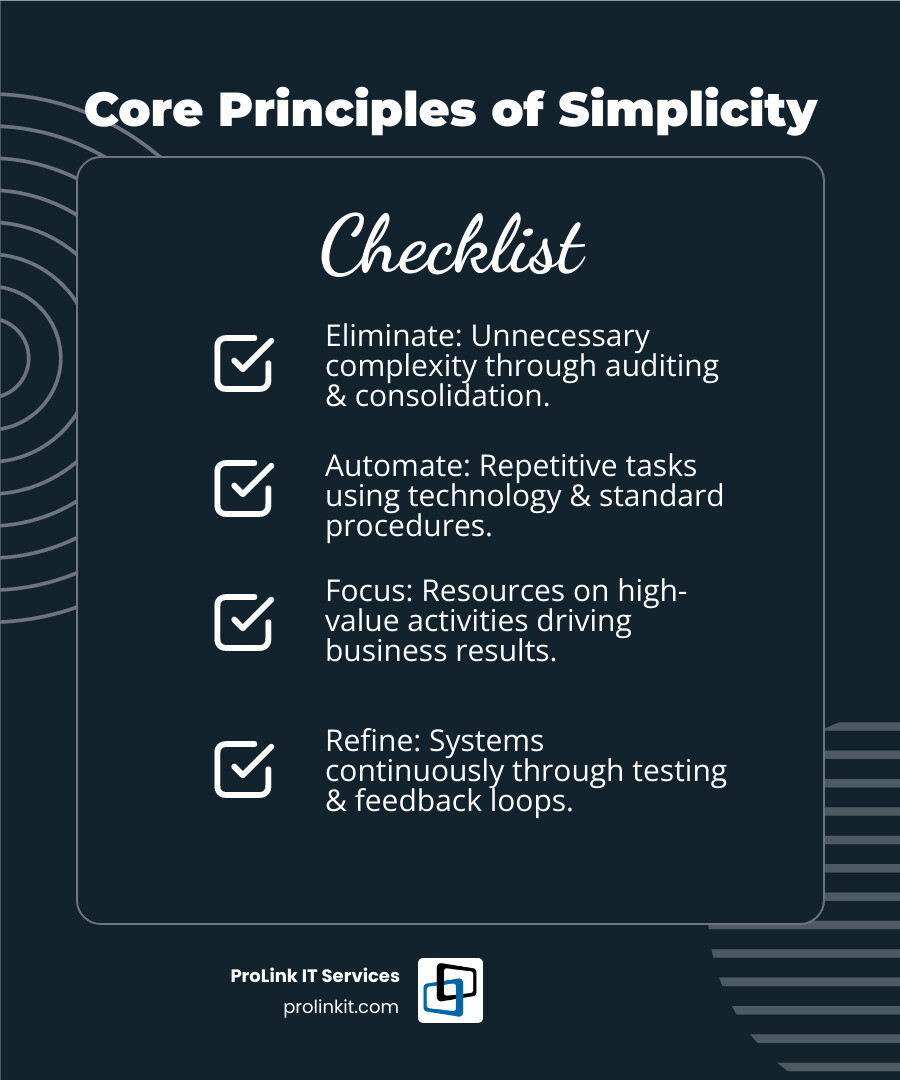
Simple systems are the foundation of efficient, scalable operations. They eliminate unnecessary complexity to maximize results by following four key principles:
- Eliminate – Remove redundant processes and tools.
- Automate – Use technology for repetitive tasks.
- Focus – Concentrate on what truly drives value.
- Refine – Continuously improve based on feedback.
Research shows businesses using this approach can save up to 40% through improved ordering processes and drastically cut training time. Yet many organizations struggle with overcomplicated workflows and scattered tools that require constant manual intervention.
Why complexity fails: Complex systems create cognitive overload, increase errors, and make scaling nearly impossible. They cause teams to lose sight of actual productivity.
The less-is-more principle isn’t about cutting corners; it’s about smart design that achieves maximum impact with minimum friction. The best solutions prioritize user experience over feature bloat.
In this expert roundup, we’ll explore how leading professionals simplify operations, sharing practical insights you can apply immediately.
I’m Mitch Johnson, founder and CEO of ProLink IT Services. With over 20 years of experience, I’ve helped businesses streamline their technology with simple systems that reduce costs and enable sustainable growth.
The Core Philosophy of Simple Systems: Why Less is More
After two decades in IT, I’ve learned that simple systems are essential for success. Whether in technology, business operations, or personal productivity, the same truth applies.
The beauty of simplicity lies in four core principles: Eliminate the unnecessary, Automate the repetitive, Focus on what matters, and Refine as you go. These are proven strategies that work.
When you strip away everything that doesn’t serve a clear purpose, your processes run smoother and faster. Your systems also become easier to scale over time. This isn’t about dumbing things down. Think of a well-designed smartphone: behind its clean interface is sophisticated technology, hidden from the user to deliver powerful results.
The long-term benefits are huge: sustained growth, reduced stress, and the mental space to innovate instead of constantly fighting fires.
The Benefits of Simple Systems in Business Operations
Complexity quietly kills businesses by burning resources, frustrating employees, and driving customers away. This is why streamlining processes is a game-changer.
Take process standardization. I’ve seen businesses transform with clear, easy-to-follow operations manuals that people actually use. When processes are standardized and simple, training is lightning-fast. New team members can become productive in days, not weeks. This means faster employee onboarding and more time focused on revenue-generating activities.
The cost savings can be incredible. We’ve seen businesses save up to 40% on ordering by implementing e-procurement that digitizes the entire purchasing workflow.
These efficiencies ripple through your supply chain. Smooth internal processes lead to consistent service delivery. Happy employees provide better service, which creates happy customers and drives growth. Plus, when your systems are simple, scaling becomes much easier—you just replicate what already works.
If you’re ready to streamline your operations, our Expert IT Consultancy Services for Optimal Business Solutions can help you design the perfect approach.
The Role of Technology in Creating Simple Systems
The best technology is the kind you don’t have to think about. At ProLink IT Services, our mission is removing tech hassles so you can enjoy the benefits of modern technology.
A great user experience (UX) makes complex tasks feel effortless. The same principle applies to business technology. Instead of juggling multiple systems and logins, lean architectures offer centralized management, reducing confusion and smoothing out daily operations.
Automation tools are key. From automated backups to streamlined workflows, the right systems free up your team to focus on creative thinking and problem-solving. The goal is data visibility without information overload—seeing what’s happening clearly without drowning in irrelevant metrics.
Our Managed IT Services are built on this philosophy. We make complex IT infrastructure work seamlessly in the background, giving you control without complexity. The right technology should empower your business, not complicate it.
Simplicity in Personal Productivity
The urge to overcomplicate also hits our personal lives. We create elaborate task management systems that take more time to maintain than they save.
Leo Babauta of Zen Habits notes in We Overcomplicate Our Task Systems that we spend too much time organizing systems instead of doing the work. His solution is the “One List” approach: keep a single master list and pick a few items for a “Today” list each morning. No complex categories or mental models are needed.
This approach helps with overcoming overwhelm by eliminating decision fatigue. You just focus on the work.
Habit formation works the same way. Pick one small thing and stick with it. Simplicity makes it easier to start and more likely to last. Real productivity comes from our ability to handle uncertainty, and simple structures create the mental space we need to do that.
A Practical Guide to Designing Your System
Creating a simple system doesn’t have to be overwhelming. The key is a clear, step-by-step approach. Our framework breaks the process into three manageable phases: identify and eliminate, automate and standardize, and finally, test and refine.
The magic happens when you realize that designing simplicity is itself a simple process, requiring just honest assessment, smart automation, and continuous improvement.
Step 1: Identify and Eliminate Unnecessary Complexity
The first step is being brutally honest about what’s necessary.
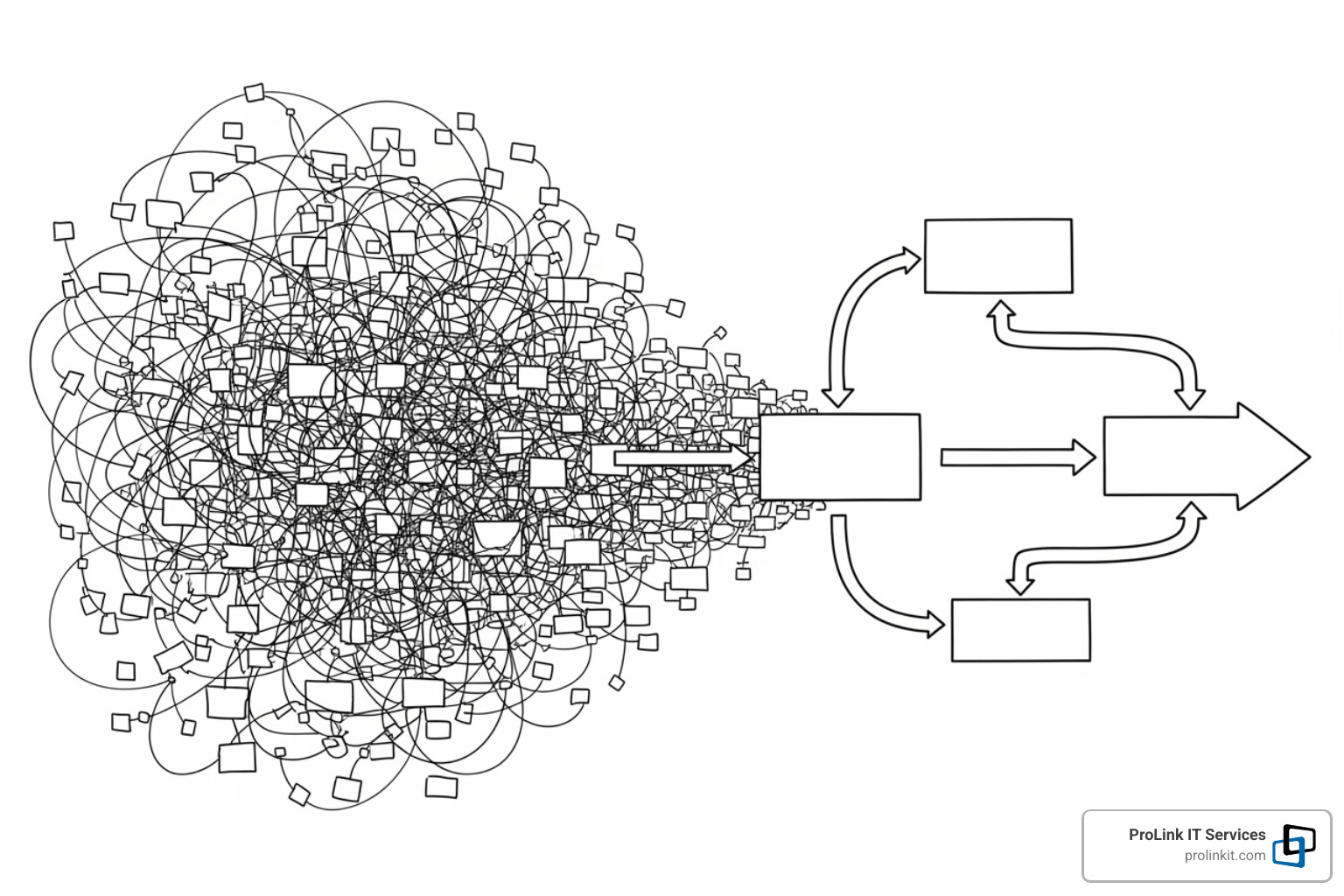
Start by auditing your current processes. Map everything from start to finish. You’ll be amazed at how many steps exist simply because “that’s how we’ve always done it.” The secret is asking “why” at every step. You’ll often find processes built to solve problems that no longer exist.
Process mapping reveals the bottlenecks draining your resources. Perhaps customer onboarding is slow because it bounces between too many departments.
Through our Reliable Business IT Support Lift Your Company’s Success, we often find companies paying for multiple software licenses when one integrated solution would be better and cheaper. Removing redundant tools saves money and reduces the mental overhead of switching between systems.
Step 2: Automate and Standardize
Once you’ve cleared out the clutter, it’s time to make the remaining processes run like clockwork.
Automation is your best friend for repetitive tasks. An e-procurement platform, for example, can handle everything from requests and approvals to invoicing without human intervention, making the process faster and more accurate.
But automation needs standardization. You need clear Standard Operating Procedures (SOPs) that spell out how things should be done. With proper documentation, new employees can become productive quickly.
Creating standard procedures means defining who does what, when, and how. There are no more guessing games, and operations run smoothly even when team members are away.
This is where cloud-managed services become incredibly powerful. Our Cloud Managed Services centralize your data and applications, making them accessible from anywhere. A standardized and automated infrastructure lets your team focus on growth.
Step 3: Test, Gather Feedback, and Refine
A design that looks neat on paper is worthless if it doesn’t work in the real world.
Real-world testing means using your new system under normal operating conditions. Roll it out to your team and see how it performs when things get busy and unexpected issues arise.
Creating feedback loops is crucial. Your team will quickly find things you never considered. Make it safe for people to speak up. Feedback like, “this new process is more confusing,” is gold—it tells you exactly where to focus your refinement efforts.
Continuous improvement means treating your system as a living thing that adapts. The best operations manuals are written, tested by clients, and revised until they are genuinely helpful. This iterative design approach ensures your setup stays simple as your business evolves.
Real-World Examples in Action
Nothing beats seeing simple systems work in the real world. From clever home projects to business strategies that drive growth, these examples prove that simplicity is a practical approach that delivers measurable results. The same principles work across different domains, proving the power of eliminating complexity, automating tasks, and focusing on what matters.

The DIY Innovator: Low-Cost Home Solutions
Some of the most impressive results come from people solving everyday problems with ingenuity. These aren’t high-tech solutions; they’re proof that smart design beats expensive gadgets.
Consider the A $9 Gravity-fed Greywater System on Instructables. This setup uses a hand pump and tubing to capture shower water for garden irrigation, cutting one homeowner’s water bill in half during the first year.
The same principle applies to food production. A Simple Hydroponic System shows how to grow fresh food in less than a month for under $10. This remarkable self-sufficiency comes from a system anyone can build.
Even home energy gets the simplicity treatment. Solar hot water systems with a drain-back design use plain water and simple plumbing, preventing freezing by draining water back into the house. No toxic chemicals or complicated maintenance—just clean, sustainable energy.
These innovations prove that neat, low-friction solutions deliver maximum benefit with minimum complexity.
The Strategic Business: Process-Driven Growth
In business, streamlined operations are powerful engines for scalable growth. Companies that master process-driven simplicity thrive and expand with remarkable efficiency.
Take franchise operations, where consistency is key. Successful franchises have revolutionized their growth with engaging operations manuals that help train franchisees with incredible speed. When your training is that streamlined, scaling becomes inevitable.
The procurement world offers another compelling example. Modern e-procurement platforms manage over 80 million articles from 850+ suppliers for 1500+ customers. They transform a nightmare of paperwork into automated workflows that save up to 40% through improved ordering processes.
Sometimes simplicity means getting back to basics. Many successful businesses in traditional industries build their success on providing natural products of the highest quality without complex additives or unnecessary complications.
Even in technical fields like cybersecurity, clarity and usability prove their worth. Modern security solutions make secure communications accessible, while identity management platforms tackle the crucial challenge that 81% of confirmed breaches start with identity takeover—by providing convenient, intelligent access controls.
These examples show that the most successful businesses build systems that eliminate friction and focus resources where they create the most value.
For businesses looking to apply these principles to IT, our article on the Top Benefits of Using Managed IT Services for Your Business explores how strategic partnerships can drive similar results.
Overcoming Common Pitfalls on the Path to Simplicity
The journey toward simple systems has predictable traps that can pull us back into complexity. The good news is that we can spot and avoid them. The biggest challenge isn’t technical—it’s human. We’re wired to think more features are better, and change is uncomfortable. But the most successful businesses push through these challenges, understanding that simplicity is about focusing on what truly matters.
Resisting ‘Feature Creep’ and Over-Complication
Feature creep happens gradually, often with the best intentions. Someone suggests a new report, then another tool integration, and soon your neat solution becomes a monster. The cause is often a fear of missing out (FOMO)—a worry that without every possible feature, the system will be inadequate.
Focusing on core needs is your best defense. The 80/20 principle applies here: 80% of your results will come from 20% of your features. Find that crucial 20% and protect it. Prioritizing user value means asking if a feature actually makes life easier for users. If not, it’s probably feature creep. Our goal at ProLink IT Services is to “remove the hassles and inconvenience of technology,” not add more complexity.
Tackling Legacy Systems and Organizational Inertia
The “we’ve always done it this way” mindset is a major enemy of simplicity. It’s comfortable but often keeps businesses stuck with inefficient processes.
Change management is about helping people understand why change matters. Document the real costs of your current complexity—how many hours are lost to workarounds? Concrete examples make the case for simplification much stronger.
Phased implementation works because it introduces change gradually. Start with a small area where simplification will have immediate, visible benefits. Early wins build momentum for larger changes.
Gaining stakeholder buy-in requires partnership. As a veteran-owned business, we know trust is earned. We work alongside our clients in West Jordan, UT, and throughout Utah, showing how streamlined systems can transform operations. This is especially critical with our Cybersecurity Solutions, where trust is essential. Involving stakeholders in the design process turns skeptics into champions.
Frequently Asked Questions about System Simplification
How do I know if my current system is too complex?
The warning signs are often in plain sight. If you spend weeks training new employees on processes that should take days, that’s a red flag. Other signs include frequent bottlenecks, team frustration with tools, and a general lack of clarity. A simple test: if your employees spend more time managing the system than doing their work, it’s over-complicated. If even experienced employees struggle to explain how something works, your setup needs simplification.
Can a simple system scale with a growing business?
Yes, absolutely. Simple systems are actually better at scaling than complex ones. When something is easy to understand and use, it’s also easy to teach, replicate, and manage as you grow. Consider operations manuals that allow for rapid franchisee training. Their power comes from simplicity and clarity. The ease of replication is key. When processes are streamlined, adding new team members or locations doesn’t require rebuilding from scratch. You have a solid foundation that can grow with you.
Is ‘simple’ just another word for ‘basic’ or ‘less powerful’?
Not at all. This is the biggest misconception about simple systems. We’re talking about elegance in design, not a lack of power. Think of sophisticated home automation systems that control entertainment, lighting, and security from a single, intuitive interface. That’s not basic; it’s brilliant design that focuses power where it matters most. True simplicity achieves maximum impact with minimum friction. A robust cybersecurity solution, for instance, is more effective when its management interface is simple and clear. Robustness through clarity is the goal.
Conclusion
The journey through simple systems reveals a profound truth: simplicity is about doing what matters most with clarity and purpose. From a $9 greywater system to enterprise platforms that save businesses up to 40% on costs, the right approach to simplicity creates extraordinary results.
The Eliminate, Automate, Focus, and Refine framework is a practical roadmap. These are the natural outcomes of systems designed with intention and maintained with discipline.
After two decades in IT, I’ve seen how often complexity is mistaken for sophistication. The most powerful solutions are often the most neat. A robust cybersecurity system or a scalable cloud infrastructure shouldn’t create headaches. The best technology removes friction, not adds to it.
At ProLink IT Services, this philosophy is core to what we do. As a veteran-owned company serving West Jordan, UT, and the surrounding region, we bring discipline and integrity to your IT challenges. We don’t just implement solutions; we partner with you to build systems that make sense for your goals.
The beauty of simple systems lies in their resilience. Clear processes and streamlined technology make your business antifragile—positioned to thrive through change. This foundation gives you the freedom to innovate, adapt, and grow.
Ready to experience what simplified IT can do for your business? Find out how we can simplify your IT infrastructure and gain the peace of mind that comes with systems that work as they should.