

The Ultimate Guide to Network Management Services Providers
Why Network Management Services Are Essential for Modern Businesses
Network management services are IT solutions from third-party experts who monitor, maintain, and secure your business network infrastructure. These services cover everything from basic monitoring to comprehensive management of servers, firewalls, and cloud resources.
What Network Management Services Include:
- 24/7 network monitoring and real-time alerts
- Proactive maintenance and troubleshooting
- Security management including firewalls and threat detection
- Performance optimization and capacity planning
- Technical support and help desk services
- Compliance management for regulations like HIPAA and PCI
The global network management systems market has grown to over $9.3 billion in 2022, with an anticipated growth rate of 9.4% through 2027. This growth reflects a critical reality: the average cost of network downtime is $5,600 per minute, making reliable network management essential for business continuity.
Managing a complex IT infrastructure internally is a major challenge. It demands specialized expertise, constant monitoring, and significant capital investment, distracting from core business goals.
Why businesses choose managed network services:
- Reduce operational costs and eliminate unexpected IT expenses
- Access expert knowledge without hiring specialized staff
- Ensure 24/7 network availability and security
- Free internal teams to focus on strategic business initiatives
- Scale network resources as the business grows
I’m Mitch Johnson, Founder and CEO of ProLink IT Services. With over 20 years of experience helping Utah businesses, I’ve seen how the right network management services approach transforms operations and drives growth.
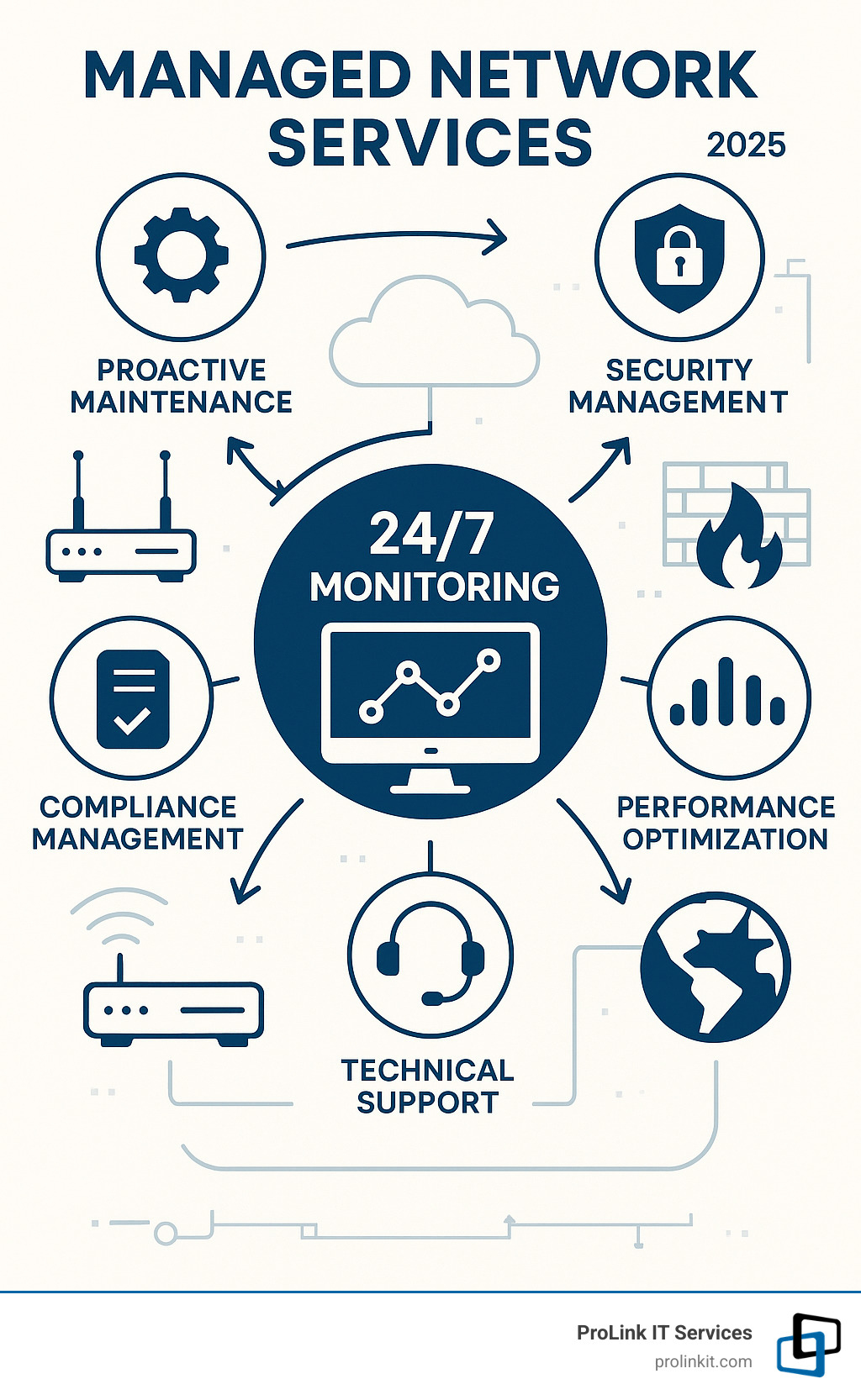
Essential network management services terms:
What Are Managed Network Services (MNS) and What Do They Encompass?
Managed network services (MNS) are outsourced services that provide a dedicated team of network experts to manage your digital infrastructure around the clock, without the overhead of an in-house team. Instead of just fixing problems, your provider acts as your Network Operations Center (NOC), continuously monitoring and maintaining your entire network ecosystem.
These services are flexible, covering your local office network (LAN), connections between locations (WAN), and modern SD-WAN solutions for improved performance. Providers also manage VPNs for secure remote access, keep all hardware (routers, switches, firewalls) updated, and handle network provisioning to scale with your business.

If you want to explore how these services can transform your specific operations, check out our network management services page for detailed information.
The Core Functions of MNS
Your managed network provider handles seven critical functions that keep your business running smoothly.
- Monitoring is the 24/7/365 foundation, spotting issues before they become problems.
- Maintenance is proactive, involving regular updates and patching to prevent costly downtime.
- Troubleshooting is immediate, with providers diagnosing and resolving issues quickly to restore service.
- Performance optimization ensures critical applications get priority, keeping your team productive.
- Security management is critical, including firewall management and intrusion detection to protect your data.
- Technical support acts as your first line of help for employee network issues.
- Reporting provides detailed insights into network performance, security, and resource use, demonstrating value.
The Scope of a Typical MNS Agreement
A good MNS partnership is defined by clear Service Level Agreements (SLAs), which guarantee uptime, response times, and service quality.
Your agreement typically covers all your network devices—every router, switch, and access point. Servers are monitored and optimized, whether on-premises or in the cloud. Cloud resources are seamlessly integrated and managed, creating a unified hybrid environment.
Agreements can also cover voice and data solutions, ensuring reliable communication platforms like phone systems and video conferencing. User administration is handled to ensure only authorized users have access to the right resources.
The key is finding a provider who tailors the agreement to your specific needs, growth plans, and security requirements, creating a true partnership that adapts as your business evolves.
The Core Benefits of Partnering with a Network Management Services Provider
When you partner with a network management services provider, you’re making a strategic investment in your business’s future. The benefits impact everything from your bottom line to your competitive edge. With the average cost of network downtime at $5,600 per minute, preventing outages is crucial. More importantly, managed network services free your business to focus on growth and customer service.
Reduce Costs and Minimize Downtime
Predictable monthly expenses replace surprise repair bills and large capital expenditures (CapEx). A fixed monthly fee shifts IT costs to a manageable operational expenditure (OpEx), freeing up capital.
The reduced hardware costs add up, as your provider often hosts services and manages equipment, meaning fewer servers for you to purchase and maintain. You get access to enterprise-grade infrastructure without the enterprise-grade price tag.
Proactive management is key. With 24/7 monitoring, providers prevent problems before they cause downtime, making that $5,600-per-minute cost a rarity.
The improved ROI comes from spending less on hardware, avoiding costly downtime, and accessing expertise that would be expensive to hire in-house. For more insights, see our guide on the Top Benefits of Using Managed IT Services for Your Business.
Improve Security and Ensure Compliance
Cybersecurity is a business survival issue. Businesses face sophisticated threats daily that can halt operations and destroy reputations.
Proactive threat detection uses 24/7 monitoring and AI-powered tools to identify and neutralize threats before they cause damage.
Vulnerability management keeps your systems secure through regular, automated patching and updates, closing security gaps as soon as they’re finded.
Compliance adherence is critical for regulated industries like healthcare (HIPAA) and finance (PCI-DSS). MNS providers have the expertise to steer these complex requirements, ensuring your network stays compliant and avoids hefty fines.
The 24/7 protection gives you peace of mind, knowing experts are protecting your network around the clock. Learn more about comprehensive protection in our article on 7 Top Network Security Tips for Businesses.
Free Your Internal IT Team to Focus on Strategy
This is a transformative benefit. Freeing your IT team from daily fire-fighting allows them to drive business value.
Offloading routine tasks like monitoring and patching allows your skilled professionals to work on projects that move your business forward.
A focus on innovation replaces reactive maintenance. Your team can research new technologies and develop strategies that align IT with business goals, turning the IT department from a cost center into a growth driver.
Strategic initiatives and business growth projects become the priority. Your team can implement new productivity tools or explore emerging technologies to gain a competitive advantage.
Partnering with an MSP eliminates skills gaps affordably. You gain access to a team of specialists in security, cloud, and networking for less than the cost of hiring a single in-house expert. Your internal team becomes more strategic and focused on driving business success.
Key Features and Provider Operations Models
Providers keep hundreds of client networks running smoothly using sophisticated technology, proven processes, and dedicated expertise.

At the core of operations is the Network Operations Center (NOC), the 24/7/365 mission control for your network. Skilled engineers use it to monitor client networks in real-time and respond to alerts instantly, day or night.
A Service Delivery Platform (SDP), combined with powerful automation, streamlines everything from routine maintenance to emergency response. Many tasks are handled automatically in the background. Modern ticketing systems track every alert, request, and resolution, ensuring nothing is missed.
For a broader look at how comprehensive IT management transforms businesses, explore our Managed IT Services offerings.
Typical Features Included in a Service Offering
When you partner with a provider, you get a toolkit designed to keep your network at peak performance.
- Performance monitoring continuously tracks bandwidth, latency, and other metrics to identify and resolve bottlenecks before they impact users.
- Configuration management ensures all network devices have consistent settings and security policies.
- Fault management involves not just fixing issues, but also performing root cause analysis to prevent recurrence.
- Security services are a protective shield, including management of firewalls, Intrusion Detection Systems (IDS), and VPNs for secure remote access.
- Patch management is a critical service where providers ensure all your devices and software have the latest security updates and bug fixes.
- Detailed reporting and analytics provide insights into network performance and security incidents, helping you make informed decisions.
How Providers Deliver Network Management Services
The delivery of network management services is both comprehensive and flexible.
Engineers in the Network Operations Center (NOC) use sophisticated remote monitoring tools to oversee client networks. These tools collect performance data and send alerts when something needs attention.
The relationship is built on Service Level Agreements (SLAs), which are promises defining response times, uptime guarantees, and resolution targets.
Most providers offer tiered support models, allowing you to choose the level of service that fits your needs and budget. Flexible pricing models are another key advantage. Options include predictable per-device pricing, scalable per-user pricing, or comprehensive all-inclusive models.
This flexibility allows businesses of all sizes to transform unpredictable IT headaches into manageable, predictable monthly expenses.
The Future of Networking: AI, SDN, and Advanced Security
The field of network management services is rapidly evolving, changing how networks operate, learn, and defend themselves.

Artificial Intelligence and Machine Learning are integral to modern networking. They constantly learn your network’s normal behavior to spot and remediate anomalies instantly, often before users are affected. This has led to AIOps (AI for IT operations), creating networks that can increasingly manage themselves.
The rise of Network as a Service (NaaS) allows businesses to consume networking capabilities as a subscription. This model provides incredible flexibility, allowing you to scale services up or down on demand, just like a cloud service.
Enhancing Network Security and Ensuring Compliance
Security is getting smarter and more comprehensive, moving beyond the outdated “fortress” model.
Zero Trust architecture is the new security standard. It operates on the principle of “trust nothing, verify everything,” scrutinizing every access request regardless of location. This enables secure work from anywhere.
Multi-Factor Authentication is a crucial component, requiring multiple forms of verification to prevent unauthorized access even if a password is stolen.
Providers implement centralized policy enforcement, applying the same security rules consistently across your entire infrastructure, whether on-premises or in the cloud.
Continuous compliance monitoring is essential for regulated industries. It automates the process of demonstrating adherence to standards like HIPAA or PCI-DSS, ensuring you are always audit-ready. For more insights, check out 24/7 Protection: How Network Security Services Keep Your Data Safe.
The Role of Emerging Technologies in Modern Network Management Services
These technologies are actively making networks smarter and more reliable.
Artificial Intelligence (AI) analyzes vast amounts of network data to spot threats and performance issues that are impossible for humans to detect, amplifying the expertise of network engineers.
Predictive analytics uses historical data to forecast future needs, such as bandwidth requirements or potential hardware failures, preventing bottlenecks.
Automated remediation is where the system not only detects an issue but often fixes it automatically—rerouting traffic or isolating a threat in seconds.
Software-Defined Networking (SDN) centralizes network management. Instead of configuring individual devices, network behavior is programmed from a single control point, providing incredible agility and centralized control.
SD-WAN is a prime example, intelligently managing network connections to prioritize critical applications and ensure seamless failover if a primary connection goes down.
These innovations make network management services more proactive and intelligent. For more on essential security measures, explore our guide on 5 Essential IT Security Services to Consider.
Frequently Asked Questions about Network Management Services
When considering network management services, businesses often have the same key questions. Here are the answers to the most common ones.
What is the difference between managed network services and in-house IT?
The key differences lie in expertise, cost, and approach. In-house IT requires you to hire, train, and retain a team of specialists. With managed network services, you gain access to an entire team of specialists for a fraction of the cost, including 24/7 coverage. The cost structure shifts from large, unpredictable capital expenses (CapEx) to a predictable monthly operational cost (OpEx). Finally, the approach is different: in-house teams are often reactive, while managed service providers are built for prevention, using 24/7 monitoring to address issues proactively. This allows your internal team to focus on strategic projects that grow the business.
How do I choose the right provider for my business?
Choosing the right provider is a critical decision. Here’s what to look for:
- Evaluate their technical expertise. Look for relevant certifications (Cisco, Microsoft, etc.) and proven experience.
- Review their Service Level Agreements (SLAs). They should contain clear, specific guarantees for uptime, response times, and resolution. A lack of clear SLAs is a red flag.
- Assess their security posture. Ask detailed questions about how they protect their systems and your data and what compliance standards they follow.
- Talk to their current clients. A good provider will offer references. Ask them about communication, reliability, and overall satisfaction.
- Ensure a good cultural fit. You need a partner who understands your industry, communicates well, and is invested in your success.
What are the potential challenges when switching to a managed service?
Switching to a managed service can present challenges, but they are manageable with proper planning.
- The integration process requires patience as the provider learns your network. A good partner will streamline this.
- Some owners struggle with giving up direct control. The key is to choose a transparent provider who keeps you informed.
- Clear communication is essential during the transition. Establish designated contacts and regular check-ins to prevent misunderstandings.
- Service continuity is crucial. Your provider must have a solid plan for the transition, including failovers, to prevent downtime.
These challenges are temporary. An experienced provider will guide you through them, and the long-term benefits are well worth the adjustment. At ProLink IT Services, our veteran-owned approach brings discipline and careful planning to every transition, ensuring your network stays secure and operational.
Conclusion: Finding the Right Partner for Your Network’s Future
Your network is the digital backbone of your business. Its flawless performance is critical for every transaction, email, and file share.
Network management services are a strategic investment in business continuity, security, efficiency, and scalability. The right partner transforms your operations, allowing you to focus on your core mission while ensuring your infrastructure is robust and secure.
The change is remarkable: unpredictable IT emergencies become planned operations, your team drives innovation instead of fighting fires, and your IT costs become predictable. However, not all providers are created equal. Choosing the right partner is crucial for success.
A veteran-owned provider like ProLink IT Services brings a unique commitment to discipline, integrity, and partnership that you simply won’t find everywhere. We understand what it means to have someone’s back when the stakes are high. We know that reliability isn’t just a nice-to-have—it’s mission-critical. Our approach ensures your network isn’t just managed, but strategically aligned with your business goals.
Your network deserves a partner who sees the bigger picture and treats your success as their own mission.
Don’t let network complexities hold your business back from reaching its full potential. Learn how our Network Management services can secure and optimize your operations and propel your business toward the future you’re building.