

Managed Cloud Services Made Simple
Understanding Managed Cloud Services: A Simple Definition
Managed cloud services are applications, services, or ecosystems in the cloud managed by a third-party organization. Instead of handling your cloud infrastructure yourself, you outsource this responsibility to experts who manage everything from setup to ongoing maintenance.
Quick Answer: What Are Managed Cloud Services?
- Definition: Outsourcing cloud resource management to a third-party provider
- What’s Included: Infrastructure setup, monitoring, security, maintenance, and optimization
- How It Works: Subscription-based model with 24/7 support and management
- Who Benefits: Businesses wanting to focus on growth rather than IT management
- Key Advantage: Access to expert knowledge without hiring internal teams
Think of it like having a property manager for your rental properties. They handle maintenance and operations so you can focus on other investments. A managed cloud service provider handles your IT infrastructure so you can focus on growing your business.
The cloud managed services market is growing rapidly, with McKinsey Digital predicting that 60% of enterprise environments will be cloud-based by 2025. This reflects the value businesses find in letting experts handle their cloud operations. As CEO of ProLink IT Services, I’ve seen how these services transform businesses by freeing them from infrastructure worries to focus on their core goals.
Managed cloud services terms simplified:
What are managed cloud services and how do they work?
A managed cloud service involves an external provider taking partial or full responsibility for your cloud environment. This is typically a subscription model, often with pay-as-you-go options for flexibility. The managed cloud service provider (MCSP) is responsible for the ongoing management of your cloud resources, including:
- 24/7 monitoring: Proactively identifying and addressing issues.
- Maintenance: Keeping all components updated and running smoothly.
- Optimization: Fine-tuning your environment for performance and cost-efficiency.
- Technical support: Providing expert assistance when you need it.
Service Level Agreements (SLAs) define expectations for performance and support, bringing predictability to your IT operations. We handle the daily grind of cloud management so you can focus on your core business.
To learn more about how cloud services can boost your organization’s output, you can Explore Top Cloud Services to Boost Productivity.
Managed Cloud vs. Traditional Cloud Computing
Traditional cloud computing is a self-managed approach where your internal IT team handles every aspect of your cloud infrastructure. This requires significant time, expertise, and resources.
Managed cloud services shift that operational burden to us, allowing your team to focus on strategic initiatives. It’s the difference between doing all your own car maintenance and leasing a car with a full maintenance package.
Here’s a quick comparison:
| Factor | Traditional Cloud (Self-Managed) | Managed Cloud Services |
|---|---|---|
| Management Responsibility | Entirely on your in-house IT team | Shared or primarily on the Managed Cloud Service Provider (MCSP) |
| Cost Structure | Variable, includes direct infrastructure costs, staffing, training, tools | Predictable, subscription-based, often includes all management and support |
| Expertise Required | High-level, specialized cloud architects, engineers, security experts | Minimal in-house cloud expertise needed; MCSP provides specialists |
| Support | Internal IT team handles all support and troubleshooting | 24/7/365 expert support from MCSP, with defined SLAs |
| Control | Full control over every aspect | Less direct control over infrastructure, but strategic control remains |
| Focus | Operational management, maintenance, problem-solving | Business innovation, strategic growth, core competencies |

With traditional cloud, your team needs extensive technical expertise. With managed cloud services, we provide certified specialists who are always up-to-date with the latest advancements, allowing you to allocate your internal resources more strategically.
Common Types of Managed Cloud Services
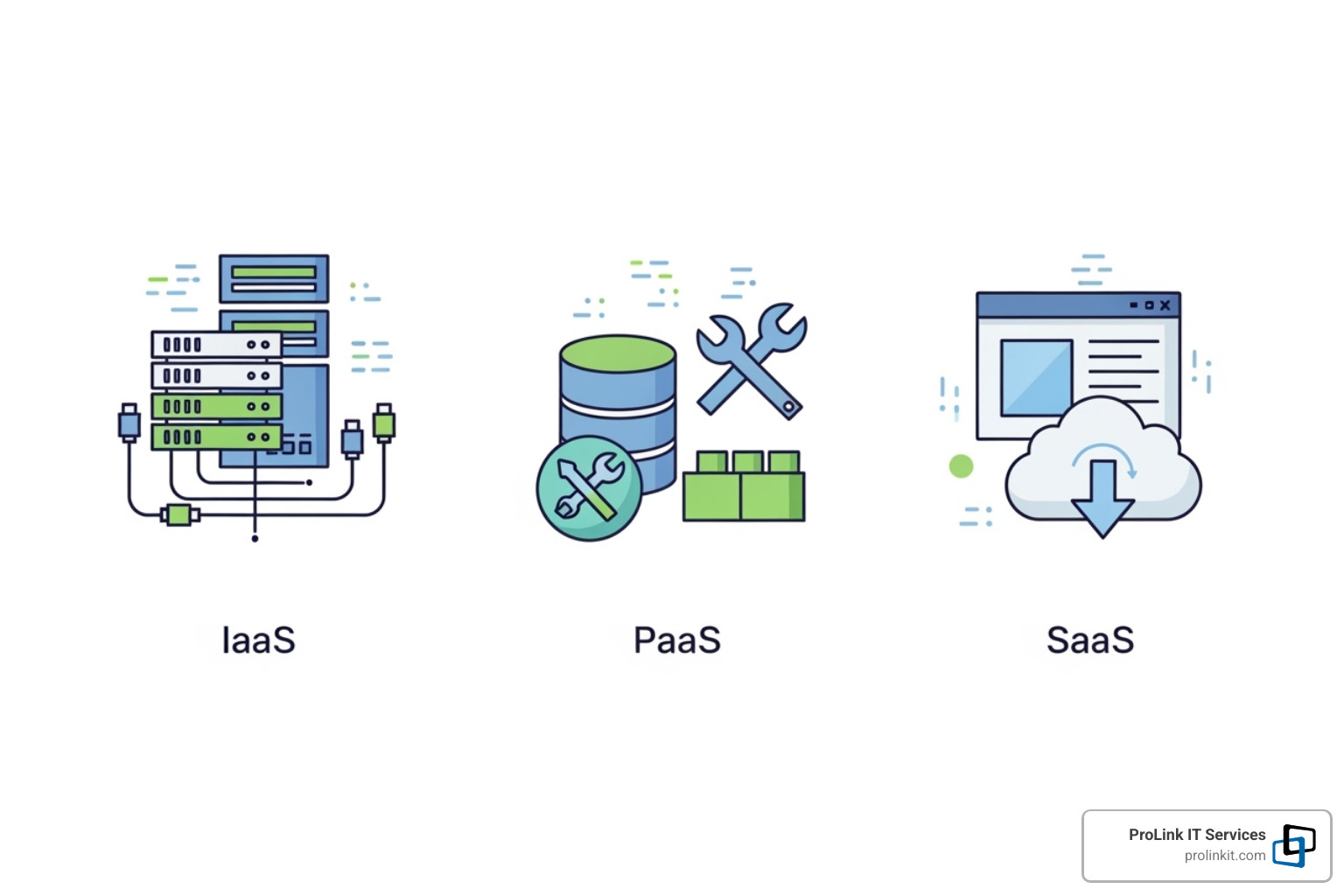
Managed cloud services follow the main cloud computing models: Infrastructure as a Service (IaaS), Platform as a Service (PaaS), and Software as a Service (SaaS). Beyond these, specialized offerings address specific business needs.
Specialized services include:
- Managed security: Proactive threat detection, vulnerability management, and incident response.
- Managed networks: Ensuring smooth cloud connections, from virtual private clouds to load balancers.
- Managed infrastructure: A broad approach covering servers, storage, and networking.
- Backup and disaster recovery: Protecting your critical data from loss.
At ProLink IT Services, we create a custom blend of services that fits your unique needs and goals, ensuring everything works together harmoniously.
For businesses serious about protecting their data, understanding How Data Backup Services Can Save Your Business From Disaster is essential reading.
Managed Infrastructure (IaaS)
Managed Infrastructure as a Service (IaaS) means we handle the foundational elements of your IT: virtual machines, servers, storage, and networking. We manage all the behind-the-scenes work, ensuring your infrastructure is secure, accessible, and optimized for performance.
A key benefit is scalability. We can scale your resources up or down seamlessly to match business demand, eliminating the need to purchase expensive hardware that might sit unused or scramble to add capacity during peak times. You can focus on your work, knowing the underlying infrastructure is handled by experts.
Managed Platforms (PaaS)
Managed Platform as a Service (PaaS) goes a step further by managing the entire platform your applications run on. This includes operating systems, database management, development tools, and deployment environments.
This service is a game-changer for development teams. Your developers can stop worrying about patching operating systems or configuring databases and focus on creating software that drives your business. We manage the platform’s application lifecycle, so your tools are updated, environments are ready, and databases are optimized. This removes operational friction and accelerates software development.
Managed Applications (SaaS)
Managed Software as a Service (SaaS) adds a management layer on top of vendor-managed applications. We provide services that go beyond what the software vendor typically offers.
This includes managing user access and permissions, ensuring updates and patches are applied without disrupting workflows, and monitoring performance to catch issues early. We also help integrate your SaaS applications with other business systems, creating a seamless flow of information. This comprehensive approach ensures your critical business applications run smoothly, securely, and efficiently, allowing your teams to focus on using the tools, not troubleshooting them.
The Core Benefits and Potential Challenges of Managed Cloud Services
Managed cloud services offer transformative benefits but also have potential challenges. Understanding both sides is key to making an informed decision for your organization.

The advantages include significant business value, cost-effectiveness, improved security, and improved scalability and reliability. Potential challenges include vendor dependence and limited control.
Primary Benefits for Your Organization
Adopting managed cloud services offers compelling benefits that directly impact your bottom line and operational efficiency.
- Cost savings: Avoid the significant expense of hiring, training, and retaining a specialized in-house IT team. Many businesses see optimized operational expenses, with some reducing cloud spending by 30% or more.
- Predictable spending: A subscription-based model provides clear, predictable monthly costs, simplifying budgeting and eliminating surprise IT expenditures.
- Reduced IT workload: Free your internal IT team from routine maintenance and troubleshooting to focus on strategic initiatives that drive business growth.
- Access to expertise: Gain instant access to a team of certified cloud experts with deep knowledge of industry best practices and cutting-edge tools.
- Improved security: Benefit from 24/7 monitoring, proactive threat detection, and robust disaster recovery solutions managed by specialists who prioritize security.
- Business agility: With experts handling your cloud infrastructure, your business can be more responsive to market changes, scaling resources up or down as needed.
These benefits transform IT from a cost center into a strategic asset. To understand more about the broader advantages of managed IT, check out Top Benefits of Using Managed IT Services For Your Business. McKinsey Digital research on cloud value highlights the immense value for companies that fully accept the cloud.
Potential Disadvantages and How to Mitigate Them
While the benefits are compelling, it’s important to be aware of potential challenges and have mitigation strategies in place.
- Dependence on provider: You become reliant on your provider’s expertise and reliability.
- Mitigation: Choose a provider with a proven track record and strong client testimonials. Insist on clear SLAs that define responsibilities and performance metrics.
- Security concerns in multi-tenant environments: Your data resides alongside others, which can raise concerns about data isolation.
- Mitigation: Vet your provider’s security measures, certifications (ISO 27001, SOC 2), and compliance frameworks (HIPAA, GDPR). Understand their incident response plan and use additional security layers like encryption and multi-factor authentication.
- Limited control over infrastructure: You give up some granular control over the underlying infrastructure.
- Mitigation: Clearly define your requirements and choose a provider that offers transparency through reporting and allows for customization. You are outsourcing operational control, not strategic direction.
- Potential for hidden costs: Some providers may have opaque pricing for add-on services or overages.
- Mitigation: Get a clear understanding of all costs upfront. Ensure the pricing model aligns with your usage patterns and ask for detailed breakdowns.
By understanding these potential pitfalls, you can build a robust and successful partnership with your managed cloud services provider.
How to Choose the Right Managed Cloud Service Provider
Choosing a managed cloud services provider is a critical business decision. It’s about finding a partner who understands your goals, has your back, and can grow with you. At ProLink IT Services, we build partnerships based on trust, discipline, and integrity.

Before you start looking, assess your business needs. Understanding your specific pain points—whether they are unpredictable costs, security concerns, or an overworked team—will help you find a provider who can solve your actual problems. The best providers become an extension of your team, offering strategic guidance that aligns with your business objectives.
Key responsibilities of a managed cloud services provider
A quality managed cloud services provider should handle the following, freeing you to focus on your business:
- Performance monitoring: 24/7/365 observation of your systems to catch potential issues before they become problems.
- Security management: Comprehensive protection including firewalls, intrusion detection, vulnerability scanning, and access management.
- Compliance reporting: Assisting with technical requirements and documentation for standards like HIPAA or GDPR.
- Cost optimization: Actively finding ways to reduce waste in your cloud spending and improve efficiency.
- Infrastructure maintenance: Handling all routine but critical tasks like patches, updates, and backups.
- Technical support: Providing fast, expert support from people who understand your business.
- Strategic guidance: Helping you plan for the future and make smart technology decisions.
Factors to Consider in Your Decision
When evaluating potential partners, look beyond the technical specs to understand how they will work with you.
- Skills and expertise: Look for certified specialists in AWS, Azure, or Google Cloud, but also for experience in your specific industry.
- Security and compliance certifications: These are essential. Ask tough questions about data protection, incident response, and their security posture. Our Managed Security Services are built around these critical concerns.
- Transparency and control: A good provider offers clear visibility into system performance and their management activities.
- Support availability: Ensure their support model (e.g., 24/7 vs. business hours) matches your operational needs.
- Pricing models: The model should be clear and predictable. Ask direct questions about what’s included and what costs extra to avoid hidden fees.
- Scalability options: The provider must be able to scale resources up or down to match your business cycles without creating a technical burden for you.
The right managed cloud services provider becomes a true business partner, anticipating your needs and helping you use technology to support your growth.
Frequently Asked Questions about Managed Cloud Services
Here are answers to the most common questions business owners ask about managed cloud services.
Who is responsible for security in a managed cloud environment?
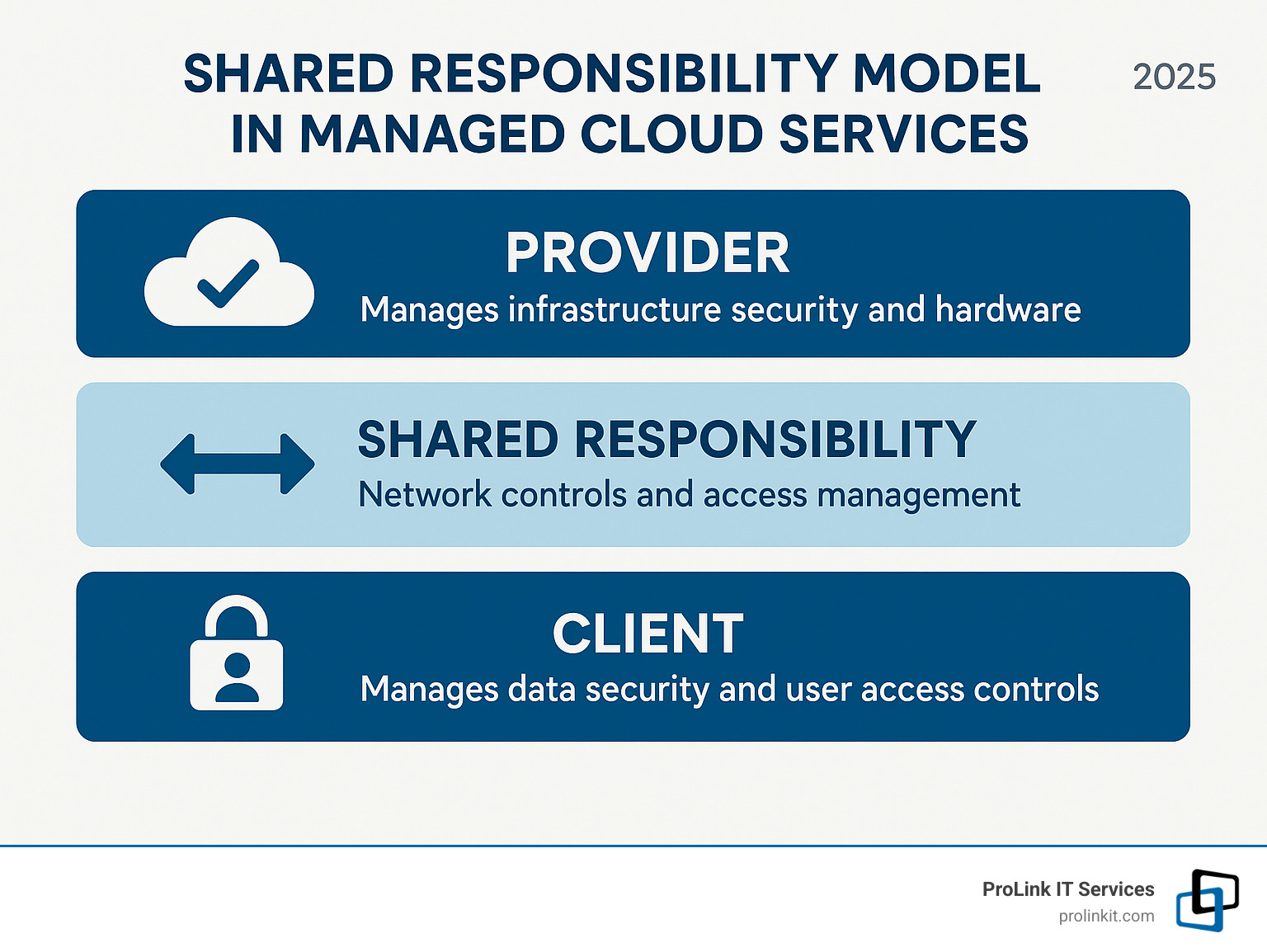
Security is a partnership governed by the shared responsibility model.
- The cloud provider (AWS, Azure, Google Cloud) is responsible for the security of the cloud. This includes the physical data centers and the core network infrastructure.
- Your managed cloud service provider (like ProLink IT) is responsible for security in the cloud. We configure firewalls, manage patches, control access, and monitor for threats.
- You are responsible for the security of your data and applications. You control who has access to your information and how your applications are used.
Clear SLAs are vital to spell out these responsibilities, ensuring there are no security gaps.
How much do managed cloud services cost?
The cost of managed cloud services varies based on your specific needs. Most providers use predictable subscription models (monthly or annual fees), sometimes combined with pay-per-use pricing for resources like storage. Tiered pricing (basic, standard, premium) is also common.
Key cost factors include:
- Complexity: A simple website costs less to manage than a complex, multi-database system.
- Scale: The more resources you use, the higher the cost.
- Support Level: 24/7 support costs more than standard business-hours support.
When evaluating cost, consider the Total Cost of Ownership (TCO). Factoring in the high cost of in-house IT staff, training, and potential downtime, managed services are often more cost-effective. Many of our clients have optimized their IT spending by 30% or more.
When is the right time for a business to switch to managed cloud services?
The right time to switch is usually when managing your cloud environment is holding your business back. Key indicators include:
- Lack of in-house expertise: Your IT team is struggling to keep up, or you can’t find qualified cloud professionals to hire.
- Rapid growth: Your business is scaling quickly, and your IT infrastructure needs to keep pace without the high cost and risk of rapidly building an internal team.
- Desire to refocus: You want your team focused on core business goals like product development or customer service, not server maintenance.
- Security and compliance pressures: You’re dealing with regulations like HIPAA or GDPR or are concerned about cybersecurity threats.
- Unpredictable IT costs: Your IT budget is volatile due to unexpected hardware failures or emergency fixes. A predictable subscription model brings stability.
Partner with an Expert for Your Cloud Journey
Navigating cloud technology shouldn’t be a barrier to your success. With the right managed cloud services partner, you can focus on your core business while a trusted advisor handles the technical complexities.
At ProLink IT Services, we are a veteran-owned company that brings discipline and integrity to every client relationship. Our partnership approach means we become an extension of your team, taking the time to understand your unique challenges and strategic goals.
Partnering with us frees your team to focus on innovation, developing new products, and improving customer experiences. Instead of reacting to IT problems, you can proactively grow your business with the support of a stable, scalable, and secure cloud environment. We’ve seen this change empower companies to achieve their ambitions.
Ready to see how our veteran-owned discipline and partnership mindset can help your business thrive?
Speak to our cloud experts today, and let’s build your path to cloud success together.