

Uptime All the Time – Your Guide to Preventing System Downtime
Why Understanding Downtime Prevention is Critical for Your Business
Understanding how to prevent downtime is critical, as unplanned system failures cost businesses an average of $14,056 per minute, with larger enterprises facing costs of $23,750 per minute during major outages.
Key Strategies to Prevent Downtime:
- Monitor proactively – Use real-time monitoring tools to catch issues before they become problems
- Maintain regularly – Preventive maintenance reduces unplanned downtime by 65%
- Plan for recovery – Have backup systems and disaster recovery plans ready
- Train your team – Human error causes 70% of service outages
- Invest in redundancy – Use cloud services and multiple systems for failover protection
- Update consistently – Keep all software, hardware, and security patches current
A single outage in July 2024 cost Fortune 500 companies over $5.6 billion, proving downtime is a business survival issue. Every minute of downtime means lost revenue, frustrated customers, and long-term reputational damage.
The reality is stark: 95% of business downtime is preventable, stemming from hardware failures, human errors, and software issues, not natural disasters. This means most downtime can be avoided with the right strategies.
I’m Mitch Johnson, and with over 20 years in the technology sector, I’ve helped businesses learn how to prevent downtime through strategic planning. At ProLink IT Services, we know the right approach transforms a business’s resilience and growth.
Key how to prevent downtime vocabulary:
Understanding the Anatomy of Downtime
Downtime is any period when your systems, servers, or applications are unavailable to users, grinding operations to a halt. For businesses, it’s a direct threat to your bottom line and reputation. When systems go dark, customers click away to competitors, and rebuilding that lost trust can take years.
Understanding how to prevent downtime starts with recognizing the two distinct types:
| Characteristic | Planned Downtime | Unplanned Downtime |
|---|---|---|
| Definition | Scheduled in advance for maintenance or updates | Unexpected system failure or unavailability |
| Examples | Software upgrades, hardware replacement, system backups, security patches | Hardware failure, software bugs, cyberattacks, human error, power outages |
| Impact | Minimal disruption if managed well; allows for system improvement | Significant financial loss, productivity halt, reputational damage, customer dissatisfaction |
| Management Strategy | Clear communication, off-peak scheduling, staggered updates, maintenance mode pages | Rapid incident response, robust recovery plans, proactive monitoring, redundancy |
Planned downtime is scheduled maintenance to prevent future issues, while unplanned downtime is a sudden, disruptive failure.
The True Cost: How to Calculate Financial Impact
The cost of downtime is staggering. Unplanned downtime costs an average of $14,056 per minute, and up to $23,750 for large enterprises.
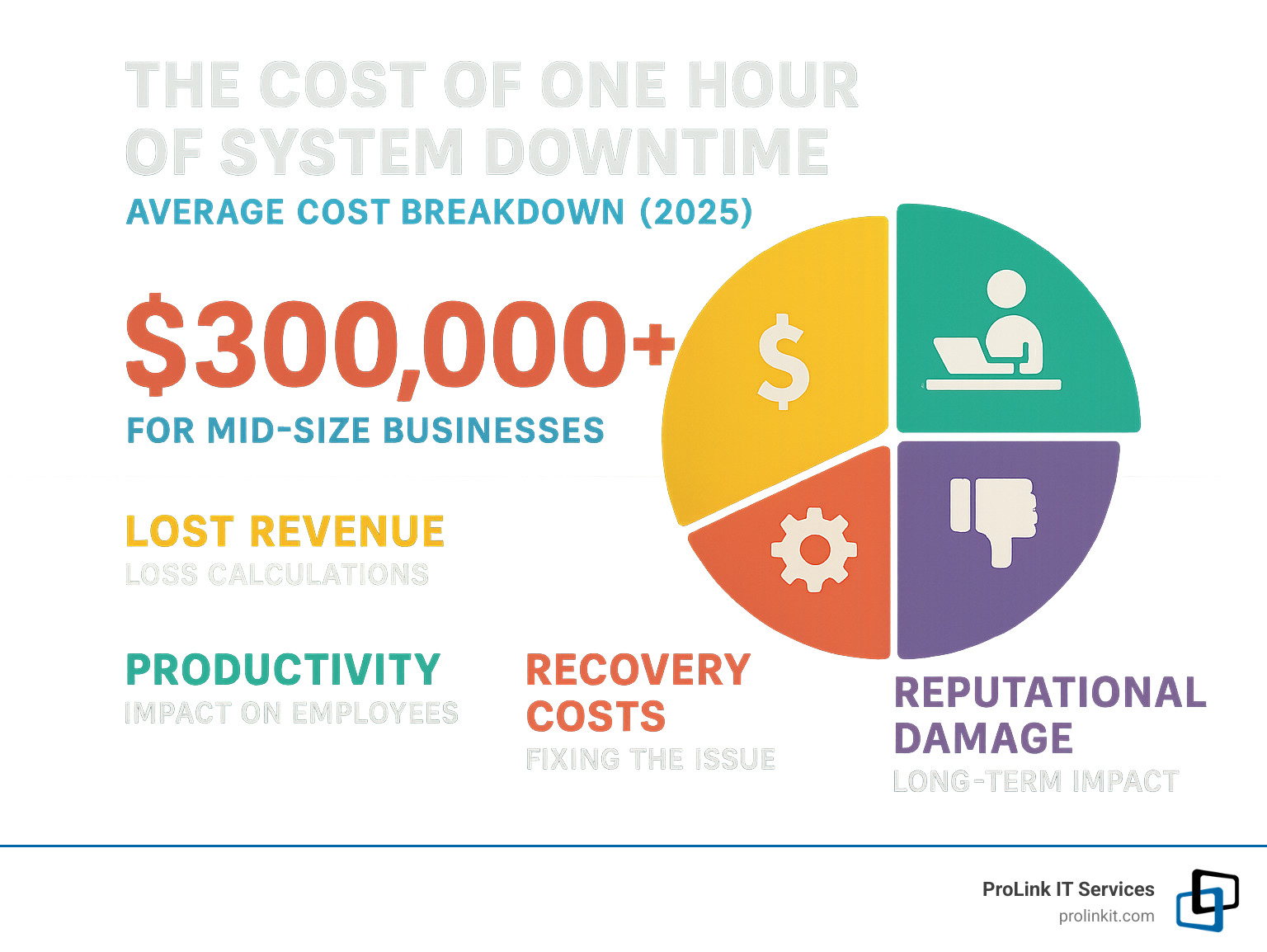
According to Gartner, the average cost is $5,600 per minute, or over $300,000 per hour. Fortune Global 500 companies lose roughly $1.5 trillion annually to unplanned downtime.
Calculating your cost involves four areas. Lost revenue is the most obvious; a business earning $100 million annually loses about $190 per minute, or $11,400 per hour, during an outage. Productivity loss is also significant; if 200 employees earning $50/hour can’t work, that’s $10,000 lost per hour. Recovery costs add to this with IT overtime and emergency support.
The most devastating cost is reputational damage. Lost customer trust can cause revenue declines long after service is restored, making it critical to learn how to prevent downtime.
For insights on maintaining business continuity, explore our guide on reliable business IT support.
Common Culprits: What Causes System Failures?
Understanding the causes of downtime is the first step to building defenses. The good news is that 95% of business downtime is preventable, with only 5% resulting from natural disasters.
- Aging equipment causes 29% of unplanned downtime. Old hardware becomes unreliable, and issues like poor cooling can lead to system failure.
- Human error is a major cause, responsible for a staggering 70% of service interruptions, according to Uptime Intelligence reports. This includes accidental deletions or incorrect configurations.
- Hardware failures (22% of downtime) can happen without warning, as a failed hard drive or faulty memory can bring systems down instantly.
- Software issues, like bugs or glitches from updates, can crash applications or entire systems.
- Cybersecurity threats like ransomware and DDoS attacks are a growing danger. A single cyber incident in July 2024 cost Fortune 500 companies $5.4 billion, showing how quickly these events can escalate.
Other causes include network and power outages, but the pattern is clear: most downtime is preventable and internal.
To strengthen your defenses against these vulnerabilities, check out our 7 Top Network Security Tips for Businesses.
Proactive Defense: Foundational Strategies for Uptime
How to prevent downtime is like car maintenance—you don’t wait for the engine to seize before an oil change. A proactive approach is the most effective way to avoid costly outages by catching problems before they become disasters. This approach is essential for survival. Continuous monitoring, regular maintenance, and tracking the right metrics build a fortress around your operations.

Implement Proactive Monitoring and Alerting
Real-time monitoring acts like a 24/7 security guard for your IT infrastructure, alerting you instantly to suspicious activity. Your system should track key metrics like network traffic, CPU usage, memory consumption, and disk utilization. Crossing a threshold triggers an immediate alert, allowing you to act before it’s too late.
Predictive analytics is key. Modern tools analyze patterns to predict future issues, like warning you of a potential hard drive failure weeks in advance. With performance metrics, you can investigate slow database queries before users complain, a core principle of our Network Management Services.
Master Your Maintenance and Testing Routines
A surprising statistic: preventive maintenance can reduce unplanned downtime by 65%. Regular maintenance is critical. Hardware requires cleaning, inspections, and timely replacements. Software needs consistent updates and security patches to remain stable and secure.
Patch management is vital, as outdated systems are vulnerable to cyberattacks. Load testing simulates high-traffic scenarios to find bottlenecks before your customers do. Regular audits of logs and configurations complete your maintenance routine.
Many businesses find tremendous value in outsourcing these critical tasks to experts. You can learn more about Why Businesses Are Turning to Outsourced IT Support in 2025.
Measure What Matters: Key Performance Indicators (KPIs)
To improve, you must measure. For how to prevent downtime, the right KPIs are essential.
- Mean Time Between Failures (MTBF) shows system reliability—a higher number is better.
- Mean Time To Repair (MTTR) measures recovery speed—a lower number is better.
- Overall Equipment Effectiveness (OEE) combines availability, performance, and quality into one metric to show how efficiently your systems operate.
- Availability percentage is crucial. The difference between 99.9% (8.76 hours of annual downtime) and 99.99% (52.56 minutes) is significant. The gold standard for mission-critical systems is 99.999% (under 6 minutes of downtime per year).
Modern businesses also track metrics like deployment frequency, one of the four DORA metrics, to identify potential issues in development processes before they cause system-wide problems.
These foundational strategies create a solid defense against downtime, but they’re just the beginning.
Building Resilience: Advanced Strategies for How to Prevent Downtime
After mastering basic monitoring and maintenance, build resilience into your IT infrastructure. This means upgrading from a simple alarm to a fortress that can weather any storm. The secret to how to prevent downtime is embracing modern technologies like cloud computing, automation, and disaster recovery, which form the backbone of resilient businesses.
Leverage the Cloud for Superior Availability
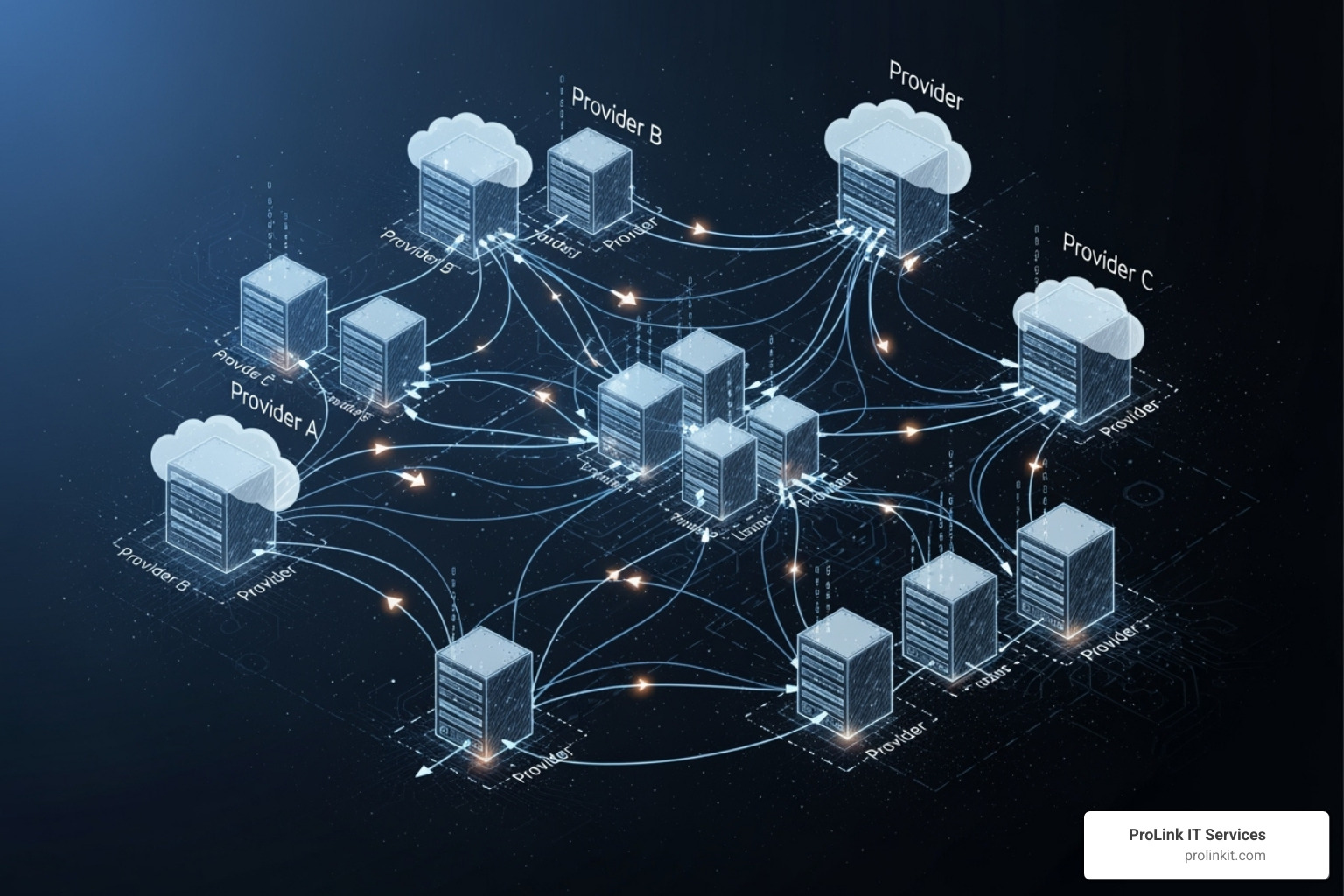
Moving to the cloud is one of the most effective ways to prevent downtime. Cloud platforms are designed for maximum availability, keeping your systems running no matter what. High availability is built into cloud architecture. Platforms like AWS and Google Cloud run applications across multiple data centers, so if one component fails, another instantly takes over.
Cloud scalability allows your systems to handle sudden traffic spikes by automatically adjusting resources. With managed maintenance, your cloud provider handles hardware upkeep and security patches, often offering uptime guarantees above 99% via Service Level Agreements (SLAs).
Our Cloud Managed Services can help you harness these advantages while ensuring everything works seamlessly with your existing operations.
Accept Automation and Redundancy
Manual processes make preventing downtime an uphill battle. Resilient businesses use smart automation and build redundancy into every critical system.
- CI/CD pipelines automate software updates, eliminating the human error that causes 70% of outages. Techniques like rolling updates mean users experience no downtime during deployments.
- Self-healing systems work like a 24/7 IT technician, automatically detecting and fixing problems like failed services or resource needs.
- Automated failover ensures backup systems engage instantly. Multi-instance architecture spreads applications across multiple servers, so if one fails, others pick up the slack.
The foundation of all this automation is solid data protection. Understanding How Data Backup Services Can Save Your Business From Disaster is crucial for building truly resilient systems.
Create a Bulletproof Backup and Disaster Recovery Plan
Even with advanced prevention, things can go wrong. A bulletproof backup and disaster recovery (DR) plan is essential for survival. Regular backups are the backbone of recovery. Follow the 3-2-1 rule: keep three copies of your data on two different media types, with one copy stored offsite.
Your Recovery Time Objective (RTO) (how quickly you must restore systems) and Recovery Point Objective (RPO) (how much data loss is tolerable) are key metrics that drive your DR planning. Many businesses fail to test their DR plans. DR plan testing is critical to reveal gaps and ensure your plan works. Consider Disaster Recovery as a Service (DRaaS) for robust, cloud-based recovery.
For practical guidance on building your backup strategy, check out our Data Backup Essentials: A COVID-19 Checklist. While it was created during the pandemic, the principles apply to any business continuity situation.
Fortifying the Human Element in Your Downtime Strategy
Technology is only half the battle in learning how to prevent downtime. The human element—from cybersecurity awareness to crisis communication—often determines if a small hiccup becomes a major outage. Even with the best technology, a simple human error can cause an outage. A security-conscious, well-trained team is as important as the latest hardware.

Bolster Your Cybersecurity Defenses to Prevent Downtime
Cyberattacks are a fast-growing cause of downtime for businesses of all sizes. A single ransomware attack can shut down your operation for weeks.
- Strong firewalls and access controls are foundational. Modern firewalls actively monitor for threats, while multi-factor authentication (MFA) adds a crucial layer of protection.
- Ransomware prevention is critical. Your best defense is regular, tested data backups, including offline or immutable copies that ransomware cannot target.
- DDoS attacks overwhelm your systems with fake traffic. DDoS mitigation services filter this malicious traffic, keeping you online during an attack.
- Penetration testing, or hiring ethical hackers, helps you find and fix vulnerabilities before attackers can exploit them.
At ProLink IT Services, our Cybersecurity Solutions are designed to protect your business from these evolving threats. As we always tell our clients, Don’t Wait Until After an Attack to Protect Yourself – prevention is always cheaper than recovery.
Empower Your Team with Training and Clear Protocols
Human error causes 70% of service outages, but most of these are preventable with proper training and clear procedures.
- Security awareness training creates a culture where everyone understands their role in maintaining uptime.
- Clear communication protocols are critical during an incident. Knowing who to call and how to escalate issues prevents the panic that can double your downtime.
- Role definition is also key. In a crisis, everyone must know their specific responsibilities and have the authority to act quickly.
- Phishing simulations are learning opportunities that keep awareness sharp and identify areas for additional training.
Our IT Service Desk Support can help ensure your team has the resources and knowledge they need to respond effectively.
Develop a Robust Incident Response Plan
Incidents will happen. Your response speed and effectiveness determine whether it’s a minor hiccup or a major disaster.
- Rapid Incident Identification: Your monitoring systems must alert the right people at the right time.
- Immediate Containment: Isolate affected systems to stop the problem from spreading.
- Root Cause Identification and Eradication: Fix the underlying problem to prevent it from recurring.
- System Recovery: Follow your RTOs and RPOs, using tested backups and clear procedures.
- Post-Mortem Analysis: Conduct a no-blame review to learn from the incident and strengthen your defenses.
If you’re dealing with a cyberattack specifically, our guide on 6 Steps to Regain Control During a Cyberattack provides detailed steps for immediate response.
Frequently Asked Questions about Preventing Downtime
Here are answers to the most common questions business owners have about how to prevent downtime.
What is a good uptime percentage for a business?
For most businesses, 99.99% uptime (“four nines”) is an excellent and realistic goal. This translates to less than one hour (about 52.56 minutes) of downtime per year. That extra ‘9’ matters: 99.9% uptime means over 8 hours of downtime annually, which can be devastating.
Mission-critical services may strive for 99.999% uptime (“five nines”), which is less than 6 minutes of downtime per year, but this requires significant investment. Start with 99.99% as your goal and adjust based on your needs and budget.
How can I minimize disruption during planned downtime?
You can minimize disruption during planned downtime with careful planning and clear communication.
- Schedule strategically during off-peak hours to minimize user impact.
- Communicate clearly and early with all stakeholders. Inform them of the what, why, and when to avoid surprises.
- Use maintenance mode pages to inform visitors, rather than showing them error messages. You can use tools like SeedProd or follow guides on how to put a WordPress site into maintenance mode.
- Stagger your updates by implementing changes in phases to keep some services operational and reduce user impact.
- Prepare for reversion with a clear rollback plan in case anything goes wrong during maintenance.
What is the single biggest cause of unplanned downtime?
The single biggest cause of unplanned downtime is human error. According to Uptime Intelligence, it’s responsible for the majority of outages, often due to a lack of training or resources.
Statistics show human error accounts for 70% of service outages, far outweighing technical issues like aging equipment (29%) or hardware failure (22%). This isn’t about blame, but recognizing that well-intentioned people make mistakes without proper training or clear procedures.
The good news is that human error is largely preventable through comprehensive training and clear protocols. This is why we emphasize training and documentation to how to prevent downtime. Investing in your team’s knowledge pays dividends in uptime.
Conclusion
Learning how to prevent downtime is about more than keeping servers running; it’s about protecting the heart of your business and maintaining customer trust. With downtime costing an average of $14,056 per minute, prevention is essential for survival. A single outage causes immediate revenue loss and long-term reputation damage.
The good news is that 95% of downtime is preventable, stemming from controllable factors like hardware, software, and human error. You have the power to reduce your risk.
- Proactive monitoring is your early warning system, helping you catch and address problems while they are still small.
- A resilient architecture using cloud services, automation, and redundancy creates a safety net to keep your business running when components fail.
- An empowered, well-trained staff is your secret weapon. Since human error causes 70% of outages, investing in your team pays huge dividends.
At ProLink IT Services, we know every business is unique. As a veteran-owned company, we apply military discipline and integrity to protect your IT infrastructure. We form true partnerships with our clients, working to keep your systems running smoothly.
Located in West Jordan, UT, we help businesses transform their approach to uptime so they can focus on growth and customer service.
Ready to take control of your uptime and protect your business from costly downtime? Partner with us for comprehensive Managed IT Services and find what true peace of mind feels like.