

Finding Your Cloud Guru—A Guide to Managed Service Providers
Why Cloud Managed Service Providers Are Essential for Modern Business
A cloud managed service provider is a third-party company that handles the day-to-day management, monitoring, and maintenance of your cloud infrastructure and applications. They provide a range of services, including:
- Infrastructure and application management (IaaS, PaaS)
- 24/7 monitoring for issues and threats
- Cloud migration and strategy
- Performance and cost optimization
- Cloud security managed services and compliance
- Cloud managed data center services like backup and disaster recovery
Partnering with an MSP offers key benefits like cost reduction through predictable fees, access to specialized cloud experts, 24/7 support, improved security, and faster innovation.
The cloud landscape is incredibly complex, with platforms like AWS offering over 240 services. This complexity is why 83% of organizations find application management challenging. Instead of struggling with technical details, smart business owners partner with a cloud managed service provider to focus on their core business while experts handle the infrastructure.
As Mitch Johnson, CEO of ProLink IT Services, I’ve seen how the right partnership transforms a business’s efficiency and growth. Success comes from finding a provider who understands your business goals, not just your technical needs.
This guide will explore cloud based managed services and how to find the right partner for your business.
What Are Managed Cloud Services and Providers?
If your team spends more time wrestling with cloud configurations than driving your business forward, a cloud managed service provider (MCSP) can be a strategic partner. Think of them as your dedicated, off-site IT team that lives and breathes cloud technology, without the overhead of an in-house department.
Managed cloud services involve the partial or complete management of your cloud platform, from migration and deployment to ongoing maintenance and optimization. This field has evolved from early Application Service Providers (ASPs) to today’s sophisticated providers managing public, private, and hybrid cloud environments.
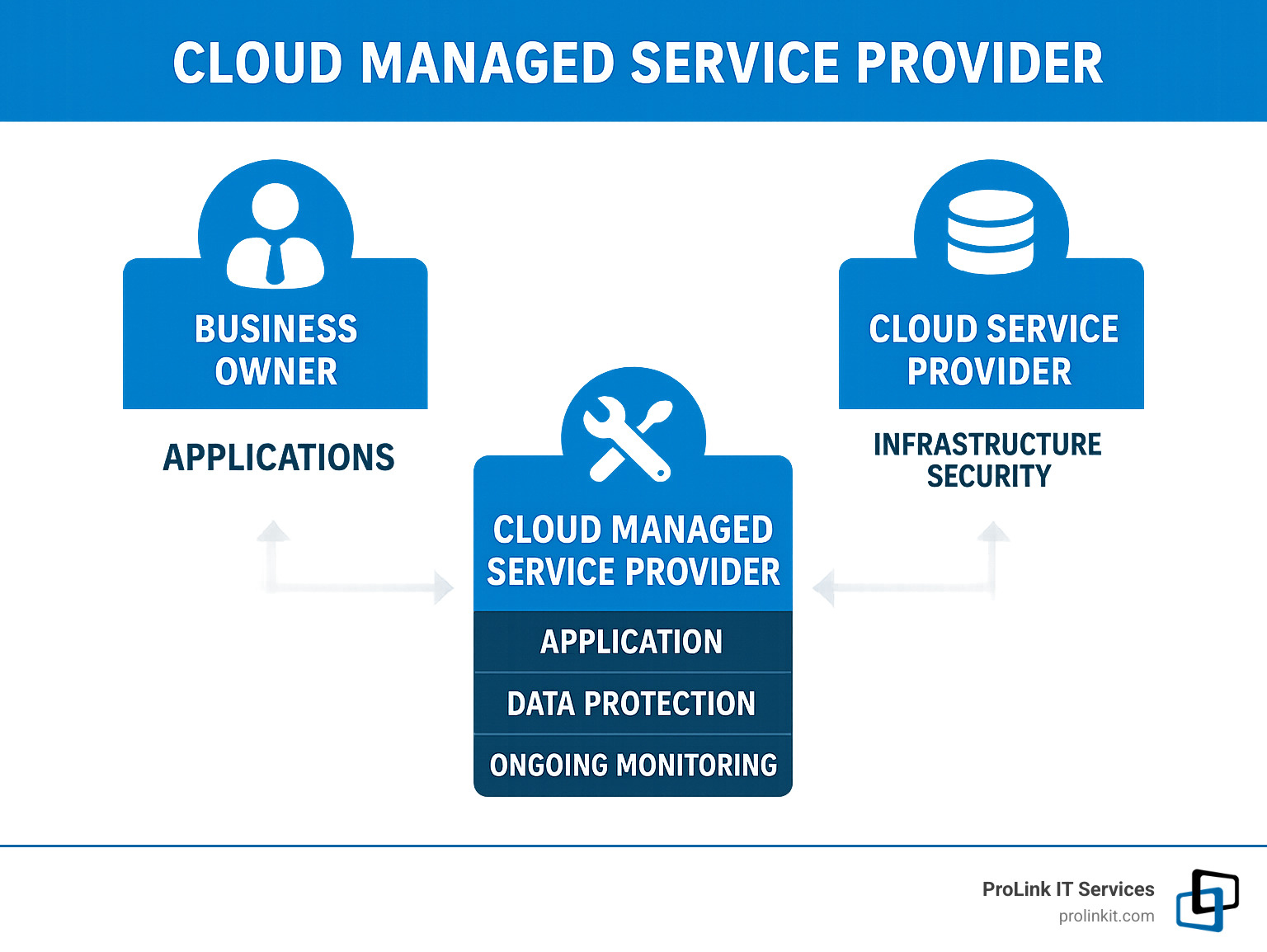
A crucial distinction exists between a Cloud Service Provider (CSP) like AWS or Azure and an MCSP. A CSP provides the raw infrastructure (like an electric utility), while an MCSP is the expert contractor who designs, maintains, and ensures your systems run efficiently and safely on that infrastructure.
Whether you need to replace or supplement your in-house IT team, an MCSP offers the flexibility to adapt to your needs, providing enterprise-level expertise without the enterprise-level budget. If you’re ready to explore how cloud services can boost your productivity, Explore Top Cloud Services to Boost Productivity.
The Role of a Managed Cloud Service Provider (MCSP)
An MCSP’s primary role is to handle technical complexities so you can focus on business growth. They act as your cloud navigators, ensuring your digital assets run smoothly.
Their responsibilities include:
- Day-to-day Operations: They manage and monitor system health, user access, and performance, making continuous adjustments to keep your business running optimally.
- Migration and Optimization: They guide your move to the cloud and continuously fine-tune resources to reduce costs, improve performance, and align with your business goals.
- Security and Support: They implement robust security measures, provide 24/7 monitoring, and offer disaster recovery support. This round-the-clock expert help is a core part of their service, providing increased data protection and proactive problem-solving.
By handling engineering, operations, and implementation, your MCSP frees your internal teams to focus on strategic initiatives. For support that can lift your company’s success, consider partnering with an experienced provider for Reliable Business IT Support.
The Core Benefits: Why Partner with a Cloud Managed Service Provider?
Partnering with a cloud managed service provider is a game-changer that allows you to focus on your business, not your servers.

Here’s a breakdown of the key advantages:
-
Reduced Costs & Predictable Spending: Avoid massive upfront infrastructure costs and replace unpredictable IT expenses with a flat monthly fee. This makes budgeting easier and directs your capital toward growth, not maintenance.
-
Access to Expertise: Instantly gain a team of certified cloud experts in areas like data analytics, AI/ML, and advanced security without the high cost of hiring. Research shows MSPs help Google Cloud customers accelerate modernization up to 4x faster.
-
Improved Security & Compliance: Benefit from professional-grade threat detection, 24/7 monitoring, and robust data protection. MCSPs help you steer complex compliance requirements like HIPAA or PCI DSS, protecting your business from regulatory issues.
-
Business Continuity & Scalability: Dramatically reduce the risk of downtime with proactive monitoring and disaster recovery plans. As your business grows, your cloud resources can scale seamlessly without over-provisioning.
-
Focus on Innovation: When your team isn’t putting out IT fires, they can focus on core business functions like product development and strategic planning. This agility allows for a faster time-to-market, giving you a competitive edge.
With 24/7 proactive support, issues are often fixed before you’re even aware of them, ensuring your business keeps running and you have peace of mind. For a deeper dive into these advantages, check out the Top Benefits of Using Managed IT Services for Your Business. The trend toward outsourced IT is growing, and you can read more about Why Businesses Are Turning to Outsourced IT Support in 2025.
A Spectrum of Expertise: Services Offered by MCSPs
Partnering with a cloud managed service provider gives you access to a comprehensive suite of specialized services. Instead of hiring multiple specialists, you get an integrated team that handles everything from high-level strategy to detailed implementation.
An MCSP can develop an outcome-driven cloud strategy, manage the entire migration process, and provide ongoing management. Core services often include:
- Infrastructure Management: Covering IaaS, PaaS, serverless, and containers.
- Application Management: Support for databases and enterprise applications.
- DevOps Support: CI/CD pipelines and automation.
- Cost Optimization: Continuous analysis to keep spending in check.
- Advanced Services: Data analytics, AI/ML integration, SD-WAN, Microsoft 365 Management, Disaster Recovery as a Service (DRaaS), and Backup as a Service (BaaS).
Core Infrastructure and Network Management
Your MCSP acts as the architect and caretaker of your digital foundation. They manage IaaS environments by right-sizing virtual machines and storage, and for PaaS management, they handle the underlying platform so your developers can focus on coding. They also ensure modern architectures like serverless computing and container management run smoothly. Through continuous performance monitoring and expert network configuration, they ensure your data flows securely and efficiently, preventing bottlenecks before they impact users. For businesses looking to strengthen their network foundation, professional Network Management services can make all the difference.
Security and Disaster Recovery
An MCSP is your frontline defense against evolving cyber threats.

They provide 24/7 threat detection and response, using advanced tools to neutralize dangers immediately. Proactive vulnerability management patches security holes before they can be exploited. Your sensitive information is protected with data encryption, both at rest and in transit. MCSPs also help with compliance audits for regulations like SOC 2, HIPAA, and PCI DSS. Crucially, their backup and recovery services provide a safety net, ensuring your business can survive any disaster. For comprehensive protection, explore Managed Security Services. To understand the importance of backups, read How Data Backup Services Can Save Your Business From Disaster.
Weighing Your Options: Advantages and Disadvantages
Partnering with a cloud managed service provider is a major business decision with both compelling advantages and potential challenges to consider.
The primary advantages include:
- Specialized Expertise: Access to certified professionals in AWS, Azure, and Google Cloud.
- Predictable Costs: A stable monthly fee replaces surprise IT bills, optimizing your cloud spending.
- Effortless Scalability: Quickly scale resources up or down to meet project demands.
- Improved Security: Benefit from 24/7 monitoring and deep compliance expertise.
Potential disadvantages to manage include:
- Loss of Direct Control: Handing over critical infrastructure can be a concern.
- Vendor Lock-in: Contracts can sometimes make it difficult to switch providers.
- Hidden Costs: Unclear pricing models can lead to unexpected fees.
Maximizing the Pros and Mitigating the Cons
The key to a successful partnership is a strategic approach.
To maximize benefits, focus on clear communication of your business goals and establish defined SLAs that outline performance metrics and response times. Treat your MCSP as a strategic partner, not just a vendor. At ProLink IT Services, our veteran-owned approach emphasizes this discipline and integrity, ensuring our services align with your growth goals.
To mitigate risks, conduct a thorough vetting process. Ask for proof of their expertise and experience with businesses like yours. Demand transparent pricing and carefully review contracts, paying attention to termination clauses and data ownership. Inquire about their security practices, certifications like SOC 2, and how they handle multi-tenancy risks. Understanding their approach upfront prevents most potential issues.
Selecting Your Ideal Partner: Key Factors for Choosing an MCSP
Choosing the right cloud managed service provider is a critical strategic decision. You’re not just hiring an IT vendor; you’re selecting a partner who will have access to your most vital systems and data.

Focus your evaluation on these key areas to find a partner who aligns with your business goals. The roles and responsibilities of MSPs are changing, so a thorough evaluation is crucial. MSP roles and responsibilities are undergoing rapid change — here’s why.
Evaluating Expertise, Security, and Reliability
When assessing a potential MCSP, dig deeper than the sales pitch:
-
Technical Expertise & Experience: Look for extensive team certifications for platforms like AWS, Azure, and Google Cloud. Ask for case studies and customer testimonials relevant to your industry and challenges. A quality provider will often perform a technical assessment, demonstrating their structured approach. For expert guidance, consider our Expert IT Consultancy Services for Optimal Business Solutions.
-
Security & Compliance: Security is non-negotiable. Inquire about their specific security measures, especially in multi-tenant environments. SOC 2 compliance is a baseline requirement. If you handle sensitive data, ensure they have expertise in HIPAA or PCI DSS and can provide a Business Associate Agreement (BAA). Ask about their data encryption and protection policies.
-
SLAs & Transparency: A strong Service Level Agreement (SLA) is the foundation of a reliable partnership. It should clearly define guaranteed uptime (typically 99.9%+), response time metrics for different issue severities, and remedies for non-compliance. Vague SLAs are a red flag. The provider should be transparent in their reporting and communication, so you’re never left wondering about the status of your systems.
Understanding Operations and Costs: How MCSPs Work
Partnering with a cloud managed service provider means shifting from a reactive “break/fix” model to a proactive management approach. The process is designed to keep your systems running smoothly before problems surface.
The journey begins with an initial assessment of your current IT environment and business goals. This is followed by a structured onboarding process to transition your IT management to their systems, which may include detailed migration planning.
Once onboarded, MCSPs use sophisticated tools to manage your environment. RMM (Remote Monitoring and Management) tools provide 24/7 oversight, often catching issues before you’re aware of them. PSA (Professional Services Automation) applications help them manage projects, billing, and internal operations efficiently. You’ll receive regular reporting and analytics for clear insights into system performance, security, and spending.
This entire operation is based on continuous improvement, with your provider constantly seeking ways to optimize your environment. Financially, most MCSPs use a Monthly Recurring Revenue (MRR) model, where you pay a predictable fee for a defined set of services, eliminating surprise IT costs.
Common pricing models for a cloud managed service provider
Understanding pricing models helps you choose the right fit for your budget. Common approaches include:
- Per-device pricing: A flat fee for each managed desktop, server, or network device.
- Per-user pricing: A flat fee for each person supported, regardless of their number of devices.
- Tiered pricing: Service packages (e.g., Bronze, Silver, Gold) with different levels of support and features.
- All-inclusive pricing: One flat fee covering all IT services and support for maximum budget predictability.
- Monitoring-only pricing: A budget-friendly option where the MCSP monitors systems and alerts your internal team to issues.
The subscription model is the framework for most of these options, providing you with predictable costs. A good cloud managed service provider will help you find the approach that best suits your business.
Conclusion
Think of your business journey as navigating complex territory. A cloud managed service provider is the trusted guide who helps you steer technical obstacles, security threats, and the ever-changing digital landscape.
An MCSP transforms IT from a burden into a business advantage. By preventing problems before they happen, they offer clear benefits: cost predictability, access to expert knowledge, and 24/7 monitoring for peace of mind. Most importantly, they free your team to focus on projects that drive growth.
However, not all providers are created equal. The right partner takes the time to understand your unique business, communicates clearly, and treats your success as their own. They will have the certifications, experience, and security posture to back up their promises.
At ProLink IT Services, we build our reputation on this type of partnership. Our veteran-owned approach emphasizes discipline, integrity, and commitment. We don’t just provide a service; we join your team.
The cloud is a powerful tool for innovation. With the right partner, it doesn’t have to be complicated. Ready to experience the difference a true partnership can make? Start your cloud journey with our Cloud Managed Services.