

Cloud Infrastructure Management Explained – Because Clouds Need Structure Too
Why Cloud Infrastructure Management Services Are Critical for Modern Businesses
Cloud infrastructure management services help organizations oversee, optimize, and secure their cloud resources for maximum performance and cost-efficiency. These services typically include:
- Resource Management – Provisioning, monitoring, and optimizing cloud resources
- Cost Control – Tracking usage, right-sizing instances, and eliminating waste
- Security & Compliance – Implementing security protocols and meeting regulatory requirements
- Performance Optimization – Monitoring metrics and tuning for peak performance
- Disaster Recovery – Backup strategies and business continuity planning
As cloud environments grow, their complexity can lead to spiraling costs, security vulnerabilities, and performance bottlenecks without proper management. Consider that 88% of cloud breaches happen because of human error, and 56% of executives say legacy infrastructure maintenance hinders modernization. These are clear warning signs that expert oversight is needed.
Fortunately, organizations that accept cloud management see dramatic improvements. Companies using managed services are 82% more likely to achieve their cloud outcomes, experiencing faster innovation, better security, and significant cost savings.
As the founder and CEO of ProLink IT Services, I’ve seen how our cloud infrastructure management services turn complexity into a competitive advantage. We help businesses transition from chaotic cloud environments to well-structured, optimized systems.

Cloud infrastructure management services terms you need:
What is Cloud Infrastructure Management (CIM)?
Think of your cloud environment as a digital city. Cloud infrastructure management (CIM) is the process of acting as its mayor—overseeing, optimizing, and securing all the components to ensure everything runs smoothly, efficiently, and safely.
At its core, CIM is about making your cloud resources work smarter, not harder. Without it, a cloud environment can become a chaotic sprawl of scattered resources, spiraling costs, and security gaps. Effective CIM delivers performance optimization, seamless scalability, cost-efficiency, system reliability, and the business agility to pivot when opportunities arise.
A proactive approach prevents resource sprawl, ensures consistent configurations, and tracks usage patterns, leading to smooth application delivery and a healthier bottom line.
If you’re curious about how different cloud services can boost your overall productivity, check out our guide on exploring top cloud services to boost productivity.
The Core Components of Cloud Infrastructure
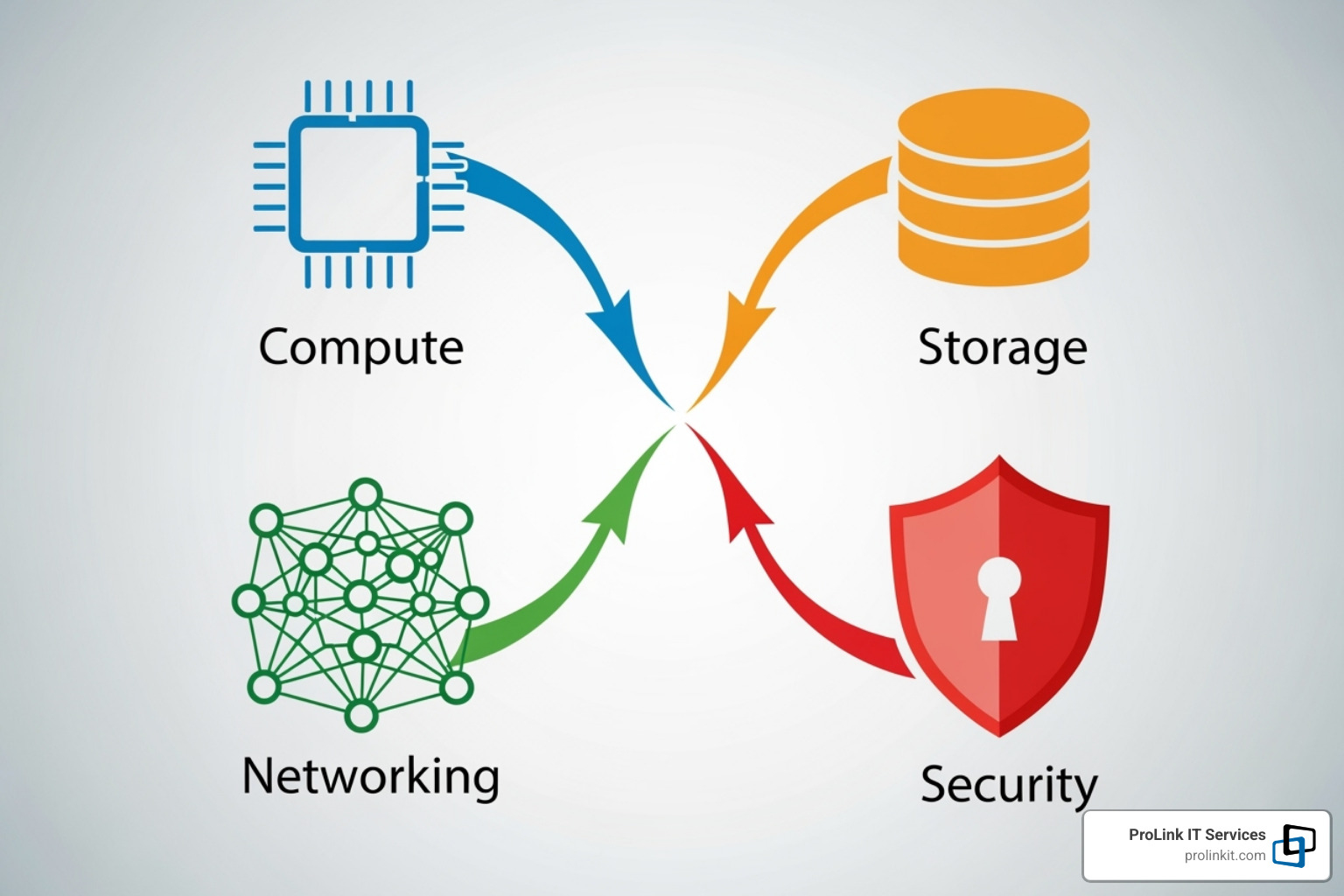
Every cloud environment is built on four fundamental pillars that must work together.
-
Compute power is the engine of your operation, processing data and running applications. Modern cloud-based compute infrastructure includes virtual machines and serverless functions that scale on demand.
-
Storage infrastructure is your infinitely expandable digital warehouse. Cloud storage infrastructure adapts to your needs, whether you’re storing files, databases, or large data lakes for analytics.
-
Networking infrastructure is the highway system connecting everything. Cloud networking infrastructure includes virtual networks, load balancers, and firewalls to ensure data flows smoothly and securely.
-
Virtualization is the technology that makes it all possible. Virtualization divides physical hardware into multiple, dynamic virtual resources, allowing for incredible flexibility.
Common Challenges & Best Practices in Cloud Infrastructure Management Services
Managing cloud infrastructure presents common challenges, but proven strategies can overcome them. Most organizations face similar problems with cost, complexity, and security.

Challenge 1: Spiraling Costs and Complexity
Unexpectedly high cloud bills are a major pain point. This is often caused by underused resources left running, complex pricing models that are hard to track, and a general lack of visibility into the environment. Integration challenges with existing systems and the burden of legacy infrastructure maintenance further complicate matters. In fact, 56% of executives say legacy maintenance hinders modernization.
Challenge 2: The Security and Compliance Maze
A staggering 88% of cloud breaches are due to human error, such as misconfigurations that expose data. Navigating regulatory compliance like HIPAA or GDPR adds another layer of difficulty, with strict rules and severe penalties. It’s also vital to understand the shared responsibility model: the cloud provider secures the cloud itself, but you are responsible for securing your data and applications within it. This is why robust Cloud Security Managed Services are a critical part of any cloud strategy.
Best Practice: Automate Everything and Implement Governance
Automation is the best defense against complexity and human error.
- Infrastructure as Code (IaC): Using tools like AWS CloudFormation or Azure Bicep, you can define and deploy infrastructure consistently every time.
- Automated Scaling and Disaster Recovery: Resources automatically scale with demand, and recovery processes kick in instantly when issues arise, minimizing downtime and cost.
- Governance: Implementing Role-Based Access Control (RBAC) ensures people only access what they need, while tagging policies provide clear visibility for cost tracking and ownership.
Best Practice: Proactive Monitoring and Performance Optimization
Continuous monitoring provides the visibility needed to spot problems before they escalate.
- Key Metrics: We track utilization, uptime, and response time to ensure you’re only paying for what you use and that applications are performing well.
- APM Tools: Tools like AWS CloudWatch and Azure Monitor offer deep insights into application performance.
- Optimization: We focus on right-sizing resources to match actual usage and perform performance tuning to maximize your cloud investment.
This proactive approach is central to our IT Infrastructure Services Salt Lake City UT, turning cloud challenges into competitive advantages.
Optimizing Costs and Maximizing ROI
Smart cloud spending is about being strategic, not just cheap. With our cloud infrastructure management services, we apply financial governance to ensure every dollar spent on the cloud delivers real value. A well-managed cloud environment should be a tuned engine, not a gas-guzzler.
Strategies for Cloud Cost Optimization
Controlling cloud costs means matching resources to actual needs. Key strategies include:
- Right-sizing instances: We analyze usage patterns to ensure you’re not paying for oversized services.
- Leveraging reserved instances: For consistent workloads, committing to reserved instances can significantly cut costs.
- Using spot instances: For flexible applications, spot instances offer access to unused capacity at a deep discount.
- Tiered storage: We move less critical “cold” data to cheaper archival storage, saving money on premium options.
- FinOps practices: This cultural shift empowers teams to make data-driven decisions about cloud usage, promoting cost-consciousness.
- Terminating unused resources: A simple but effective step is to shut down forgotten development or test environments that drain the budget.
The Key Benefits of Robust Cloud Infrastructure Management
When done right, the positive impact of cloud management is felt across the entire organization.

- Improved scalability: Systems adapt to traffic spikes or business growth without breaking the budget.
- Increased reliability and availability: Proactive monitoring and automated disaster recovery minimize downtime.
- Improved security posture: Consistent configurations and access controls create a comprehensive security system.
- Faster innovation cycles: Development teams are freed from infrastructure tasks to focus on building value.
- Better resource allocation: Cost savings from optimization can be reinvested into strategic growth initiatives.
Effective cloud management transforms your infrastructure from a cost center into a competitive advantage. Our Managed Cloud Services are designed to deliver these results.
Managing Different Cloud Environments
The cloud is not a one-size-fits-all solution. Organizations use public, private, hybrid, and multi-cloud models, each with unique management requirements. Effective cloud infrastructure management services must adapt to these nuances.
Public Cloud Management
Public clouds like AWS, Azure, and Google Cloud offer incredible services but require careful management. Key considerations include:
- Shared Responsibility Model: The provider secures the cloud, but you are responsible for securing your data and applications within it.
- Vendor Lock-in: Relying too heavily on one provider’s proprietary services can make future migrations difficult and costly.
- Latency and Availability: Smart network design and multi-region deployments are crucial for performance and uptime.
- Cost Control: Without continuous monitoring, public cloud bills can escalate quickly.
Private Cloud Management
Private clouds offer greater control but also more responsibility. Management focuses on:
- Capacity Planning: You are responsible for forecasting needs and managing hardware resources.
- Hardware Lifecycle Management: This includes purchasing, maintaining, and retiring physical servers.
- Performance Optimization: Granular control allows for fine-tuning the environment for specific workloads.
- Higher Control and Security: This model is often chosen by organizations with sensitive data or strict regulatory needs.
Our Cloud Managed Data Center Services help you steer these complexities.
Hybrid and Multi-Cloud Management
These environments combine the best of different models but introduce orchestration challenges:
- Workload Placement: Strategically deciding where applications and data should reside based on cost, performance, and security.
- Unified Security: Implementing consistent security policies and identity management across disparate environments.
- Data Egress Costs: Moving data between clouds can incur significant and often overlooked charges.
- Centralized Governance: A unified framework is essential for maintaining visibility and control across all cloud resources.
Our Cloud-Based Managed Services are designed to help you master these diverse landscapes.
The Future of Cloud Management and The Role of Managed Services
The cloud landscape is evolving rapidly, requiring a forward-thinking approach to cloud infrastructure management services. Staying ahead of these shifts is key to maintaining a competitive edge.
Future Trends in Cloud Infrastructure Management
Several key trends are reshaping cloud management:
- Artificial Intelligence (AI) and Machine Learning (ML): These technologies are becoming practical tools for predictive analytics, automated threat detection, and self-optimizing infrastructure.
- Serverless Computing: This model shifts focus from managing servers to orchestrating functions, allowing developers to concentrate purely on application logic.
- Edge Computing: Processing power is moving closer to data sources, which is critical for IoT and low-latency applications.
- Sustainability and Green Computing: Organizations are increasingly considering the environmental impact of their cloud providers, prioritizing renewable energy and efficiency.
- Increased Automation: The trend toward hyper-automation will continue to reduce manual work, minimize human error, and enable real-time optimization.
How a Cloud Managed Service Provider Can Help
Keeping up with these trends while running a business is a significant challenge. Most organizations face an expertise gap as the pace of cloud innovation outstrips internal training capabilities. A managed service provider bridges this gap.
- Expertise and 24/7 Monitoring: We provide a dedicated team of experts who live and breathe cloud technology, monitoring your environment around the clock to prevent issues.
- Cost Optimization: Our specialists stay on top of complex pricing models and new cost-saving features to ensure you get the most value from your cloud spend.
- Security Expertise: We implement the latest security protocols and threat detection methods to protect your business from evolving cyber threats.
- Strategic Focus: By offloading technical management, your team can focus on innovation and core business objectives.
Statistics show that 82% of companies achieving cloud outcomes use managed services. This highlights the value of partnership.
At ProLink IT Services, our veteran-owned approach brings discipline and integrity to your cloud environment. We act as a strategic partner to help you steer the future of cloud technology. Learn how a Cloud Managed Service Provider can prepare you for what’s next.
Frequently Asked Questions about Cloud Infrastructure Management
Here are answers to the most common questions we hear from business leaders about managing their cloud environments.
What are the key metrics to track in cloud infrastructure management?
To get a complete picture of your cloud’s health, we track several key metrics:
- Resource Utilization: Monitors how much of your allocated CPU, memory, and storage is actually being used, identifying waste.
- Cost Tracking and Attribution: Breaks down cloud spending by department, project, or application to provide clear financial visibility.
- Uptime and Availability: Measures the percentage of time your applications are accessible to users, which is critical for business continuity.
- Incident Response Time: Tracks how quickly problems are detected and resolved to minimize business impact.
These metrics help us optimize your investment in cloud infrastructure management services.
How does automation improve cloud infrastructure management?
Automation is essential for modern cloud management. It delivers several key benefits:
- Reduces Human Error: By automating manual tasks, you minimize the risk of misconfigurations, a leading cause of security breaches.
- Ensures Consistency: Infrastructure as Code (IaC) allows you to deploy resources using templates, ensuring configurations are consistent and reliable.
- Improves Efficiency: Auto-scaling adjusts resources to meet demand automatically, so you don’t pay for idle capacity or suffer from performance slowdowns.
- Increases Speed: Provisioning and deployment of new environments can be done in minutes instead of days, accelerating innovation.
Who is responsible for security in the cloud?
This is governed by the shared responsibility model, a concept that is crucial to understand.
- The Cloud Provider’s Responsibility: The provider is responsible for the security of the cloud. This includes the physical security of data centers, the hardware, and the foundational networking and compute services.
- Your Responsibility: As the customer, you are responsible for security in the cloud. This includes securing your data, managing user access, configuring applications and firewalls correctly, and patching operating systems.
Many organizations struggle to manage their side of this responsibility. Our cloud infrastructure management services ensure your security posture is robust, with proper configurations and ongoing monitoring to keep your business protected.
Conclusion
Effective cloud infrastructure management services are essential for modern business growth. Without a structured approach, the cloud’s promise of agility and cost-efficiency can devolve into complexity, unexpected costs, and security risks.
A well-managed cloud environment is the backbone of a modern business, enabling your teams to stop fighting fires and start innovating. A structured approach turns cloud potential into business reality, freeing your IT team to focus on creating competitive advantages instead of getting bogged down in maintenance.
At ProLink IT Services, we understand these challenges. As a veteran-owned company in West Jordan, UT, we apply discipline, integrity, and a partnership-focused approach to every client relationship. We don’t just manage your cloud; we simplify your journey and turn complexity into a competitive edge.
The cloud should propel your business forward, not drain your resources. Ready to make that happen?
Take control of your cloud environment with our Managed Cloud Services and find what’s possible when your cloud works as hard as you do.