

Cloud Data Management Explained – Because Data Shouldn’t Live in the Wild
Why Your Business Data Needs Professional Management
Cloud data management services are specialized solutions that help businesses store, organize, protect, and analyze their data using cloud computing infrastructure and services. These services leverage cloud-based technologies to manage data throughout its entire lifecycle – from creation and storage to processing and eventual disposal.
What cloud data management services include:
- Data storage and organization – Scalable cloud storage with automated classification
- Data security and governance – Access controls, encryption, and compliance management
- Data integration and migration – Moving data between systems and creating unified views
- Backup and disaster recovery – Automated protection against data loss and system failures
- Analytics and business intelligence – Tools to extract insights from your data
Your data is growing exponentially. Traditional storage systems are failing to keep up with today’s needs for scalability, better cost control, and flexible access options. Companies that empower employees to consistently use data as a basis for decision-making are nearly twice as likely to reach their data and analytics objectives.
The shift from managing data in physical servers to cloud-based solutions isn’t just about technology – it’s about business survival. When your data lives “in the wild” without proper management, you risk security breaches, compliance failures, and missed opportunities for growth.
As Mitch Johnson, founder of ProLink IT Services with over 20 years in the technology sector, I’ve helped countless businesses transform their data chaos into strategic assets through comprehensive cloud data management services. My experience has shown that the right cloud data management approach doesn’t just protect your data – it turns it into your competitive advantage.
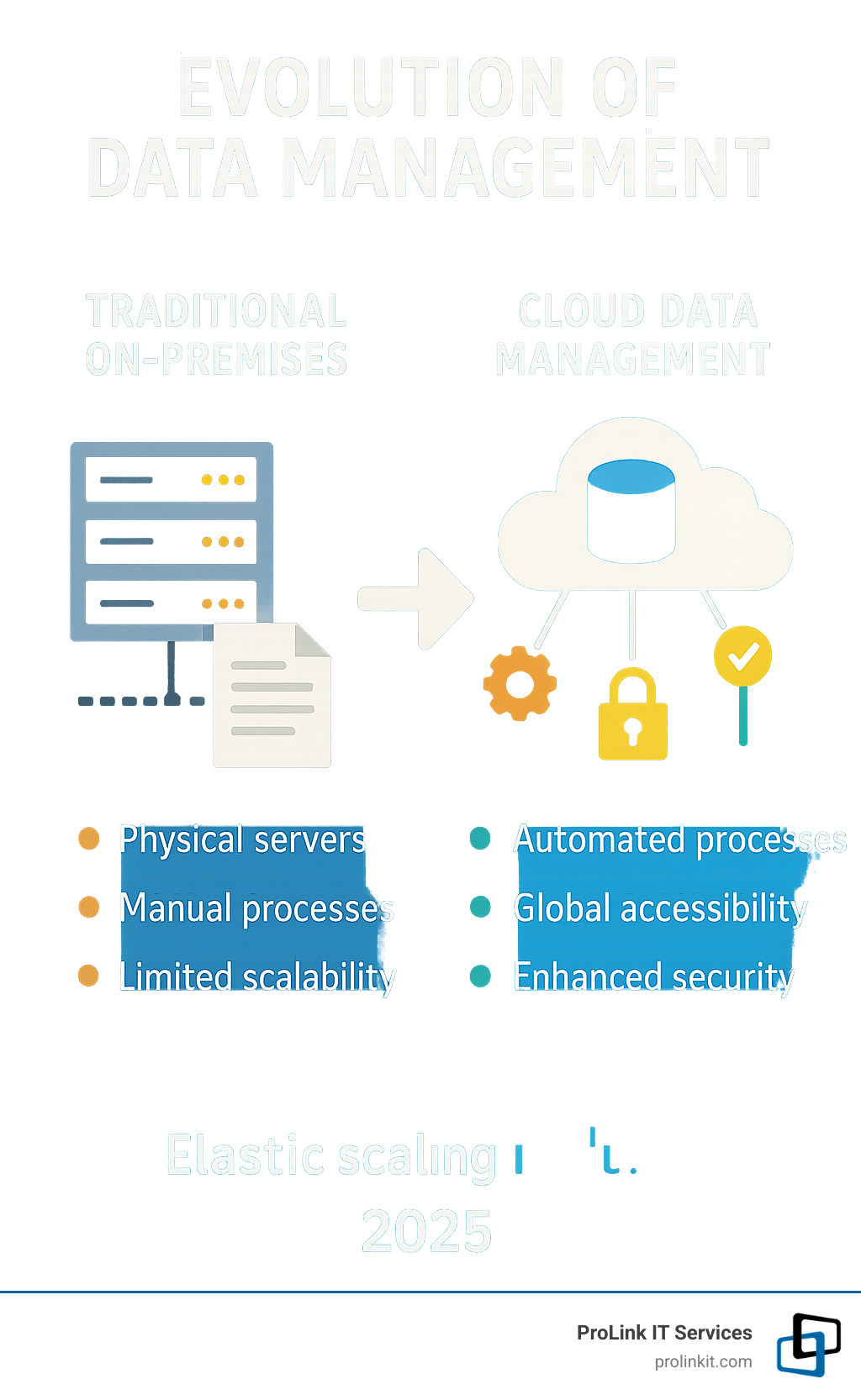
Simple guide to cloud data management services:
What is Cloud Data Management and Why Is It Crucial?
Picture your business data as a busy city where each department lives in its own isolated neighborhood. These data silos create walls between teams, making it nearly impossible to share information or see the bigger picture. This fragmentation hinders successful digital change and makes achieving true business agility an uphill battle.
Cloud data management services act as master planners for your data, tearing down those walls and building efficient highways that connect every department. Suddenly, everyone has access to the information they need, when they need it.
Companies that empower employees to consistently use data as the foundation for their decisions are nearly twice as likely to hit their analytics goals. When your data flows freely and securely, data-driven decision making becomes second nature, and teams start making moves based on real insights. The result is operational efficiency that moves the needle on your bottom line.
The Importance of Cloud Data Management Services for Modern Business
Modern businesses need the advantages that cloud data management services deliver.
Scalability and elasticity mean you can grow without hitting walls. With cloud solutions, you can instantly add terabytes or even petabytes of capacity as needed, like a storage unit that magically expands.
Global accessibility is essential. Your team in West Jordan needs the same real-time data as your remote workers. Cloud data management makes this seamless—authorized users can access what they need from anywhere with an internet connection. For more ways to boost your team’s productivity, Explore Top Cloud Services to Boost Productivity.
The cost savings are significant. Traditional systems demand huge upfront capital expenditure (CapEx). Cloud solutions flip this to operational expenditure (OpEx) with pay-as-you-go pricing. Some companies report 84% savings on annual data management costs after making the switch.
Improved security is a key benefit. Cloud providers invest millions in security infrastructure that most businesses could never afford in-house, including advanced encryption and round-the-clock monitoring. A striking 94% of cloud adopters report security improvements after their migration.
Disaster recovery becomes simple. Cloud data management automatically replicates your data across multiple geographic locations, so you can bounce back quickly from almost any disruption.
Cloud vs. Traditional Data Management
Traditional on-premises limitations create real headaches, from hardware dependency to time-consuming manual updates. When equipment breaks or you need more storage, your team must scramble to buy, install, and configure new hardware.
Cloud-native architecture changes everything. The pay-as-you-go model means you only pay for what you use, while automated processes handle routine tasks like backups, updates, and scaling without human intervention.
| Feature | Traditional Data Management (On-Premises) | Cloud Data Management Services |
|---|---|---|
| Scalability | Limited, requires hardware upgrades, often slow and costly | Highly elastic, scales up/down instantly on demand |
| Cost | High CapEx (hardware, software), ongoing OpEx (power, cooling, maintenance) | OpEx (pay-as-you-go), lower upfront investment, reduced maintenance |
| Security | Dependent on in-house expertise and budget, limited physical security | Advanced, multi-layered security from providers, compliance certifications |
| Accessibility | Restricted to network access, challenging for remote teams | Global, accessible from anywhere with internet access |
| Maintenance | High, manual updates, patching, hardware repair | Low, automated by cloud provider, less burden on IT staff |
| Disaster Recovery | Complex, expensive, requires dedicated infrastructure and planning | Simplified, often built-in, replicated across regions |
The bottom line? Cloud data management services give you the modern infrastructure you need to turn your data from a storage problem into a competitive advantage.
Core Capabilities of Cloud Data Management Services
Effective cloud data management services create a unified, intelligent system for your data. This provides a single view across your organization, which is crucial for managing the entire data lifecycle and supporting multi-cloud environments.
Data Integration and Quality
Data integration brings together disparate data sources, including on-premises databases, SaaS platforms, and streaming data. To prepare this information, ETL (Extract, Transform, Load) and ELT (Extract, Load, Transform) processes are used. ETL transforms data before loading it into a destination, while ELT loads raw data first and then transforms it within the target system.
Since raw data is rarely perfect, data cleansing is essential to remove errors and inconsistencies. Furthermore, Master Data Management (MDM) establishes a “single source of truth” for critical business entities like customers or products. By breaking down data silos and creating this unified view, you eliminate confusion and improve decision-making.
Data Security and Governance
In the cloud, data security is paramount. Our approach ensures your data is secure at every stage:
- Access Controls: Strict role-based access controls (RBAC) ensure only authorized personnel can view or modify specific data.
- Encryption in-transit and at-rest: Data is encrypted as it moves across networks and when stored, safeguarding it from unauthorized access.
- Compliance (GDPR, HIPAA): We help you steer complex data regulations like GDPR, HIPAA, and CCPA, leveraging provider tools and certifications while ensuring proper policy enforcement.
- Data Masking: For testing or analytics, sensitive information is replaced with fictional but realistic data to protect privacy.
- Auditing and Monitoring: Continuous auditing and monitoring provide visibility into data access, helping detect and respond to potential threats in real-time.
For a deeper dive into protecting your cloud assets, consider our specialized Cloud Security Managed Services.
Backup, Archiving, and Disaster Recovery
Redundancy and recovery are critical. Our comprehensive strategy includes:
- Automated Backups: Regular, automated backups consistently create secure copies of your data, reducing human error.
- Immutable Storage: This feature creates data copies that cannot be altered or deleted, providing robust protection against ransomware and accidental deletions.
- Data Retention Policies: We help define and implement clear policies to ensure data is kept for the required duration and then securely disposed of.
- Ransomware Protection: Our strategies involve air-gapped copies—data separated from unsecured networks—to further isolate critical information from cyber threats.
- Failover and Recovery Plans: In an outage, well-defined plans ensure your systems can quickly switch to a redundant environment, minimizing downtime. For example, Pfizer achieved 75% savings on cold data storage by migrating over 2PB of data to the cloud.
For robust protection of your data infrastructure, explore our Cloud Managed Data Center Services.
Key Benefits and Real-World Value

Investing in cloud data management services open ups your business’s hidden potential. By changing your data from a liability into a strategic asset, you gain improved analytics, faster time-to-value for new projects, and a real competitive advantage.
Tangible Business Outcomes
The business outcomes of switching to cloud data management are dramatic:
- Cost reduction: AT&T achieved an incredible 84% savings on their estimated annual costs by switching to a cloud data platform.
- Performance improvements: Intercontinental Exchange saw their ad hoc query performance jump by 80%, while the NYSE achieved over 50% cost savings for their regulatory reporting workload.
- Productivity gains: Pfizer saved 19,000 annual hours through optimized data processing, freeing up teams to focus on innovation and growth.
- Reduced TCO: Pfizer also achieved a 57% reduction in total cost of ownership (TCO), while Merkle reported a 64% faster data development cycle by consolidating their data.
These numbers represent real businesses becoming more agile, profitable, and competitive.
Common Use Cases
Cloud data management services are versatile, solving problems across every department.
- Big data analytics: Manage massive datasets to uncover trends and patterns that drive smart strategic decisions.
- Centralized data warehousing: Bring scattered information into one scalable repository for straightforward business intelligence and reporting.
- Regulatory compliance reporting: Organize data to make gathering information for industry and government regulations a routine process.
- Application development and testing: Provide development teams with scalable, on-demand environments to accelerate innovation.
- AI and machine learning model training: Provide the vast, organized data needed for AI/ML. For example, Siemens Energy made over 800,000 pages searchable through a chatbot powered by their cloud data platform and AI.
For broader solutions that can transform your entire business operations, explore our Cloud-Based Managed Services.
Implementing a Winning Cloud Data Management Strategy

Implementing cloud data management services requires strategic planning, a phased migration approach, and a commitment to continuous optimization. A successful strategy unfolds in stages, allowing your team to adapt and your systems to stabilize at each step.
Best Practices for Implementation
Following a proven roadmap that addresses both technical and human factors is key to success.
- Start with a clear plan: Define the specific business problems you aim to solve, such as improving disaster recovery, speeding up analytics, or lowering costs.
- Define data governance policies early: Establish clear rules for data access, retention, and protection to prevent chaos and ensure clarity.
- Prioritize data security: Implement strong access controls, encryption, and continuous monitoring. Security is a shared responsibility between you and your provider.
- Automate where possible: Use cloud automation for backups, quality checks, and maintenance to reduce human error and free up your team for strategic work.
- Ensure data quality: Implement checks to prevent bad data from entering your system and continuously monitor its quality.
- Train your team: Ensure employees understand the new systems and processes, and foster collaboration between business and technical teams.
Choosing the Right Cloud Data Management Services
Selecting the right provider is a critical decision. At ProLink IT Services, our veteran-owned foundation means we approach every relationship with discipline and integrity.
- Assessing your business needs: Analyze your data types, growth rate, performance needs, and compliance requirements.
- Evaluating provider capabilities: Look for comprehensive services (integration, security, governance, backup, analytics) and flexible deployment options (public, private, hybrid).
- Understanding pricing models: Seek transparency in pricing for storage, data transfer, and compute resources to avoid surprises.
- Checking for compliance certifications: Ensure the provider holds necessary certifications like HIPAA, PCI DSS, or GDPR if you’re in a regulated industry.
- Scalability and performance requirements: Choose a solution that can handle your future growth, not just today’s challenges.
When you’re ready to explore your options, we’re here to guide you. Learn more about how we can serve as your trusted Cloud Managed Service Provider.
The Role of AI and Automation
AI and automation make cloud data management smarter and more reliable. As the experts at OpenText point out, “Information management powers trust and AI” – highlighting how well-managed data becomes the foundation for intelligent systems.
- Automated data findy: AI algorithms scan and classify vast amounts of information, identifying sensitive data and relationships automatically.
- AI-driven data classification: Information is automatically organized based on content and sensitivity, reducing manual effort.
- Predictive analytics: Large volumes of data are processed to identify trends and forecast future outcomes.
- Self-healing data pipelines: Errors in data flows are automatically monitored and fixed, ensuring continuous operation.
- Intelligent data tiering: Data is automatically moved to the most cost-effective storage tier based on access frequency, optimizing costs.
These AI-powered features work behind the scenes to make your entire data management system more efficient and self-managing.
Frequently Asked Questions about Cloud Data Management
Moving your most valuable asset—your data—to the cloud is a big decision. Here are answers to the most common questions we hear from clients.
How does cloud data management improve security?
An overwhelming 94% of businesses report security improvements after moving to the cloud. This is because major cloud providers invest billions in cybersecurity, offering enterprise-grade security that most companies can’t build in-house.
Centralized control provides a single dashboard to monitor all data, making it easier to spot issues. Automated patching and updates protect against the latest threats without burdening your IT team, while 24/7 security monitoring watches for unusual activity. Furthermore, providers’ existing certifications for regulations like GDPR and HIPAA simplify compliance.
What is the difference between a data lake and a data warehouse in the cloud?
Think of them as different storage systems for your data. A data lake is like a vast reservoir that stores huge amounts of raw, unstructured data in its native format. It’s ideal for data exploration and feeding machine learning models that need raw material.
A data warehouse, on the other hand, stores structured, processed data. It’s cleaned and organized, making it optimized for fast, specific business queries, like sales reports.
Modern lakehouse architecture combines both concepts, giving you the flexibility of a data lake with the speed and reliability of a data warehouse.
How much does cloud data management cost?
The cost depends on your specific needs, based on a pay-as-you-go model. Instead of large upfront hardware costs, you pay monthly only for what you actually use.
Key factors affecting your bill include the amount of data stored, data transfer volume, and the computing power used for analysis. Different storage tiers also offer different price points, from high-performance storage for active data to cheaper archival storage for old records.
Companies typically see significant total cost savings (often 50-80%) compared to on-premises solutions because you eliminate costs for idle servers, maintenance, and hardware replacement. A trusted partner can help you optimize your setup to balance performance and cost-effectiveness.
Conclusion
Your business data isn’t just a collection of files sitting on servers somewhere. It’s the heartbeat of your operations, the foundation of every smart decision you make, and frankly, one of your most valuable assets. Yet too many businesses still treat their data like that messy garage you keep meaning to organize – stuffed with important things, but impossible to find what you need when you need it.
Cloud data management services change all of that. They transform your data from a source of frustration into a competitive advantage. We’ve walked through the key benefits together: the scalability that grows with your business without breaking your budget, the security that actually improves when you make the move to the cloud, and the cost-efficiency that turns expensive capital investments into predictable monthly expenses.
The companies winning in today’s market aren’t just collecting data – they’re using it strategically. They’re breaking down those frustrating silos between departments. They’re getting insights that help them serve customers better and make smarter decisions faster. The future is data-driven and firmly rooted in the cloud, and the businesses that recognize this early will have a significant head start.
Here’s what I’ve learned after two decades in this industry: the technology transition is often the easy part. The real challenge is finding a partner who understands your business and will stick with you through the entire journey. As a veteran-owned company, ProLink IT Services brings the same discipline and integrity we learned in service to every client relationship. We don’t just implement solutions and disappear – we become your trusted technology partner.
Your data deserves better than living in chaos. It deserves a strategy that turns every byte into business value. Take control of your data with our expert Cloud Managed Services and let’s work together to build a data management approach that doesn’t just solve today’s problems, but positions your business for tomorrow’s opportunities.