

Why Managed Cloud Computing Services Are Worth Every Penny
Why Cloud Computing Managed Services Are Essential for Modern Business
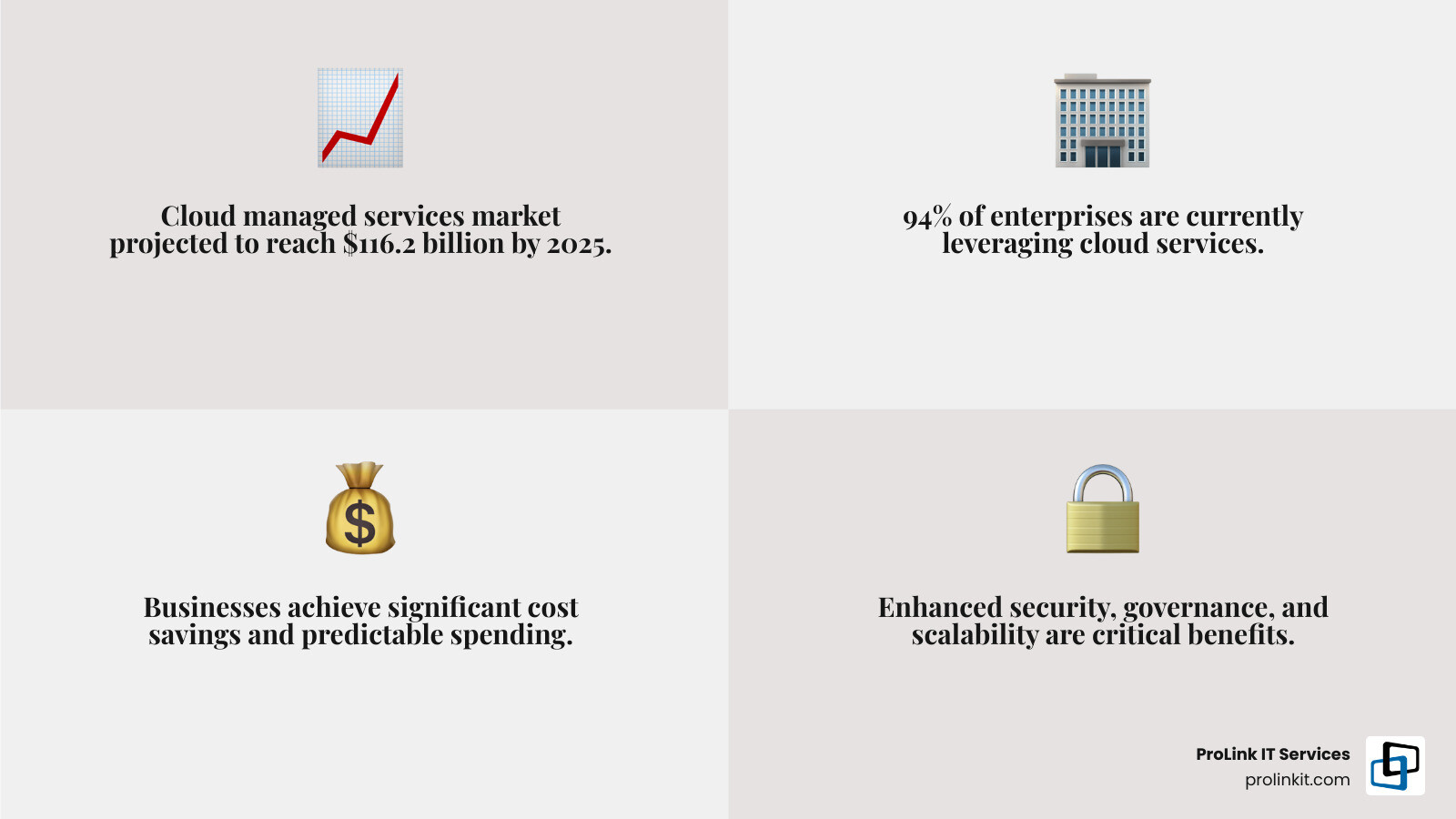
Cloud computing managed services have become the backbone of successful businesses, with the market projected to reach $116.2 billion by 2025. But what exactly are these services, and why are 94% of enterprises already leveraging them?
Quick Answer: What Are Cloud Computing Managed Services?
- Definition: Third-party management of your cloud infrastructure, applications, and operations.
- Core Services: 24/7 monitoring, security, backup/disaster recovery, and help desk support.
- Key Benefits: Cost savings, improved security, scalability, and business continuity.
- Main Goal: Free your internal team to focus on core business growth instead of IT maintenance.
The reality is that managing cloud infrastructure is complex and costly. Between security threats, compliance, and the need for 24/7 monitoring, most businesses struggle to keep up. IT teams get stuck in maintenance mode instead of driving innovation.
This is where managed services transform everything. Instead of your team wrestling with patches and troubleshooting, you get experienced professionals handling these critical tasks while you focus on growing your business.
As Mitch Johnson, Founder and CEO of ProLink IT Services with over 20 years in the technology sector, I’ve seen how cloud computing managed services revolutionize operations by providing the expertise and support small and medium-sized businesses need. The right managed services partnership doesn’t just solve IT problems—it becomes a catalyst for growth and competitive advantage.
Cloud computing managed services vocabulary:
What Exactly Are Cloud Managed Services?
Imagine having a team of cloud experts working around the clock to keep your business running smoothly—without the headache of hiring, training, or managing them yourself. That’s what cloud computing managed services deliver.
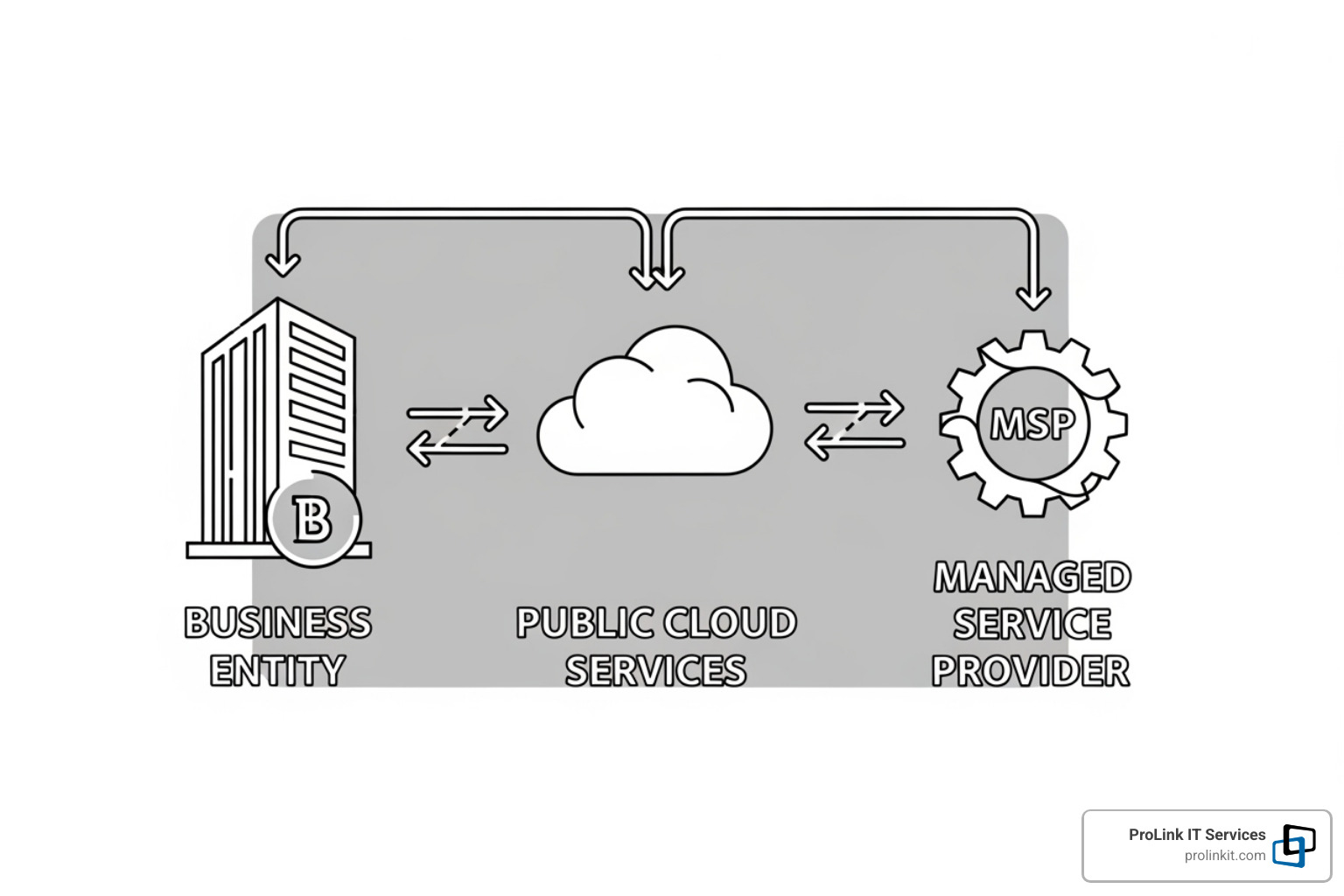
Simply put, these services involve partnering with a specialized provider who takes care of your cloud environment so you can focus on running your business. It’s like having a pit crew for your IT infrastructure; they handle technical maintenance and optimization while you stay focused on the race.
This approach is a game-changer compared to traditional IT. Instead of your internal team needing to be experts in everything, cloud computing managed services bring in specialists who live and breathe cloud technology. The result? Your team can finally step out of firefighting mode and start driving real business innovation.
The Core Concept: Outsourcing Cloud Management
With cloud computing managed services, you choose how much or how little you want to hand over to the experts. Some businesses opt for complete management, where the provider handles everything. Others prefer a partial approach, keeping certain tasks in-house while outsourcing complex work that requires specialized expertise.
Either way, you’re freeing up internal resources for projects that move the needle. Instead of troubleshooting server issues, your IT team can focus on strategic initiatives that give you a competitive edge. This strategic partnership approach transforms IT from a cost center into a growth enabler, with your provider acting as an extension of your team.
More info about Managed IT Services
More info about IT Outsourcing Utah
What’s Included? A Look at Typical IT Tasks
A cloud computing managed services provider handles the critical but time-consuming tasks that keep your cloud environment humming:
- Infrastructure Monitoring: 24/7 surveillance to catch issues before they become problems.
- Round-the-Clock Help Desk Support: Immediate assistance for your team, from password resets to complex technical issues.
- Security Operations: Dedicated experts protect your data with threat detection, vulnerability management, and incident response.
- Backup and Disaster Recovery: Automated backups and tested recovery plans ensure business continuity.
- Performance Optimization: Continuous fine-tuning of resources to manage costs and keep applications running at peak efficiency.
- Cloud Migration and Network Management: Support for moving to the cloud and ensuring seamless connectivity.
- Patch Management: Keeps all systems secure and up-to-date without disrupting your operations.
These tasks, which used to consume your team’s time, are handled by specialists who do this work all day, every day.
More info about Cloud Managed Data Center Services
Fully Managed vs. Partially Managed: What’s the Difference?
When it comes to cloud computing managed services, you have two main paths. The right choice depends on your specific situation and comfort level.
Fully managed services are like having a complete IT department working for you. The provider takes comprehensive responsibility for your entire cloud environment, shifting your internal team from hands-on work to strategic oversight. This is ideal for businesses with limited IT resources or those wanting to focus completely on their core operations.
Partially managed services (or co-managed) offer a more collaborative approach. You retain control over certain areas while outsourcing specific tasks where you need expert help, like infrastructure monitoring and security. This gives you the best of both worlds: external expertise where you need it most, plus control over key areas.
| Feature | Fully Managed Services | Partially Managed Services (Co-Managed) |
|---|---|---|
| Control | Provider handles most/all aspects; less direct control for client | Shared control; client retains significant oversight |
| Responsibility | Provider bears primary responsibility for operations, uptime, security | Shared responsibility; clear delineation of tasks |
| Cost Structure | Often a predictable monthly fee for comprehensive services | Can vary based on scope; potentially lower overall cost than full |
| Internal Expertise | Minimal internal cloud expertise required; focus on strategic oversight | Internal IT team requires some cloud expertise to manage their portion |
| Ideal For | Businesses with limited IT staff, desire for complete outsourcing, rapid scaling | Organizations with existing IT teams, specific skill gaps, desire for collaboration |
| Complexity | Reduces internal complexity significantly | Reduces complexity in specific areas, but requires internal coordination |
The key is finding a provider who understands your business and recommends the approach that makes the most sense for you.
The Unbeatable Business Benefits of Cloud Computing Managed Services
When business owners hear about cloud computing managed services, they often ask about the cost. But the better question is, “What will it save me?” These services deliver real, measurable benefits that provide substantial ROI and position your company for long-term success.

Significant Cost Savings and Predictable Spending
Cloud computing managed services transform your IT spending from a source of budget surprises into a predictable, strategic investment. Instead of large capital expenditures (CapEx) on hardware, you shift to operational expenditures (OpEx) with predictable monthly fees. This frees up capital for growth-focused activities.
With managed services, you gain instant access to certified experts without the high costs of hiring and training a specialized in-house team. Furthermore, providers continuously monitor and optimize your cloud environment to right-size resources, often reducing cloud costs by 20-40%.
The numbers speak for themselves: the cloud managed services market is projected to be worth $116.2 billion by 2025, driven by these compelling financial advantages.
Improved Security, Governance, and Compliance
Cloud computing managed services provide enterprise-grade security that is difficult for most businesses to achieve alone. You get round-the-clock protection from security experts who monitor your environment, detect threats, and respond to incidents in real-time.
These specialists stay current with the latest threat landscapes and implement proactive measures like automated patch management. They also ensure robust data protection through encryption and strict access controls. For businesses in regulated industries, providers offer expertise in meeting complex compliance standards like HIPAA, SOC 2, and GDPR.
More info about Cloud Security Managed Services
Opening Up Scalability and Business Agility
Cloud computing managed services give your business the superpower of instant adaptability. Your infrastructure can scale up or down automatically to handle demand spikes or seasonal fluctuations, so you only pay for what you use. This elasticity eliminates waste and risk.
Faster deployment of new applications becomes a competitive advantage, as your teams can focus on innovation instead of infrastructure. Providers also ensure your technology stays current by implementing upgrades and best practices, allowing you to adapt quickly to market changes without IT limitations.
More info about Managed Networks
Bolstered Business Continuity and Disaster Recovery
Downtime is expensive and potentially devastating. Cloud computing managed services are designed with resilience as a core principle. Automated backups and redundant systems across geographically dispersed data centers ensure your data is always protected.
In the event of a disaster, automated failover mechanisms switch to backup resources in minutes, not hours. This rapid recovery and reduced downtime protect your revenue and reputation. Proactive monitoring and incident response create genuine business resilience, allowing your company to withstand unexpected challenges and maintain customer trust.
How to Choose the Right Cloud Managed Service Provider
Choosing the right cloud computing managed services provider means finding a strategic partner who understands your business and shares your values. This decision shapes your technology future and deserves careful research.

At ProLink IT Services, we approach every client relationship as a partnership. Our veteran-owned values of discipline and integrity guide us to build relationships on trust, communication, and a commitment to your success.
Key Factors to Evaluate in a Provider
Look beyond marketing to find the right fit. Start with expertise and experience. Does the provider have a proven track record and certifications from major cloud platforms (AWS, Azure, Google Cloud)? Also, check for industry certifications like ISO 27001 that are relevant to your business.
Your Service Level Agreement (SLA) is your guarantee. It should clearly define uptime commitments, response times, and penalties. Ensure you have transparency and control through dashboards and regular reports. Finally, check customer testimonials and references to understand their real-world performance.
Before signing, ask these essential questions: What’s included in your pricing? How do you handle emergencies? Can services scale with our growth? What security certifications do your technicians hold? Do you use proprietary tools that could create vendor lock-in?
Understanding the Role of Automation in Cloud Computing Managed Services
Automation is the engine of modern cloud computing managed services. It handles routine work so human experts can focus on strategy and complex problems.
- Automated Deployment: Configures new resources consistently, eliminating human error and enabling rapid scaling.
- Proactive Monitoring: Works 24/7 to spot performance issues, security threats, and cost anomalies before they impact users.
- Self-Healing Infrastructure: Automatically restarts failed services or reallocates resources, dramatically reducing downtime.
- DevOps Support: Enables continuous integration and deployment (CI/CD), helping your team release updates faster.
Navigating Potential Risks: Vendor Lock-in and Loss of Control
Be aware of potential pitfalls like vendor lock-in, where switching providers becomes difficult and costly. To avoid this, insist on clear contract terms with reasonable exit clauses and data portability guarantees. At ProLink IT Services, we believe in earning your business, not trapping you with restrictive contracts.
Prefer providers who use open-source tools and standard APIs for greater flexibility. To address concerns about losing control, ensure the provider offers visibility and control through comprehensive dashboards and clear communication. You should never feel like your IT is a black box. The best protection is thorough due diligence—ask hard questions and ensure you’re entering a true partnership.
Frequently Asked Questions about Managed Cloud Services
Making the leap to cloud computing managed services brings up questions. Here are answers to the most common concerns we encounter.
How do managed services impact my existing IT team’s roles?
Your IT team won’t become obsolete; they become more valuable. Cloud computing managed services free your team from routine maintenance, allowing them to shift from firefighting to strategy. Instead of patching servers and troubleshooting, they can focus on driving business value and innovation.
The relationship is collaborative, not a replacement. Your team provides insider knowledge of your operations while we handle the heavy lifting of infrastructure management. This transition often opens up skill development opportunities in cloud architecture, data analytics, and advanced security, increasing job satisfaction and value.
What’s the difference between a cloud provider (like AWS) and a cloud managed service provider?
This is a crucial distinction. Think of a cloud provider like AWS or Azure as a landlord who provides the building and utilities (the raw infrastructure). Under their shared responsibility model, they secure the cloud, but you are responsible for securing what’s in the cloud.
A cloud computing managed services provider, like ProLink IT Services, is like a full-service property manager for your space within that building. We don’t own the infrastructure, but we manage, monitor, optimize, and secure your specific environment. The cloud provider gives you the platform; we provide the expertise and ongoing management to make it work for your business.
How are costs for cloud computing managed services typically structured?
Managed services pricing is designed for transparency and predictability, moving you away from surprise IT costs. Common models include:
- Flat Monthly Fee: A consistent amount for a defined set of services, making budgeting straightforward.
- Tiered Pricing: Different levels (e.g., Bronze, Silver, Gold) with varying features and support, so you only pay for what you need.
- Consumption-Based Pricing: Costs are tied directly to your actual usage of resources like data transfer or compute time.
- Per-Device or Per-User Pricing: Simple pricing that scales with the number of devices or users supported.
- Custom Pricing: Custom solutions for complex environments based on a detailed assessment.
The goal of all these models is transparency. You should know exactly what you’re paying for, with no hidden fees.
Conclusion: Your Path to a Smarter, More Efficient Cloud
Having a cloud presence is just the starting line. Thriving companies are those that optimize, secure, and strategically manage their cloud infrastructure. This is where cloud computing managed services prove their value.
These services offer compelling cost savings by converting capital expenses into predictable operational costs. Beyond savings, you gain a massive security upgrade with 24/7 expert monitoring, the agility to scale on demand, and the peace of mind that comes with robust disaster recovery.
The numbers tell the story: 94% of enterprises are leveraging cloud services because managing the cloud internally is complex, costly, and distracts from core business goals. Partnering with a managed services provider transforms your IT team from firefighters into strategic innovators.
At ProLink IT Services, our veteran-owned foundation of discipline and integrity guides every partnership. We don’t act as just another vendor; we become a trusted extension of your team, committed to helping businesses in West Jordan, Utah, and beyond open up their cloud potential.
Your business deserves the efficiency, security, and strategic advantage that comes with expert cloud management.
Take control of your cloud infrastructure with our Managed Cloud Services