

Set It and Forget It: Automated Network Monitoring Made Easy
Why Every Business Needs Automated Network Monitoring
Automated network monitoring is a technology solution that continuously tracks your network’s health, performance, and security without constant human oversight. Instead of manual checks, automated tools proactively detect issues, send alerts, and often fix problems before they impact your business.
Quick Answer for Automated Network Monitoring Solutions:
- Real-time monitoring – Tracks network performance 24/7 without human intervention
- Proactive alerts – Notifies you of issues before they cause downtime
- Cost savings – Reduces manual labor and prevents expensive outages
- Faster resolution – Speeds up problem identification by 25-50%
- Scalable coverage – Monitors growing networks across multiple locations
The numbers tell a stark story: 91% of mid-sized and large enterprises report that a single hour of IT downtime costs them at least $300,000 per hour. Almost half say it costs them millions.
Manual network monitoring simply can’t keep up with today’s complex IT environments. When your team is constantly putting out fires, they’re not focusing on growing your business. That’s where automated solutions shine—they watch your network so you don’t have to.
Modern networks span cloud environments, remote offices, and countless connected devices. A minor fault can halt business operations or lead to missed transactions. Automated network monitoring transforms your IT approach from reactive firefighting to proactive problem prevention.
I’m Mitch Johnson, CEO of ProLink IT Services, and over my 20+ years in technology, I’ve seen how automated network monitoring transforms businesses from reactive to proactive IT management. My experience helping Utah businesses has shown that the right monitoring setup is often the difference between thriving and just surviving in today’s digital landscape.
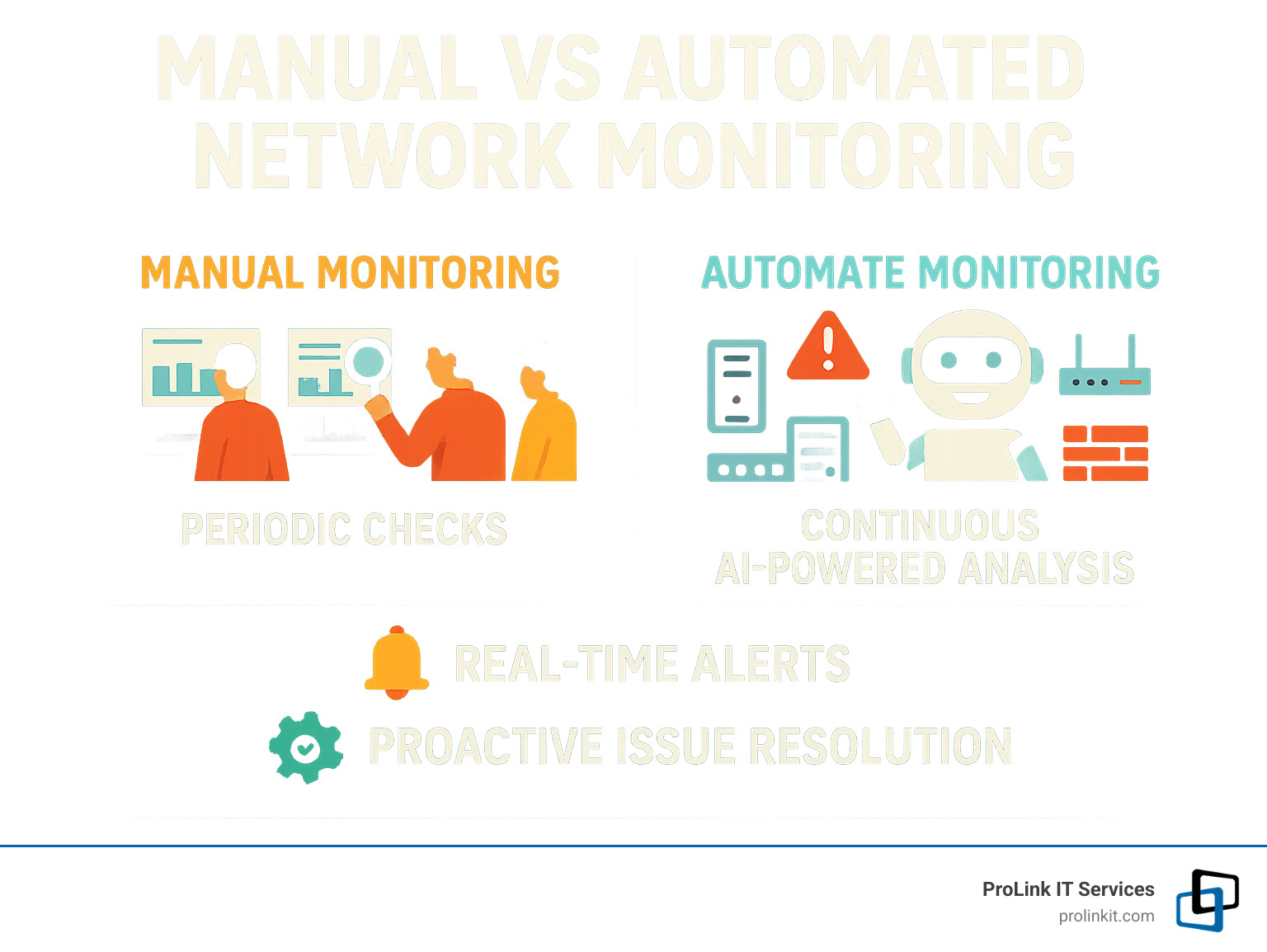
Automated network monitoring terms at a glance:
What is Automated Network Monitoring and Why is it Crucial?
Think of your network like a busy city that never sleeps. In the old days of manual monitoring, your IT team would be like security guards walking the streets with flashlights, checking each building one by one. By the time they found a problem, the damage was often done. Human error crept in when tired technicians missed critical warning signs, and slow response times meant small issues became big disasters.
Automated network monitoring changes everything. Instead of weary guards, you have a smart surveillance system watching every corner of your digital city 24/7. This technology continuously tracks the health and performance of every device, connection, and application in your network, from office routers to critical cloud servers.
The shift from reactive to proactive problem resolution isn’t just about convenience—it’s about survival in today’s business world. When your network goes down, everything stops: employees can’t access files, customers can’t place orders, and your reputation takes a hit.
Here’s the reality that keeps business owners awake at night: 91% of enterprises report downtime costs of at least $300,000 per hour. For many companies, that number climbs into the millions. These aren’t just statistics; they represent real businesses struggling with lost sales, frustrated customers, and unproductive teams.
But the benefits go beyond just preventing disasters. Automated network monitoring dramatically improves productivity by freeing your IT team from the endless cycle of manual checks and emergency fixes. Instead of fighting fires, they can focus on projects that grow your business, like improving security, planning upgrades, or implementing new technologies.
The business impact of downtime extends far beyond the immediate financial losses. Customer trust erodes when your systems fail repeatedly. Employee morale suffers when they can’t rely on their tools. Strategic initiatives get shelved because all resources go toward keeping the lights on.
This is exactly why our Managed Network Services put automated monitoring at the heart of everything we do. When you can spot and fix problems before they affect your team, you transform IT from a cost center into a true business enabler.
The Core Components of an Automated Network Monitoring System
Think of an automated network monitoring system as a smart assistant who never sleeps, takes breaks, or misses a detail. This digital assistant constantly watches your entire network, collecting information from every device, connection, and data stream.
The magic starts with network data collection. Your monitoring system gathers massive amounts of information about how your network behaves. It’s like a detailed diary of every operation across your infrastructure.
Once all this data flows in, the system establishes performance baselines. These are essentially your network’s “normal” patterns—like knowing your office network gets busy at 9 AM when everyone starts their workday, or that backup processes typically run overnight. Think of baselines as learning your network’s personality and daily rhythms.
Here’s where things get really interesting: predictive analysis. Once your system knows what “normal” looks like, it can spot when things start drifting toward “not normal.” Maybe your main server is running a bit hotter than usual, or network traffic is building up in unexpected ways. Instead of waiting for something to break, your system can flag these early warning signs.
The system also handles automatic findy—finding new stuff without you having to tell it what to look for. When someone plugs in a new printer or connects a new device, your monitoring system automatically spots it and adds it to its watchlist.
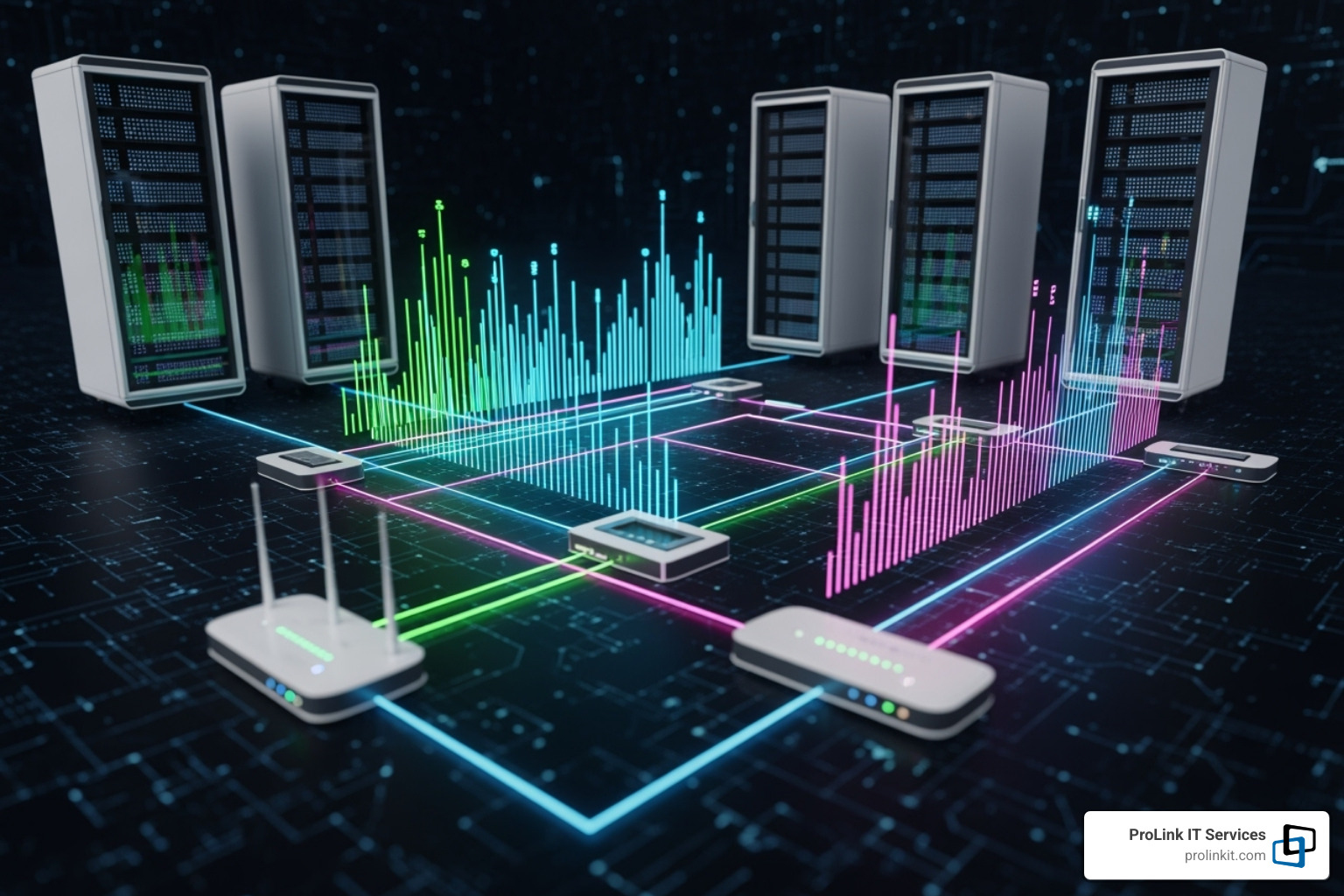
All of this information gets turned into network visualization—essentially a living, breathing map of your entire network that updates in real-time. No more outdated network diagrams gathering dust in a drawer.
Key Technologies That Power Automation
Tried-and-true technologies power this automation. SNMP (Simple Network Management Protocol) is the workhorse that does most of the heavy lifting. It’s like a universal translator that can talk to almost any network device—routers, switches, servers, you name it.
SNMP works with MIBs (Management Information Bases)—standardized filing systems that devices use to organize their status information. When something goes wrong, devices can send urgent messages called SNMP Traps directly to your monitoring system, kind of like emergency text alerts.
Flow data technologies like NetFlow and sFlow tell a different part of the story. While SNMP says “this device is working fine,” flow data reveals “here’s exactly who is talking to whom and what they’re discussing.” This gives you the inside scoop on bandwidth usage and application performance.
For the really detailed detective work, packet analysis lets you examine individual pieces of network communication. It’s like being able to read every single letter in a conversation to understand exactly what went wrong and where.
These data collection methods work together seamlessly, whether they’re using small software agents installed on devices or connecting remotely through existing protocols. The result is comprehensive visibility without adding complexity to your daily operations.
The Role of AI and Machine Learning in Automated Network Monitoring
This is where automated network monitoring gets exciting. Modern systems use artificial intelligence to learn your network’s unique personality over time. Instead of relying on rigid rules that treat every network the same, AI adapts to your specific environment.
Anomaly detection powered by machine learning means your system knows the difference between “normal busy Tuesday morning traffic” and “something suspicious is happening at 2 AM.” This intelligence dramatically cuts down on false alarms, so your team isn’t woken up for a non-crisis.
The numbers speak for themselves: AI and ML can reduce alerts by up to 60%, which means your team focuses on real issues instead of chasing false positives. Predictive analytics takes this even further, spotting trends that suggest future problems before they actually happen.
Intelligent alerting ensures that when you do get notified, it’s because something genuinely needs your attention. Instead of drowning in notifications, you get targeted alerts that help you stay ahead of problems rather than constantly reacting to them.
Network Mapping and Scalability
As your business grows, your network grows with it. New devices, new locations, new cloud services—keeping track of everything manually quickly becomes impossible. Automatic device findy solves this by continuously scanning for new additions to your network family.
Dynamic topology maps give you a bird’s-eye view that updates itself automatically. Whether you’re handling network growth across multiple offices or just trying to understand how everything connects in your main location, these visual maps make complex networks understandable at a glance.
Multi-site visibility becomes crucial when your business spans multiple locations. Your monitoring system can show you the health of networks in different cities or states, all from a single dashboard. Visualizing connections across this distributed environment helps you spot issues that might affect business operations before they impact your customers or employees.
This scalability means your monitoring solution grows with you, whether you’re adding a new office, moving services to the cloud, or integrating new technologies into your existing infrastructure.
10 Essential Features of a Modern Automated Monitoring Tool
When you’re shopping for an automated network monitoring solution, it’s easy to get overwhelmed by all the bells and whistles. Trust me, I’ve been there. After helping dozens of Utah businesses find the right fit, I’ve learned that not all features are created equal. Some are absolute must-haves, while others are nice-to-have extras that might just complicate your life.
Think of this as your roadmap to what really matters. We’ll start with the foundational features that every business needs, then move up to the more advanced capabilities that can transform how your IT team operates.
Foundational Monitoring & Findy
The first thing any good monitoring tool needs to do is find your stuff. I know that sounds obvious, but you’d be surprised how many solutions make this harder than it should be. Automatic device findy and inventory is your starting point. The system should scan your network, identify everything that’s connected – from your main servers down to that forgotten printer in the storage closet – and build a complete inventory without you lifting a finger.
Once it knows what you have, real-time performance monitoring becomes the heartbeat of your system. We’re talking about continuous tracking of the metrics that actually matter: CPU usage, memory consumption, bandwidth, latency, and uptime. Real-time means no delays, no surprises, and no “Why didn’t we know about this sooner?” moments during your Monday morning meetings.
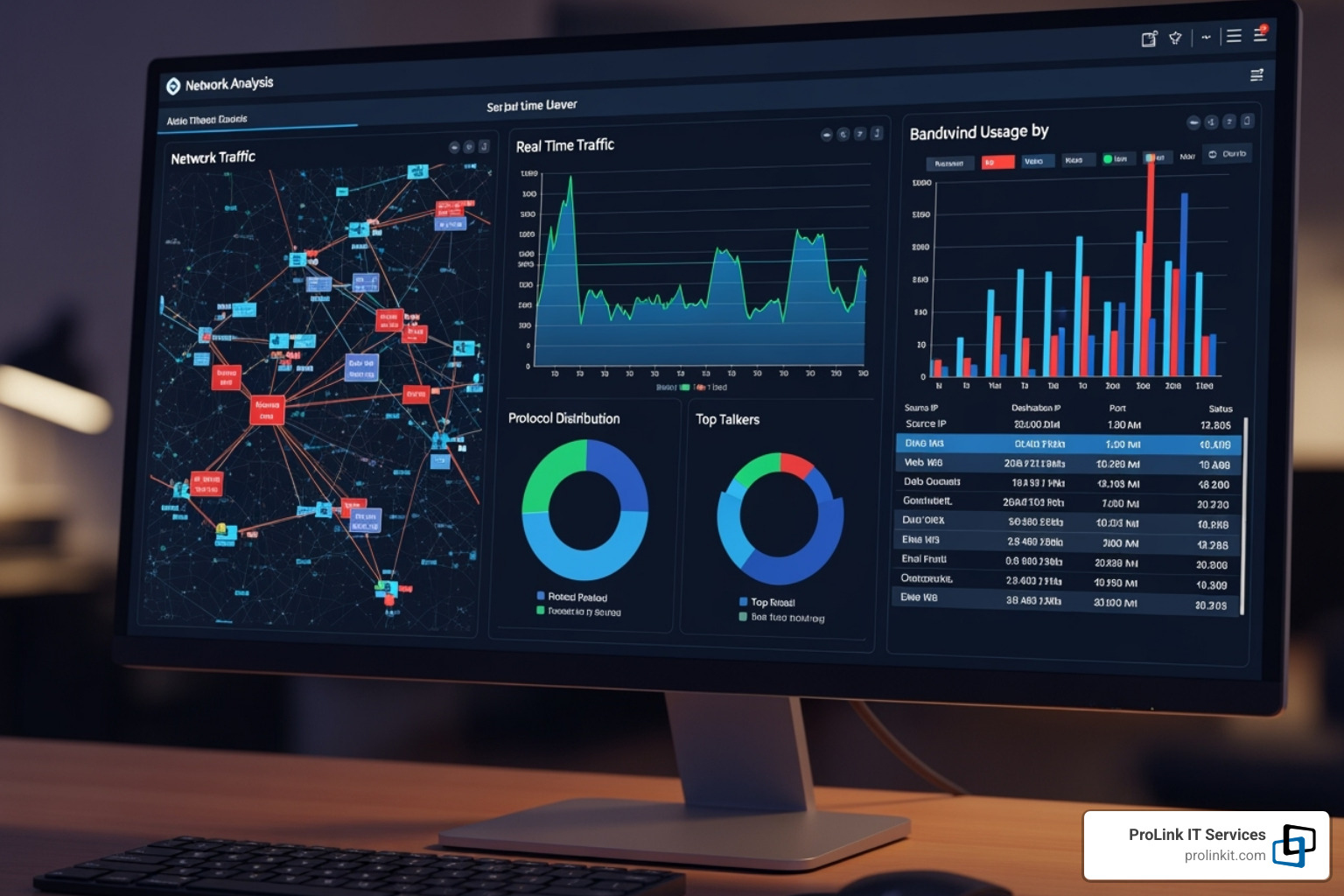
But raw data without context is just noise. That’s where dynamic network mapping and visualization comes in. Forget those static network diagrams that are outdated before the ink dries. Modern tools create live, interactive maps that show you how everything connects. Color-coded status indicators let you spot problems instantly – red usually means trouble, green means you’re good to go.
Intelligent Alerting & Reporting
Here’s where things get interesting. Customizable, threshold-based alerting might sound technical, but it’s actually pretty simple. You tell the system what “normal” looks like for your network, and it tells you when things go sideways. Set it to alert you when CPU usage hits 90% for more than five minutes, or when bandwidth usage spikes unexpectedly. The key word here is “customizable” – your network is unique, and your alerts should be too.
But even better than traditional alerting is AI-powered anomaly detection. This is where the system gets smart about your network’s personality. Instead of just watching for hard thresholds, it learns your network’s daily rhythms. It knows that traffic spikes at 9 AM when everyone logs in, but flags a similar spike at 2 AM as potentially suspicious. This approach can reduce false alarms by up to 60%, which means your team focuses on real problems instead of chasing ghosts.
All this monitoring generates a lot of data, which is why comprehensive reporting and dashboards are essential. You need dashboards that show you what’s happening right now, and reports that help with capacity planning and compliance documentation. Whether you’re planning next year’s infrastructure budget or proving to auditors that you’re meeting security standards, good reporting makes the difference between confidence and chaos.
Advanced Capabilities & Integration
Once you’ve got the basics covered, these advanced features can really set your monitoring apart. Automated configuration backup and management might not sound exciting, but it’s a lifesaver when someone accidentally misconfigures a critical router. The system automatically saves device configurations as they change, so you can quickly roll back to a working state.
Broad integration capabilities through APIs and webhooks ensure your monitoring tool plays well with others. Your network monitoring shouldn’t exist in isolation – it should connect to your ticketing system, your security tools, and whatever other systems your team relies on daily.
Modern networks are rarely simple, which is why multi-vendor and hybrid environment support matters so much. Whether you’re running Cisco switches, cloud servers, or a mix of on-premises and cloud resources, your monitoring tool should handle it all seamlessly.
Finally, don’t overlook security-oriented features. While performance monitoring is the main event, your monitoring tool is often the first line of defense against security threats. It can spot unusual traffic patterns, detect anomalies that might indicate an attack, and integrate with your broader Cybersecurity Solutions to create a comprehensive defense strategy.
The bottom line? Start with the foundational features that every business needs, then add the advanced capabilities that make sense for your specific situation. A good monitoring solution grows with your business, not against it.
Key Benefits and Potential Challenges
Let’s be honest – implementing automated network monitoring isn’t just about cool technology. It’s about changing how your business operates. After two decades in this industry, I’ve seen companies go from constant fire-fighting mode to smooth, predictable operations. But I’ve also seen implementations that didn’t go as planned. Let me share what you can realistically expect.
The Top 5 Benefits of Automation
The change starts with improved efficiency. Your IT team stops playing whack-a-mole with network issues and starts focusing on what really matters – growing your business. Instead of spending their days manually checking systems and responding to user complaints, they’re working on strategic projects that move your company forward.
Reduced downtime is where you’ll see the most dramatic impact. When your monitoring system catches a failing hard drive before it crashes, or notices unusual traffic patterns that indicate a security threat, you’re preventing disasters before they happen. It’s like having a smoke detector that also calls the fire department automatically.
The speed improvement is remarkable too. Faster MTTR (Mean Time to Resolution) means when something does go wrong, you’re not scratching your head wondering where to start. The system tells you exactly what’s happening and where. Users of automated monitoring solutions consistently report saving hundreds of hours and speeding up remediation by 25-50%. That’s the difference between a five-minute fix and a two-hour investigation.
Cost savings go far beyond preventing expensive downtime. You’re optimizing how your network uses resources, catching small problems before they require major fixes, and making smarter decisions about when to upgrade equipment. The system pays for itself, often within the first year.
Here’s something that might surprise you – improved network security comes naturally with good monitoring. When your system knows what normal looks like, it spots the abnormal quickly. That unusual spike in traffic at 3 AM? The system flags it immediately. This proactive detection works hand-in-hand with comprehensive 24/7 Protection: How Network Security Services Keep Your Data Safe to create multiple layers of defense.
Overcoming the Challenges of Automated Network Monitoring
Now, let’s talk about the real challenges you might face. Initial setup complexity is probably the biggest hurdle. This isn’t like installing a new printer – it requires careful planning, understanding your network architecture, and configuring everything properly. For complex networks, this can take weeks or even months to get right.
Alert fatigue is a sneaky problem that catches many organizations off guard. If your system isn’t configured properly, it’ll send you alerts about everything – including things that don’t really matter. Your team starts ignoring notifications, and suddenly you miss the important ones. The key is starting conservative with alerts and gradually fine-tuning them based on your actual needs.
There’s also the risk of over-reliance and complacency. Some teams install these systems and think they’re done forever. But networks evolve, new devices get added, and business requirements change. Your monitoring system needs regular attention and updates to stay effective.
Cost and licensing models can be tricky to steer. Some vendors charge per device, others per user, and still others use complex tiered pricing. What looks affordable for 50 devices might become expensive at 500. It’s crucial to understand not just the initial cost, but how pricing scales as your network grows.
The importance of proper configuration can’t be overstated. A poorly configured system is sometimes worse than no system at all because it gives you false confidence. You need to set appropriate thresholds, choose the right metrics to monitor, and establish clear escalation procedures. This is where having experienced partners makes all the difference.
At ProLink IT Services, we’ve helped dozens of Utah businesses steer these challenges. Our veteran-owned team brings the discipline and attention to detail needed to get these systems right the first time. We don’t just install the software – we partner with you to ensure it’s configured for your specific needs and continues to evolve with your business.
How to Choose the Right Solution for Your Business
Picking the right automated network monitoring solution can feel overwhelming. There are dozens of options out there, each promising to be the perfect fit. But here’s the thing – the “perfect” solution is the one that actually works for your unique situation.
I’ve helped countless businesses through this process, and I’ve learned that the companies who succeed are the ones who take time to really understand their needs before they start shopping. It’s like buying a car – you wouldn’t walk into a dealership without knowing whether you need a pickup truck or a compact sedan, right?
Assessing Your Network’s Unique Needs
Let’s start with the basics. How big is your network today, and where is it heading? This isn’t just about counting devices. Are you planning to add hundreds of IoT sensors next year? Expanding to new offices? Moving more systems to the cloud? Your monitoring solution needs to grow with you, not hold you back.
Environment complexity is another big factor. Some businesses run everything on traditional servers in their office. Others are all-in on cloud platforms. Most fall somewhere in between with a hybrid setup. Each approach has different monitoring needs, and not all tools handle every environment equally well.
Don’t forget about your team’s expertise level. A powerful tool that nobody knows how to use isn’t really powerful at all. If your IT team is small or already stretched thin, you’ll want something intuitive that doesn’t require a PhD in network engineering to operate.
For businesses here in Utah, there’s real value in working with local experts who understand your market and can provide hands-on support. Our IT Infrastructure Services Salt Lake City UT team has helped companies of all sizes steer these decisions, and we know the difference local expertise can make.
Evaluating Different Types of Tools
The monitoring tool market offers several different approaches, each with its own trade-offs.
Open-source versus commercial solutions is often the first decision point. Open-source tools can be incredibly powerful and cost-effective, but they typically require more technical expertise to set up and maintain. You’re essentially building and managing the solution yourself. Commercial tools usually offer easier setup, dedicated support, and regular updates, but they come with licensing costs.
All-in-one platforms versus specialized tools is another key choice. Some vendors offer comprehensive suites that handle everything from basic monitoring to advanced security analytics. Others focus on doing one thing exceptionally well. The all-in-one approach can simplify management and reduce complexity, while specialized tools might offer deeper capabilities in specific areas.
Cloud-based (SaaS) versus on-premises deployment affects everything from initial setup to ongoing maintenance. SaaS solutions are typically faster to deploy and easier to maintain, since the vendor handles the infrastructure. On-premises gives you more direct control but requires you to manage the monitoring system itself.
Partnering with a Managed Service Provider
Here’s where I’ll be honest with you – automated network monitoring isn’t a “set it and forget it” solution. It requires ongoing attention, fine-tuning, and expertise to deliver real value. For many businesses, especially those without dedicated network engineers, partnering with an experienced MSP makes perfect sense.
A good MSP brings deep expertise in both selecting and implementing the right solution. We’ve worked with dozens of different monitoring tools and understand their strengths and weaknesses. More importantly, we know how to match tools to specific business needs and environments.
Ongoing management and optimization is where MSPs really shine. Your network is constantly changing – new devices, updated applications, evolving security threats. Your monitoring system needs to evolve too. We handle the daily management, alert tuning, and system updates so your internal team can focus on strategic projects.
This approach reduces the burden on your internal IT teams significantly. Instead of spending hours each week managing monitoring alerts and fine-tuning thresholds, your team can focus on initiatives that directly support business growth.
If you’re considering IT Outsourcing Utah, we can show you how automated network monitoring fits into a comprehensive managed services approach. It’s not just about the technology – it’s about creating a partnership that helps your business thrive.
The right monitoring solution, properly implemented and managed, becomes invisible in the best possible way. Your network just works, problems get solved before they impact users, and your team can focus on what matters most – growing your business.
Conclusion
In today’s digital world, automated network monitoring isn’t just a nice-to-have technology—it’s become as essential as having electricity in your office. The days of manually checking every device and hoping nothing breaks overnight are behind us.
Throughout this guide, we’ve seen how automation transforms IT operations from the ground up. It dramatically improves efficiency by freeing your team from endless manual checks. It slashes downtime by catching problems before they impact your business. When issues do arise, it accelerates problem resolution by pointing directly to the root cause. The cost savings alone—preventing those $300,000+ hourly downtime disasters—make it a smart investment.
But perhaps most importantly, automated network monitoring strengthens your security posture. In an era where cyber threats evolve daily, having a system that spots unusual patterns and potential breaches gives you a critical advantage.
Yes, there are challenges. The initial setup can feel overwhelming, and nobody wants to deal with alert fatigue. But here’s the thing—these problems are temporary and completely manageable with the right approach and expertise.
Automated network monitoring does something powerful for your business: it lets your IT team stop playing defense and start playing offense. Instead of constantly putting out fires, they can focus on strategic projects that actually grow your business. It’s the difference between surviving and thriving in today’s competitive landscape.
At ProLink IT Services, we’ve helped countless Utah businesses make this transition. As a veteran-owned company, we bring the same discipline and integrity to network monitoring that we learned in service. We don’t just implement technology—we build partnerships that last.
Your network is the backbone of your business. It deserves monitoring that’s as reliable and dedicated as you are.
Ready to gain complete visibility and control over your network? Learn more about our expert Network Management services.